Department of Cardiovascular Medicine, FuZhou First Hospital, FuZhou, Fujian, China.
Cardiac Function Laboratory of Cardiovascular Medicine, FuZhou First Hospital, FuZhou, Fujian, China.
Braz J Med Biol Res. 2021 Mar 3;54(4):e10692. doi: 10.1590/1414-431X202010692. eCollection 2021.
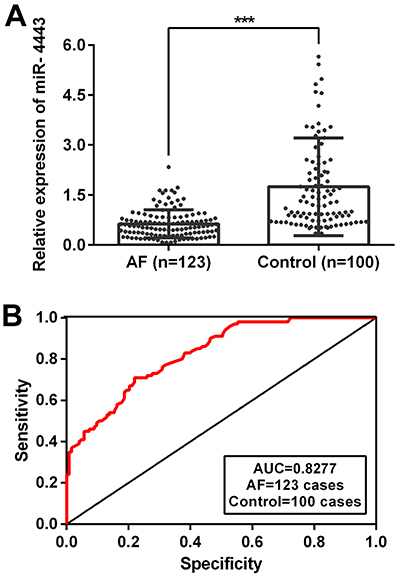
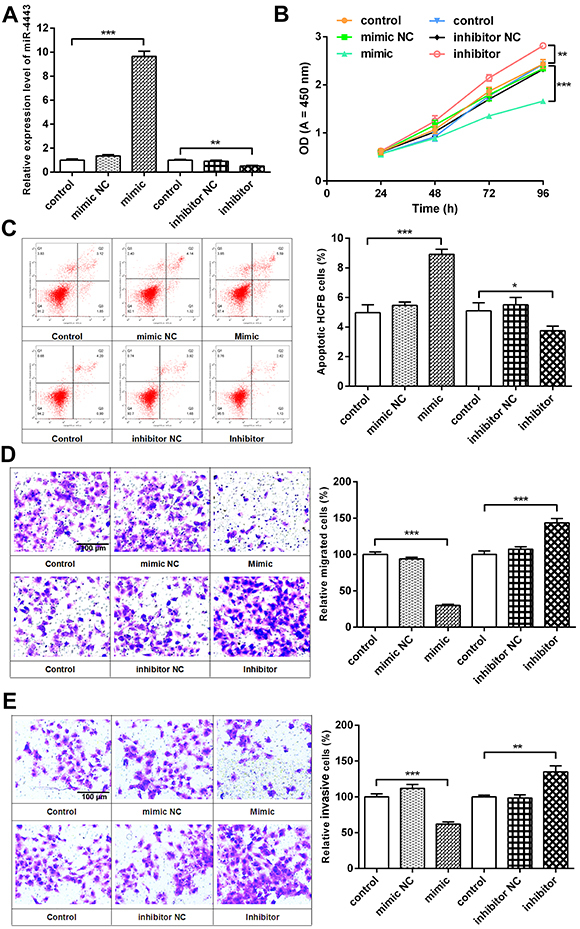
Fibrosis caused by the increase in extracellular matrix in cardiac fibroblasts plays an important role in the occurrence and development of atrial fibrillation (AF). The aim of this study was to investigate the role of hsa-miR-4443 in AF, human cardiac fibroblast (HCFB) proliferation, and extracellular matrix remodeling. TaqMan Stem-loop miRNA assay was used to measure hsa-miR-4443 expression in patients with persistent AF (n=123) and healthy controls (n=100). Patients with AF were confirmed to have atrial fibrosis by late gadolinium enhancement. At the cellular level, after hsa-miR-4443 mimic and inhibitor were transfected with HCFBs, proliferation, apoptosis, migration, and invasion were analyzed. Lastly, hsa-miR-4443-targeted gene and transforming growth factor (TGF)-β1/α-SMA/collagen pathway were evaluated by dual-luciferase reporter assay and western blot, respectively. In patients with AF, hsa-miR-4443 decreased significantly and collagen metabolism level increased significantly. Logistic regression analysis showed that low hsa-miR-4443 level was a risk factor of AF (P<0.001). The receiver operating characteristic curve revealed that hsa-miR-4443 was useful for predicting AF (area under the curve: 0.828, sensitivity: 0.71, specificity: 0.78, P<0.001). In HCFBs, hsa-miR-4443 targeted thrombospondin-1 (THBS1) and downregulated TGF-β1/α-SMA/collagen pathway. The inhibition of hsa-miR-4443 expression promoted HCFB proliferation, migration, invasion, myofibroblast differentiation, and collagen production. The significant reduction of hsa-miR-4443 can be used as a biomarker for AF. hsa-miR-4443 protected AF by targeting THBS1 and regulated TGF-β1/α-SMA/collagen pathway to inhibit HCFB proliferation and collagen synthesis.
心肌成纤维细胞细胞外基质增加引起的纤维化在心房颤动(AF)的发生和发展中起重要作用。本研究旨在探讨 hsa-miR-4443 在 AF、人心脏成纤维细胞(HCFB)增殖和细胞外基质重塑中的作用。TaqMan 茎环 miRNA 检测法用于测量持续性 AF 患者(n=123)和健康对照者(n=100)的 hsa-miR-4443 表达。通过晚期钆增强证实 AF 患者存在心房纤维化。在细胞水平上,转染 hsa-miR-4443 模拟物和抑制剂后,分析 HCFB 的增殖、凋亡、迁移和侵袭。最后,通过双荧光素酶报告基因检测和 Western blot 分别评估 hsa-miR-4443 靶基因和转化生长因子(TGF)-β1/α-SMA/胶原通路。在 AF 患者中,hsa-miR-4443 显著降低,胶原代谢水平显著升高。Logistic 回归分析显示,低 hsa-miR-4443 水平是 AF 的危险因素(P<0.001)。受试者工作特征曲线显示 hsa-miR-4443 可用于预测 AF(曲线下面积:0.828,灵敏度:0.71,特异性:0.78,P<0.001)。在 HCFB 中,hsa-miR-4443 靶向血小板反应蛋白-1(THBS1)并下调 TGF-β1/α-SMA/胶原通路。抑制 hsa-miR-4443 表达促进 HCFB 增殖、迁移、侵袭、成肌纤维细胞分化和胶原产生。hsa-miR-4443 的显著减少可作为 AF 的生物标志物。hsa-miR-4443 通过靶向 THBS1 并调节 TGF-β1/α-SMA/胶原通路抑制 HCFB 增殖和胶原合成来保护 AF。