Immunology Network, GlaxoSmithKline, Stevenage, UK.
Institute of Infection and Immunity, School of Medicine, University Hospital of Wales, Cardiff University, Cardiff, UK.
Immunology. 2021 Aug;163(4):348-362. doi: 10.1111/imm.13326. Epub 2021 May 2.
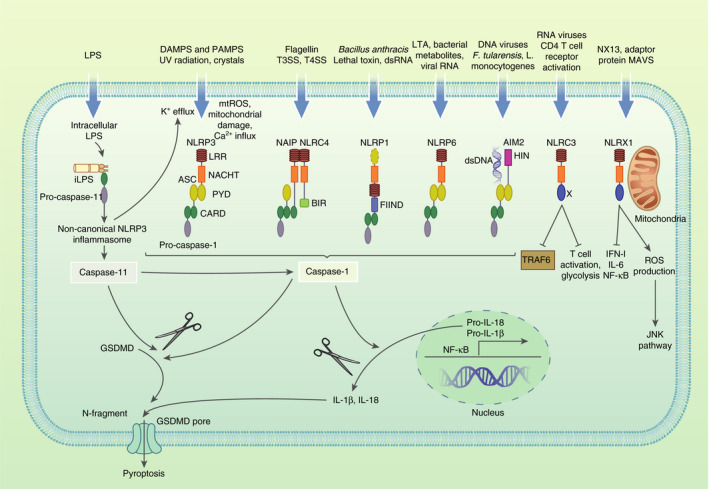
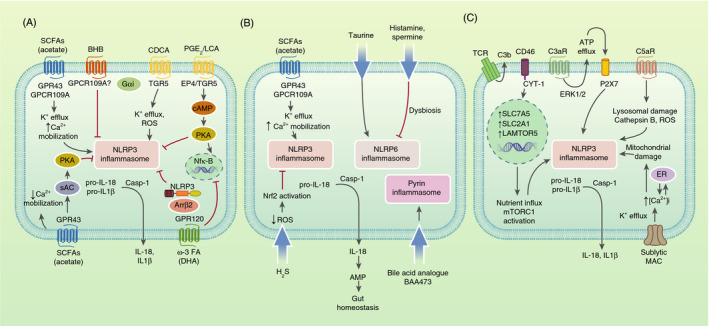
Nucleotide-binding domain and leucine-rich repeat receptor (NLR)-mediated inflammasome activation is important in host response to microbes, danger-associated molecular patterns (DAMPs) and metabolic disease. Some NLRs have been shown to interact with distinct cell metabolic pathways and cause negative regulation, tumorigenesis and autoimmune disorders, interacting with multiple innate immune receptors to modulate disease. NLR activation is therefore crucial in host response and in the regulation of metabolic pathways that can trigger a wide range of immunometabolic diseases or syndromes. However, the exact mode by which some of the less well-studied NLR inflammasomes are activated, interact with other metabolites and immune receptors, and the role they play in the progression of metabolic diseases is still not fully elucidated. In this study, we review up-to-date evidence regarding NLR function in metabolic pathways and the interplay with other immune receptors involved in GPCR signalling, gut microbiota and the complement system, in order to gain a better understanding of its link to disease processes.
核苷酸结合域和富含亮氨酸重复受体 (NLR)-介导的炎性小体激活在宿主对微生物、危险相关分子模式 (DAMPs) 和代谢性疾病的反应中很重要。已经表明一些 NLR 与不同的细胞代谢途径相互作用并导致负调节、肿瘤发生和自身免疫性疾病,与多种先天免疫受体相互作用以调节疾病。因此,NLR 的激活对于宿主反应以及调节代谢途径至关重要,这些代谢途径可能引发广泛的免疫代谢疾病或综合征。然而,一些研究较少的 NLR 炎性小体被激活的精确模式、与其他代谢物和免疫受体的相互作用以及它们在代谢性疾病进展中的作用仍未完全阐明。在这项研究中,我们综述了 NLR 在代谢途径中的功能以及与涉及 GPCR 信号、肠道微生物群和补体系统的其他免疫受体相互作用的最新证据,以便更好地了解其与疾病过程的联系。