
血清几丁质酶-3样蛋白1是评估抗中性粒细胞胞浆抗体相关性血管炎疾病活动度的有用生物标志物:一项观察性研究。
Serum chitinase-3-like 1 protein is a useful biomarker to assess disease activity in ANCA-associated vasculitis: an observational study.
作者信息
Ahn Sung Soo, Yoon Taejun, Park Yong-Beom, Prendecki Maria, Bhangal Gurjeet, McAdoo Stephen P, Lee Sang-Won
机构信息
Department of Internal Medicine, Yongin Severance Hospital, Yonsei University College of Medicine, 50-1 Yonsei-ro, Seodaemun-gu, Seoul, 03722, Republic of Korea.
Department of Medical Science, BK21 Plus Project, Yonsei University College of Medicine, Seoul, Republic of Korea.
出版信息
Arthritis Res Ther. 2021 Mar 8;23(1):77. doi: 10.1186/s13075-021-02467-1.
BACKGROUND
To investigate whether serum chitinase-3-like 1 protein (YKL-40) is associated with disease activity in anti-neutrophil cytoplasmic antibody (ANCA)-associated vasculitis (AAV).
METHODS
ELISA was performed in serum samples from AAV patients who were enrolled in our prospective observational cohort to estimate levels of YKL-40. Birmingham vasculitis activity score (BVAS) (version 3), five factor score (FFS), and short form-36 (SF-36), as well as clinical and laboratory data were collected. Kidney expression of YKL-40 was assessed by immunohistochemical staining using renal biopsy tissues from ANCA-associated glomerulonephritis patients (AAGN). Severe AAV and FFS were defined as BVAS ≥ 12 and FFS ≥ 2, and the correlations between laboratory variables, BVAS, FFS, and SF-36 score were assessed using linear regression analysis. The optimal cut-off of serum YKL-40 for severe AAV and high FFS was calculated using the receiver operator characteristic curve analysis.
RESULTS
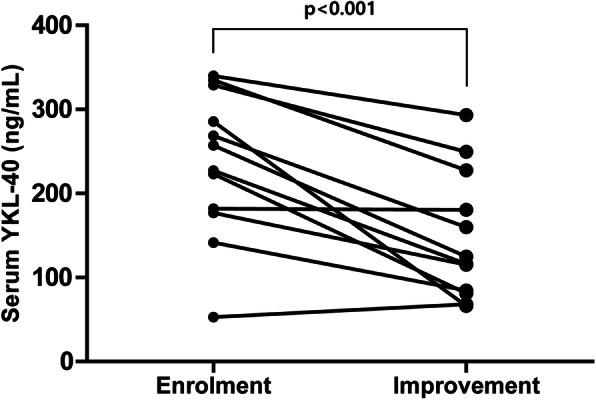
Of the included 60 patients, 32 (53.3%), 17 (28.3%), and 11 (18.3%) were classified as microscopic polyangiitis, granulomatosis with polyangiitis, and eosinophilic granulomatosis with polyangiitis. The median BVAS and FFS were 7.0 and 1.0, whereas the mean SF-36 physical and mental component scores were 50.5 and 58.3. Serum YKL-40 level was higher in patients with severe AAV and high FFS compared to those without (p = 0.007 and p < 0.001); multivariable linear regression analysis revealed that serum YKL-40 was independently associated with BVAS, FFS, and SF-36 scores. On kidney tissues obtained from AAGN patients, strong cytoplasmic staining of YKL-40 was found in cells present in inflammatory lesions. In addition, AAV patients had higher levels of serum YKL-40 compared to those with systemic lupus erythematosus, rheumatoid arthritis, osteoarthritis, and healthy control. The proportion of patients having severe AAV and high FFS was significantly higher in those with serum YKL-40 > 221.3 ng/mL and > 227.1 ng/mL than those without (relative risk 2.852 and 7.000). In 12 patients with serial YKL-40 testing, 11 patients (91.7%) exhibited a reduction in serum YKL-40 levels following a decrease in disease activity (p < 0.001).
CONCLUSION
Our findings suggest that serum YKL-40 may be a clinically useful biomarker to assess AAV disease activity.
TRIAL REGISTRATION
Retrospectively registered.
背景
探讨血清几丁质酶-3样蛋白1(YKL-40)是否与抗中性粒细胞胞浆抗体(ANCA)相关血管炎(AAV)的疾病活动相关。
方法
对纳入我们前瞻性观察队列的AAV患者的血清样本进行酶联免疫吸附测定(ELISA),以评估YKL-40水平。收集伯明翰血管炎活动评分(BVAS)(第3版)、五因素评分(FFS)、简短健康调查问卷36项简表(SF-36)以及临床和实验室数据。使用ANCA相关肾小球肾炎(AAGN)患者的肾活检组织,通过免疫组织化学染色评估肾脏中YKL-40的表达。严重AAV和FFS定义为BVAS≥12和FFS≥2,使用线性回归分析评估实验室变量、BVAS、FFS和SF-36评分之间的相关性。使用受试者工作特征曲线分析计算严重AAV和高FFS的血清YKL-40最佳截断值。
结果
纳入的60例患者中,32例(53.3%)、17例(28.3%)和11例(18.3%)分别被分类为显微镜下多血管炎、肉芽肿性多血管炎和嗜酸性肉芽肿性多血管炎。BVAS和FFS的中位数分别为7.0和1.0,而SF-36身体和精神成分评分的平均值分别为50.5和58.3。与无严重AAV和高FFS的患者相比,有严重AAV和高FFS的患者血清YKL-40水平更高(p = 0.007和p < 0.001);多变量线性回归分析显示,血清YKL-40与BVAS、FFS和SF-36评分独立相关。在AAGN患者的肾组织中,在炎症病变中的细胞中发现YKL-40有强烈的细胞质染色。此外,与系统性红斑狼疮、类风湿关节炎、骨关节炎患者及健康对照相比,AAV患者的血清YKL-40水平更高。血清YKL-40>221.3 ng/mL和>227.1 ng/mL的患者中,有严重AAV和高FFS的患者比例显著高于无上述情况的患者(相对风险分别为2.852和7.000)。在12例进行YKL-40系列检测的患者中,11例(91.7%)在疾病活动度降低后血清YKL-40水平下降(p < 0.001)。
结论
我们的研究结果表明,血清YKL-40可能是评估AAV疾病活动度的一种临床有用的生物标志物。
试验注册
回顾性注册。


 Zotero 插件