Department of Cardiothoracic and Vascular Sciences-Coronary Care Unit and Laboratory of Clinical and Experimental Cardiology, Fondazione IRCCS Policlinico San Matteo, Viale Golgi 19, 27100 Pavia, Italy.
Department of Molecular Medicine, Unit of Cardiology, University of Pavia, Viale Golgi 19, 27100 Pavia, Italy.
Eur Heart J. 2021 May 1;42(17):1661-1675. doi: 10.1093/eurheartj/ehab007.
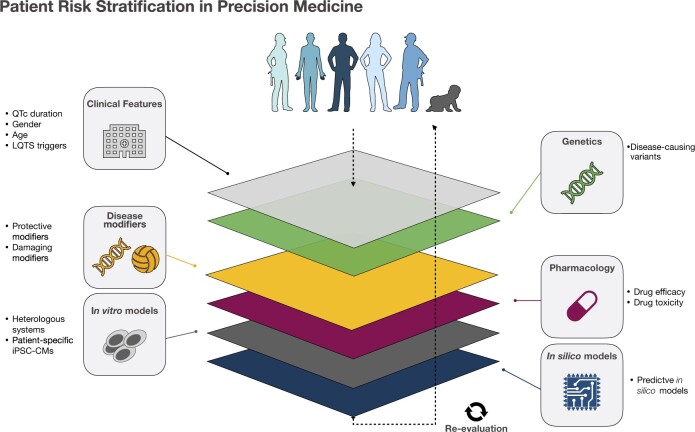
Precision Medicine (PM) is an innovative approach that, by relying on large populations' datasets, patients' genetics and characteristics, and advanced technologies, aims at improving risk stratification and at identifying patient-specific management through targeted diagnostic and therapeutic strategies. Cardiac channelopathies are being progressively involved in the evolution brought by PM and some of them are benefiting from these novel approaches, especially the long QT syndrome. Here, we have explored the main layers that should be considered when developing a PM approach for cardiac channelopathies, with a focus on modern in vitro strategies based on patient-specific human-induced pluripotent stem cells and on in silico models. PM is where scientists and clinicians must meet and integrate their expertise to improve medical care in an innovative way but without losing common sense. We have indeed tried to provide the cardiologist's point of view by comparing state-of-the-art techniques and approaches, including revolutionary discoveries, to current practice. This point matters because the new approaches may, or may not, exceed the efficacy and safety of established therapies. Thus, our own eagerness to implement the most recent translational strategies for cardiac channelopathies must be tempered by an objective assessment to verify whether the PM approaches are indeed making a difference for the patients. We believe that PM may shape the diagnosis and treatment of cardiac channelopathies for years to come. Nonetheless, its potential superiority over standard therapies should be constantly monitored and assessed before translating intellectually rewarding new discoveries into clinical practice.
精准医学(PM)是一种创新方法,通过依赖大人群数据集、患者的遗传学和特征以及先进技术,旨在改善风险分层,并通过靶向诊断和治疗策略来确定患者特定的管理方法。心脏通道病正在逐步参与 PM 带来的演变,其中一些疾病受益于这些新方法,特别是长 QT 综合征。在这里,我们探讨了为心脏通道病开发 PM 方法时应考虑的主要层面,重点是基于患者特异性人诱导多能干细胞的现代体外策略和基于计算机的模型。PM 是科学家和临床医生必须相遇并整合他们的专业知识以创新方式改善医疗保健的地方,但不能失去常识。我们确实试图通过比较最先进的技术和方法,包括革命性的发现,与当前的实践,来提供心脏病专家的观点。这一点很重要,因为新方法可能会或可能不会超过既定疗法的疗效和安全性。因此,我们自己实施心脏通道病最新转化策略的渴望必须受到客观评估的制约,以验证 PM 方法是否确实对患者产生了影响。我们相信,PM 可能会在未来几年塑造心脏通道病的诊断和治疗。尽管如此,在将智力回报丰厚的新发现转化为临床实践之前,应不断监测和评估其是否优于标准疗法。