Vaulet Thibaut, Divard Gillian, Thaunat Olivier, Lerut Evelyne, Senev Aleksandar, Aubert Olivier, Van Loon Elisabet, Callemeyn Jasper, Emonds Marie-Paule, Van Craenenbroeck Amaryllis, De Vusser Katrien, Sprangers Ben, Rabeyrin Maud, Dubois Valérie, Kuypers Dirk, De Vos Maarten, Loupy Alexandre, De Moor Bart, Naesens Maarten
Department of Electrical Engineering, Stadius Center for Dynamical Systems, Signal Processing and Data Analytics, KU Leuven, Leuven, Belgium.
Université de Paris, National Institutes of Health and Medical Research, Paris Translational Research Centre for Organ Transplantation, Paris, France.
J Am Soc Nephrol. 2021 May 3;32(5):1084-1096. doi: 10.1681/ASN.2020101418. Epub 2021 Mar 9.
Over the past decades, an international group of experts iteratively developed a consensus classification of kidney transplant rejection phenotypes, known as the Banff classification. Data-driven clustering of kidney transplant histologic data could simplify the complex and discretionary rules of the Banff classification, while improving the association with graft failure.
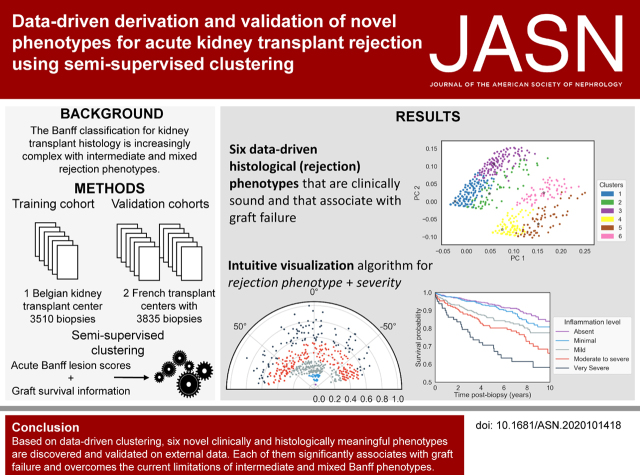
The data consisted of a training set of 3510 kidney-transplant biopsies from an observational cohort of 936 recipients. Independent validation of the results was performed on an external set of 3835 biopsies from 1989 patients. On the basis of acute histologic lesion scores and the presence of donor-specific HLA antibodies, stable clustering was achieved on the basis of a consensus of 400 different clustering partitions. Additional information on kidney-transplant failure was introduced with a weighted Euclidean distance.
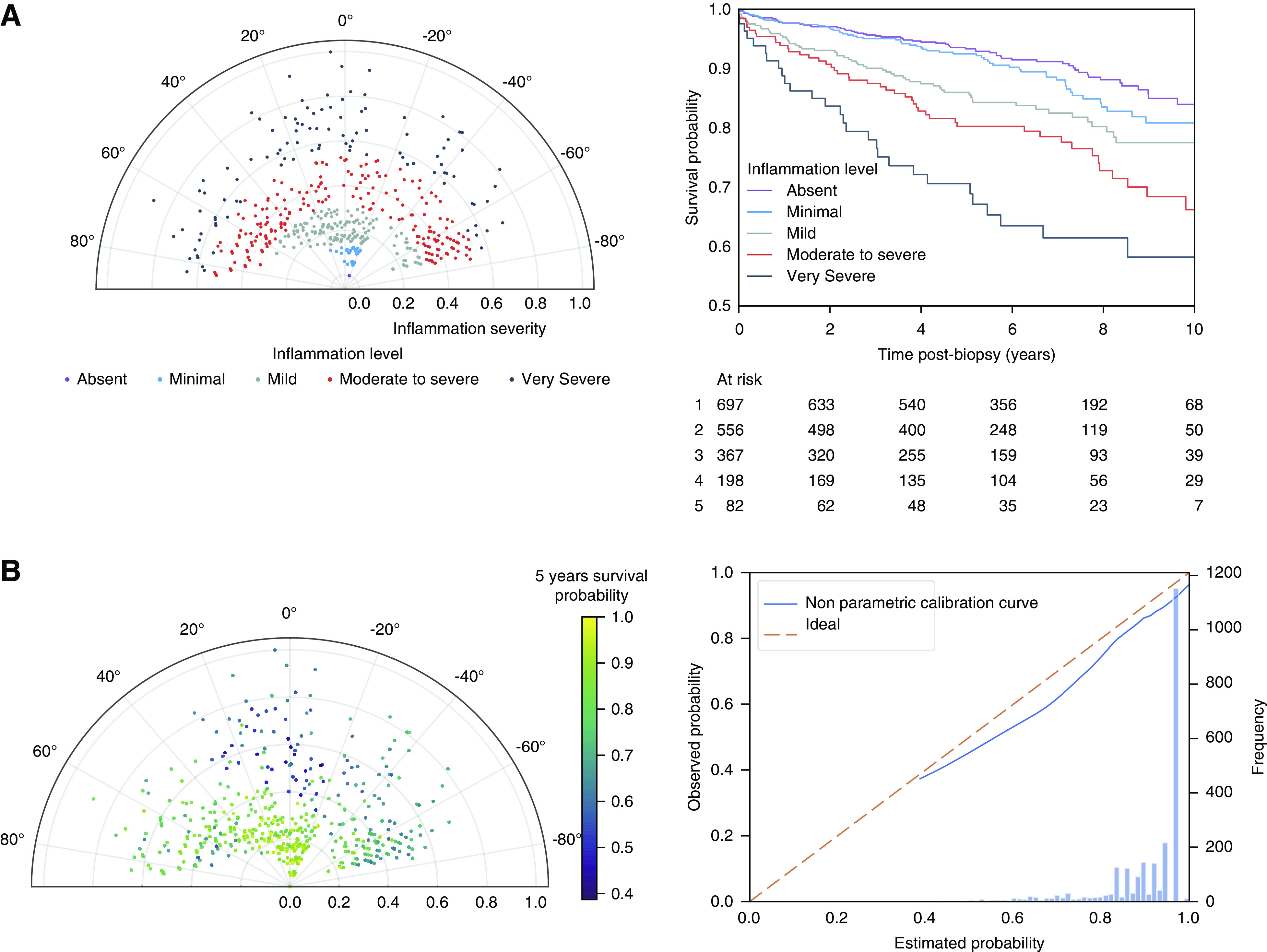
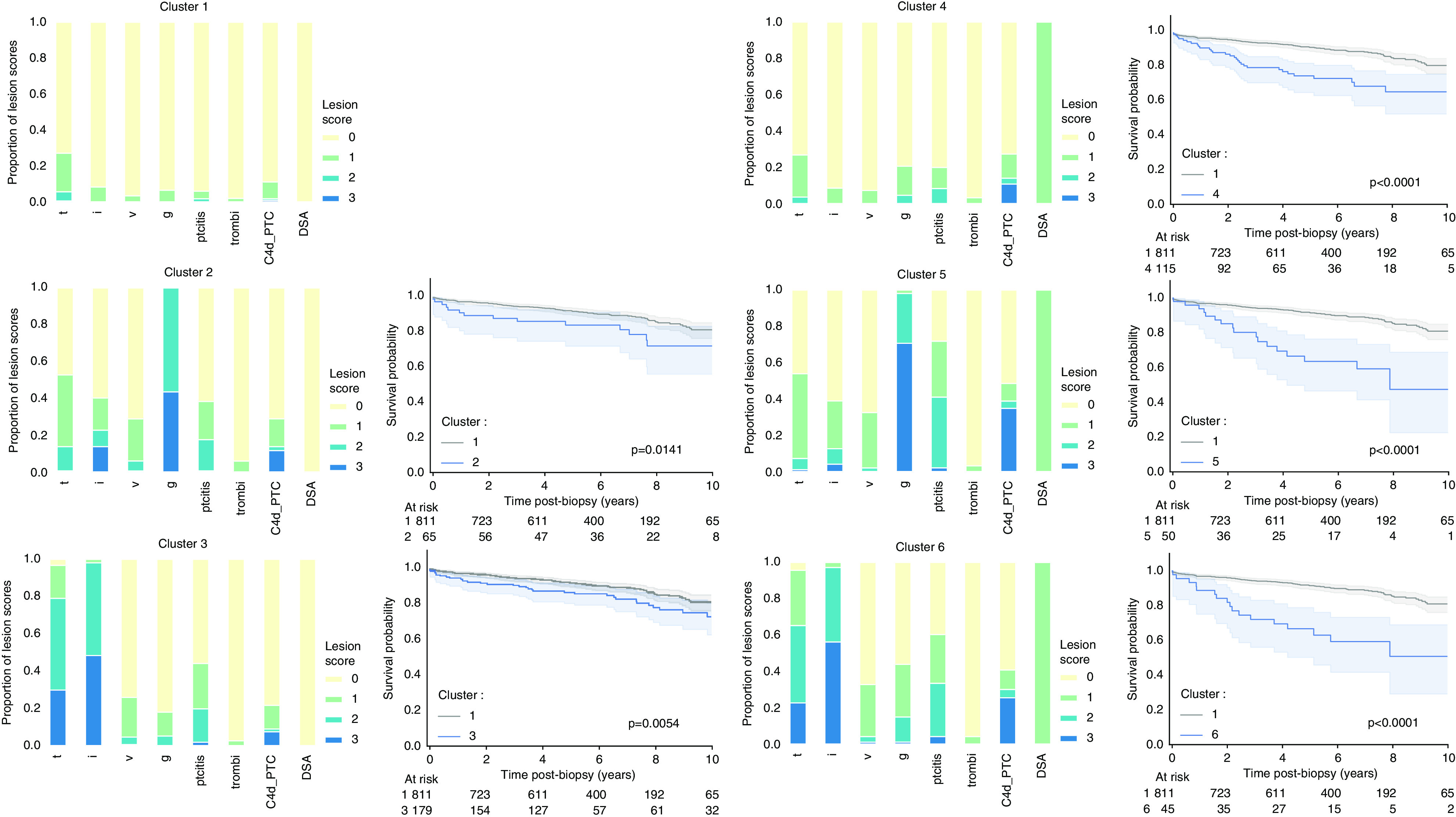
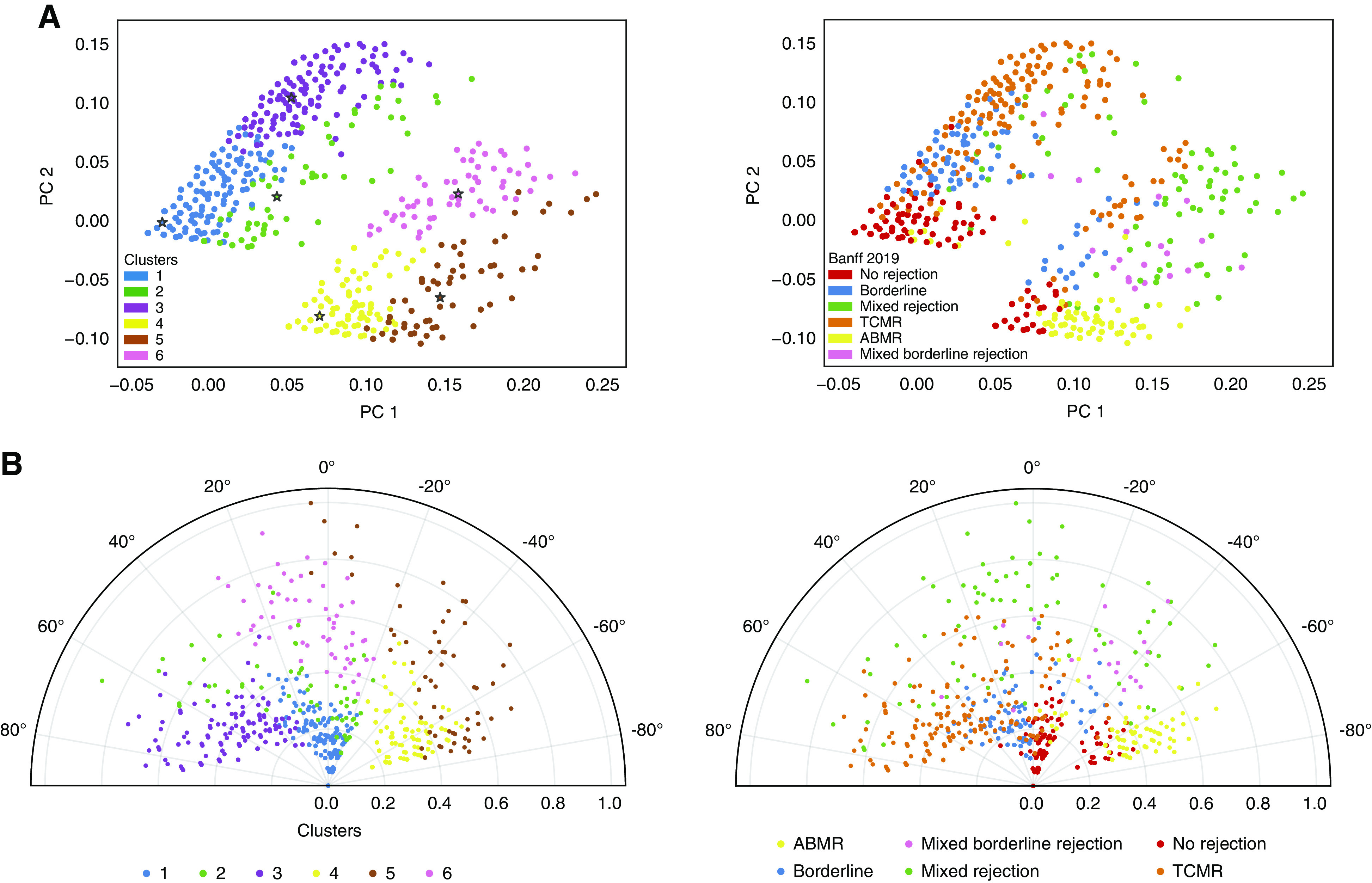
Based on the proportion of ambiguous clustering, six clinically meaningful cluster phenotypes were identified. There was significant overlap with the existing Banff classification (adjusted rand index, 0.48). However, the data-driven approach eliminated intermediate and mixed phenotypes and created acute rejection clusters that are each significantly associated with graft failure. Finally, a novel visualization tool presents disease phenotypes and severity in a continuous manner, as a complement to the discrete clusters.
A semisupervised clustering approach for the identification of clinically meaningful novel phenotypes of kidney transplant rejection has been developed and validated. The approach has the potential to offer a more quantitative evaluation of rejection subtypes and severity, especially in situations in which the current histologic categorization is ambiguous.
在过去几十年中,一个国际专家小组反复制定了肾移植排斥反应表型的共识分类,即班夫分类。对肾移植组织学数据进行数据驱动的聚类可以简化班夫分类复杂且主观的规则,同时改善与移植失败的相关性。
数据包括来自936名受者的观察性队列中的3510例肾移植活检的训练集。在来自1989名患者的3835例活检的外部数据集上对结果进行独立验证。基于急性组织学病变评分和供体特异性HLA抗体的存在,在400个不同聚类分区的共识基础上实现了稳定聚类。通过加权欧几里得距离引入了关于肾移植失败的额外信息。
根据模糊聚类的比例,确定了六种具有临床意义的聚类表型。与现有的班夫分类有显著重叠(调整兰德指数,0.48)。然而,数据驱动的方法消除了中间和混合表型,并创建了与移植失败显著相关的急性排斥反应聚类。最后,一种新颖的可视化工具以连续方式呈现疾病表型和严重程度,作为离散聚类的补充。
已开发并验证了一种用于识别肾移植排斥反应具有临床意义的新表型的半监督聚类方法。该方法有可能对排斥反应亚型和严重程度提供更定量的评估,特别是在当前组织学分类不明确的情况下。