Li Ping, Liu Chang, Wu Shuang, Deng Lin, Zhang Guangyuan, Cai Xin, Hu Silong, Cheng Jingyi, Xu Xiaoping, Wu Bin, Guo Xiaomao, Zhang Yingjian, Fu Shen, Zhang Qing
Department of Radiation Oncology, Shanghai Proton and Heavy Ion Center, Shanghai, People's Republic of China.
Shanghai Key Laboratory of Radiation Oncology, Shanghai, People's Republic of China.
Cancer Manag Res. 2021 Mar 3;13:2191-2199. doi: 10.2147/CMAR.S285167. eCollection 2021.
The purpose of this study was to assess the potential of Tc-labeled PSMA-SPECT/CT and diffusion-weighted image (DWI) for predicting treatment response after carbon ion radiotherapy (CIRT) in prostate cancer.
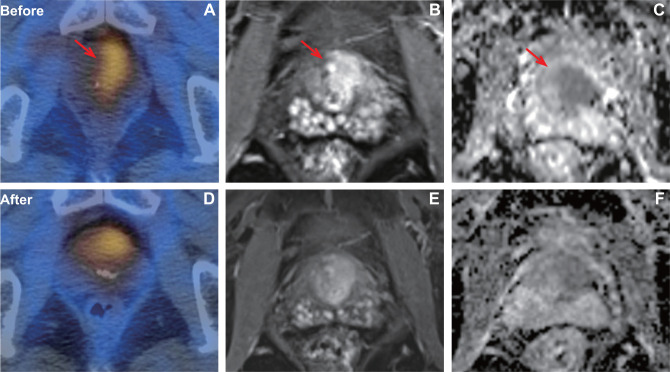
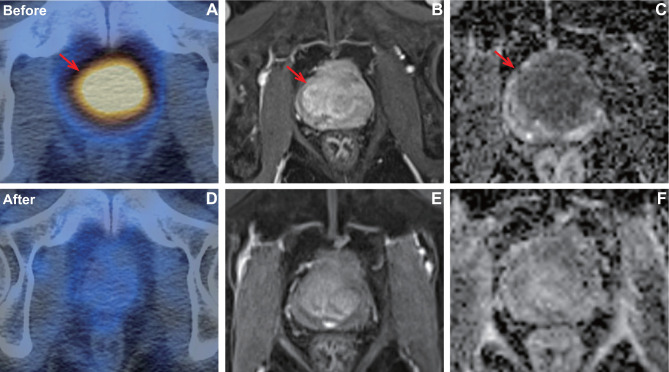
We prospectively registered 26 patients with localized prostate cancer treated with CIRT. All patients underwent Tc-labeled PSMA-SPECT/CT and multiparametric magnetic resonance imaging (MRI) before and after CIRT. The tumor/background ratio (TBR) and mean apparent diffusion coefficient (ADC) were measured on the tumor and the percentage changes before and after therapy (ΔTBR and ΔADC) were calculated. Patients were divided into two groups: good response and poor response according to clinical follow-up.
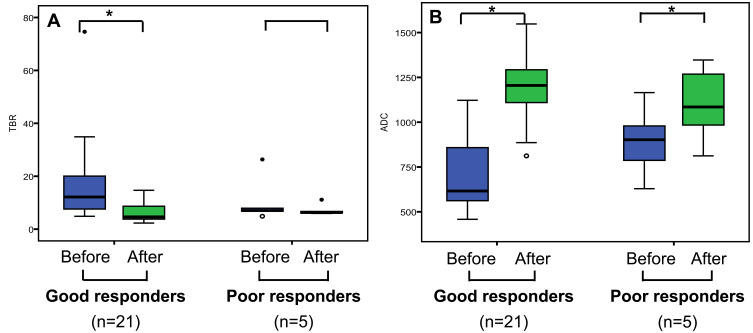
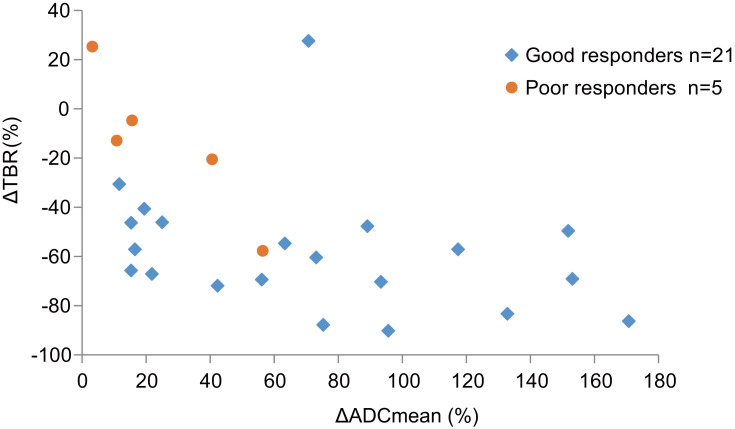
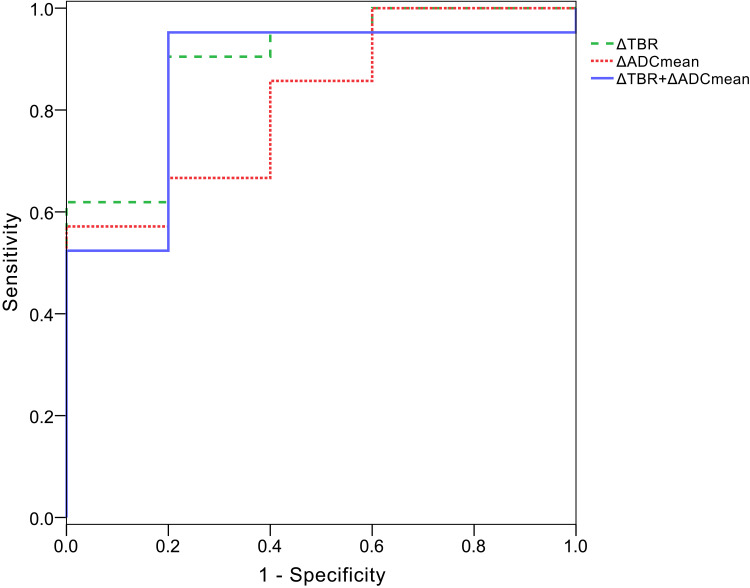
The median follow up time was 38.3months. The TBR was significantly decreased (=0.001), while the ADC was significantly increased compared with the pretreatment value (<0.001). The ΔTBR and ΔADC were negatively correlated with each other ( = 0.002). On ROC curve analysis for predicting treatment response, the area under the ROC curve (AUC) of ΔTBR (0.867) for predicting good response was higher than that of ΔADC (0.819). The AUC of combined with ΔTBR and ΔADC (0.895) was higher than that of either ΔADC or ΔTBR alone. The combined use of ΔTBR and ΔADC showed 91.4% sensitivity and 95.2% specificity.
Our preliminary data indicate that the changes of TBR and ADC maybe an early bio-marker for predicting prognosis after CIRT in localized prostate cancer patients. In addition, the ΔTBR seems to be a more powerful prognostic factor than ΔADC in prostate cancer treated with CIRT.
本研究旨在评估锝标记的前列腺特异性膜抗原单光子发射计算机断层扫描/计算机断层扫描(Tc-PSMA-SPECT/CT)和扩散加权成像(DWI)预测前列腺癌碳离子放疗(CIRT)后治疗反应的潜力。
我们前瞻性登记了26例接受CIRT治疗的局限性前列腺癌患者。所有患者在CIRT前后均接受了Tc-PSMA-SPECT/CT和多参数磁共振成像(MRI)检查。测量肿瘤的肿瘤/背景比(TBR)和平均表观扩散系数(ADC),并计算治疗前后的变化百分比(ΔTBR和ΔADC)。根据临床随访将患者分为两组:反应良好组和反应不良组。
中位随访时间为38.3个月。与治疗前值相比,TBR显著降低(=0.001),而ADC显著升高(<0.001)。ΔTBR和ΔADC彼此呈负相关(=0.002)。在预测治疗反应的ROC曲线分析中,预测良好反应的ΔTBR的ROC曲线下面积(AUC)(0.867)高于ΔADC的AUC(0.819)。联合ΔTBR和ΔADC的AUC(0.895)高于单独的ΔADC或ΔTBR。联合使用ΔTBR和ΔADC显示出91.4%的敏感性和95.2%的特异性。
我们的初步数据表明,TBR和ADC的变化可能是预测局限性前列腺癌患者CIRT后预后的早期生物标志物。此外,在接受CIRT治疗的前列腺癌中,ΔTBR似乎是比ΔADC更有力的预后因素。