Department of Medicine, Division of Infectious Diseases, Vanderbilt University Medical Center, Nashville, Tennessee, United States of America.
Department of Pathology, Microbiology, and Immunology, Vanderbilt University, Nashville, Tennessee, United States of America.
PLoS Pathog. 2021 Mar 10;17(3):e1009387. doi: 10.1371/journal.ppat.1009387. eCollection 2021 Mar.
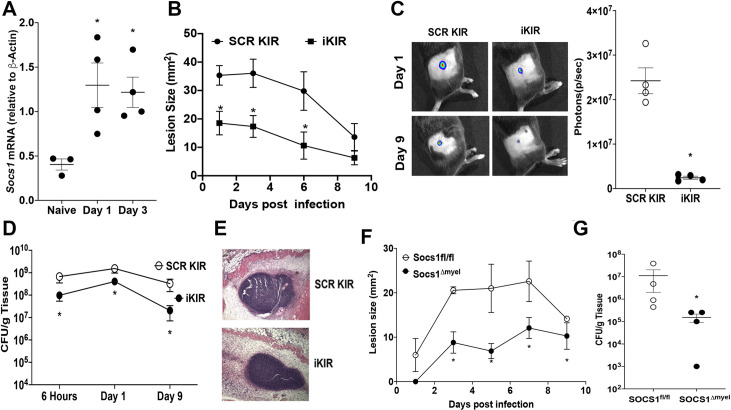
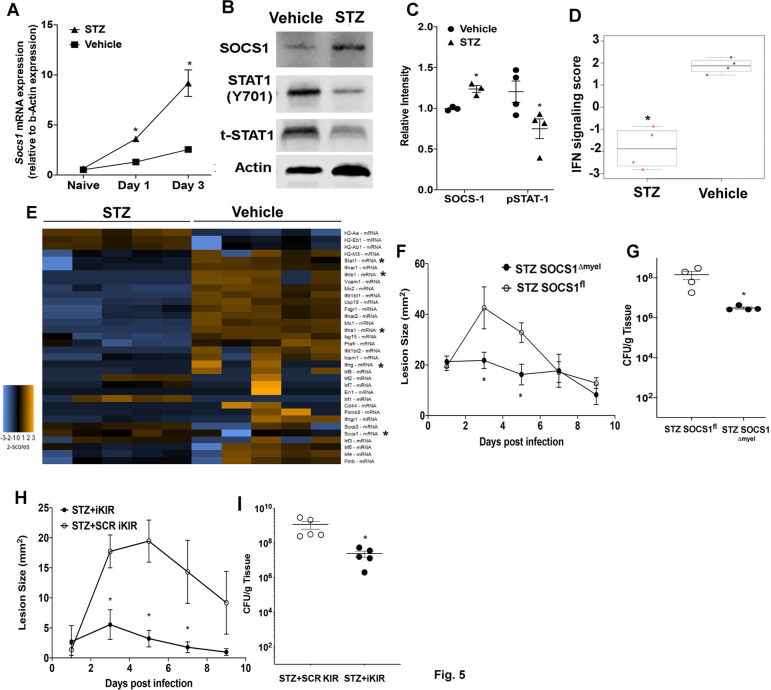
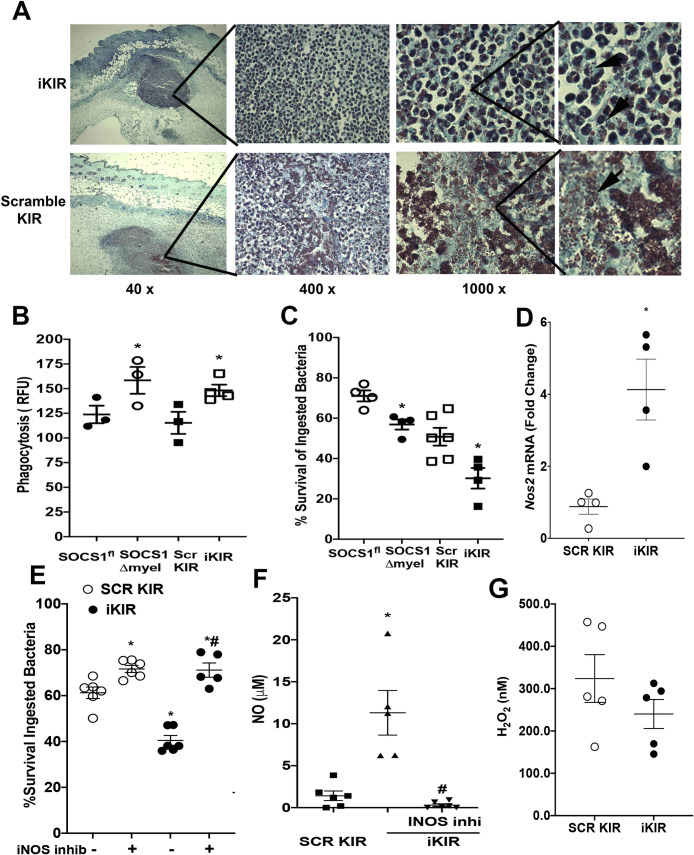
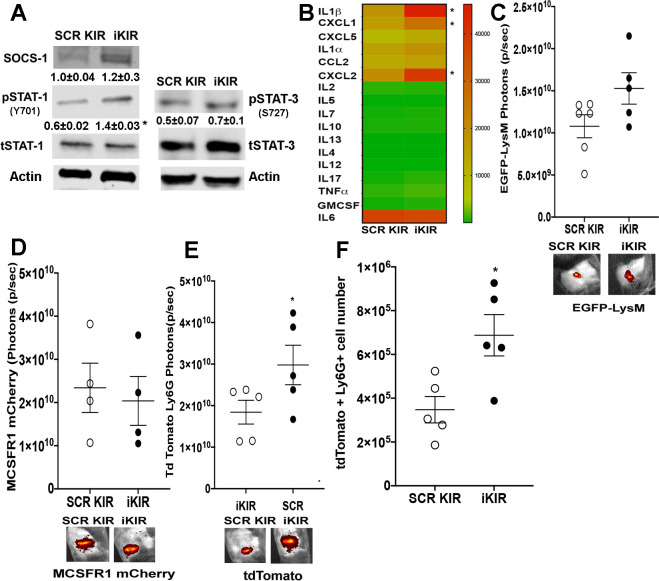
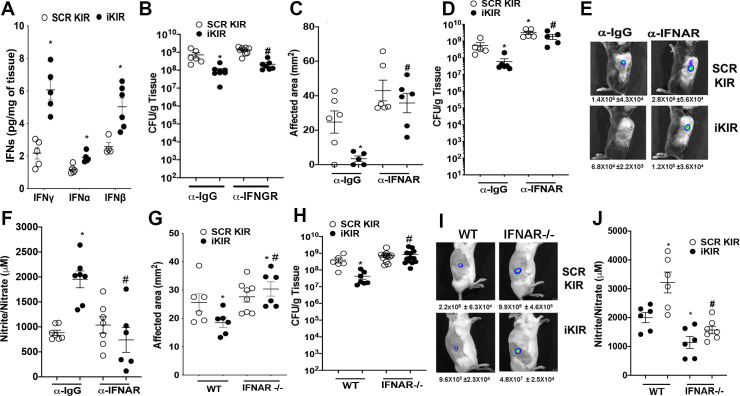
The skin innate immune response to methicillin-resistant Staphylococcus aureus (MRSA) culminates in the formation of an abscess to prevent bacterial spread and tissue damage. Pathogen recognition receptors (PRRs) dictate the balance between microbial control and injury. Therefore, intracellular brakes are of fundamental importance to tune the appropriate host defense while inducing resolution. The intracellular inhibitor suppressor of cytokine signaling 1 (SOCS-1), a known JAK/STAT inhibitor, prevents the expression and actions of PRR adaptors and downstream effectors. Whether SOCS-1 is a molecular component of skin host defense remains to be determined. We hypothesized that SOCS-1 decreases type I interferon production and IFNAR-mediated antimicrobial effector functions, limiting the inflammatory response during skin infection. Our data show that MRSA skin infection enhances SOCS-1 expression, and both SOCS-1 inhibitor peptide-treated and myeloid-specific SOCS-1 deficient mice display decreased lesion size, bacterial loads, and increased abscess thickness when compared to wild-type mice treated with the scrambled peptide control. SOCS-1 deletion/inhibition increases phagocytosis and bacterial killing, dependent on nitric oxide release. SOCS-1 inhibition also increases the levels of type I and type II interferon levels in vivo. IFNAR deletion and antibody blockage abolished the beneficial effects of SOCS-1 inhibition in vivo. Notably, we unveiled that hyperglycemia triggers aberrant SOCS-1 expression that correlates with decreased overall IFN signatures in the infected skin. SOCS-1 inhibition restores skin host defense in the highly susceptible hyperglycemic mice. Overall, these data demonstrate a role for SOCS-1-mediated type I interferon actions in host defense and inflammation during MRSA skin infection.
皮肤对耐甲氧西林金黄色葡萄球菌(MRSA)的先天免疫反应最终导致脓肿的形成,以防止细菌扩散和组织损伤。病原体识别受体(PRRs)决定了微生物控制和损伤之间的平衡。因此,细胞内制动器对于调节适当的宿主防御并诱导消退至关重要。细胞内抑制剂细胞因子信号转导抑制因子 1(SOCS-1)是一种已知的 JAK/STAT 抑制剂,可防止 PRR 衔接子和下游效应子的表达和作用。SOCS-1 是否是皮肤宿主防御的分子组成部分仍有待确定。我们假设 SOCS-1 会降低 I 型干扰素的产生和 IFNAR 介导的抗菌效应功能,从而限制皮肤感染期间的炎症反应。我们的数据表明,MRSA 皮肤感染会增强 SOCS-1 的表达,与用乱序肽对照处理的野生型小鼠相比,SOCS-1 抑制剂肽处理和髓样细胞特异性 SOCS-1 缺陷小鼠的病变大小、细菌载量和脓肿厚度均减小。SOCS-1 缺失/抑制会增加吞噬作用和细菌杀伤作用,这依赖于一氧化氮的释放。SOCS-1 抑制还会增加体内 I 型和 II 型干扰素的水平。IFNAR 缺失和抗体阻断消除了 SOCS-1 抑制在体内的有益作用。值得注意的是,我们揭示了高血糖会触发异常的 SOCS-1 表达,这与感染皮肤中总体 IFN 特征的降低相关。SOCS-1 抑制可恢复高血糖易感小鼠的皮肤宿主防御。总的来说,这些数据表明 SOCS-1 介导的 I 型干扰素作用在 MRSA 皮肤感染期间的宿主防御和炎症中发挥作用。