Department of Neurosurgery, The Second Affiliated Hospital of Chongqing Medical University, Chongqing, 400010, People's Republic of China.
Department of Orthopedics, The Second Affiliated Hospital of Chongqing Medical University, Chongqing, 400010, People's Republic of China.
Int J Nanomedicine. 2021 Mar 3;16:1805-1817. doi: 10.2147/IJN.S295598. eCollection 2021.
RNA interference is a promising therapy in glioma treatment. However, the application of RNA interference has been limited in glioma therapy by RNA instability and the lack of tumor targeting. Here, we report a novel DNA tetrahedron, which can effectively deliver small interfering RNA to glioma cells and induce apoptosis.
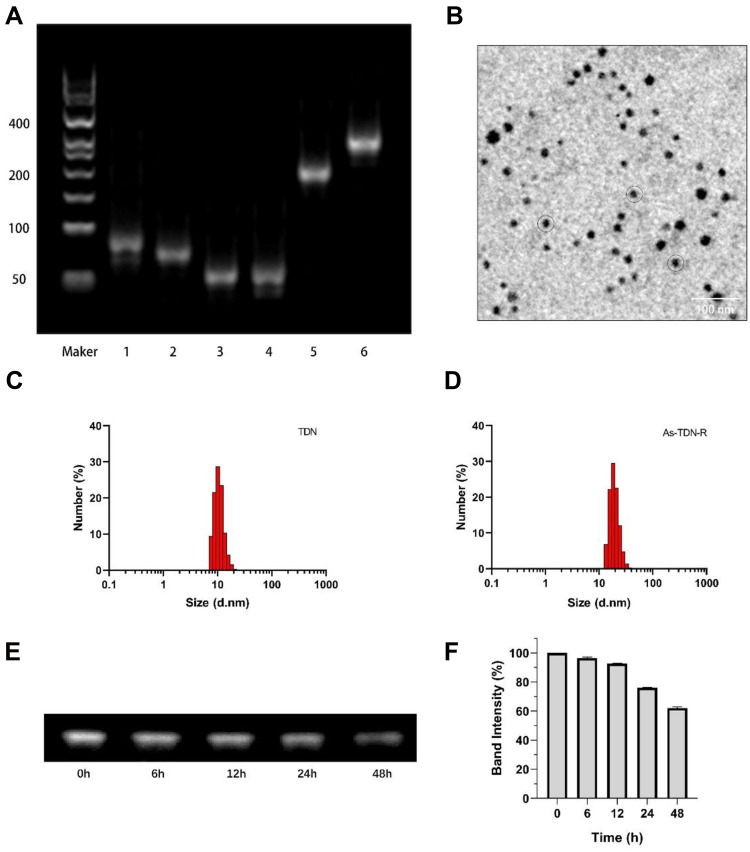
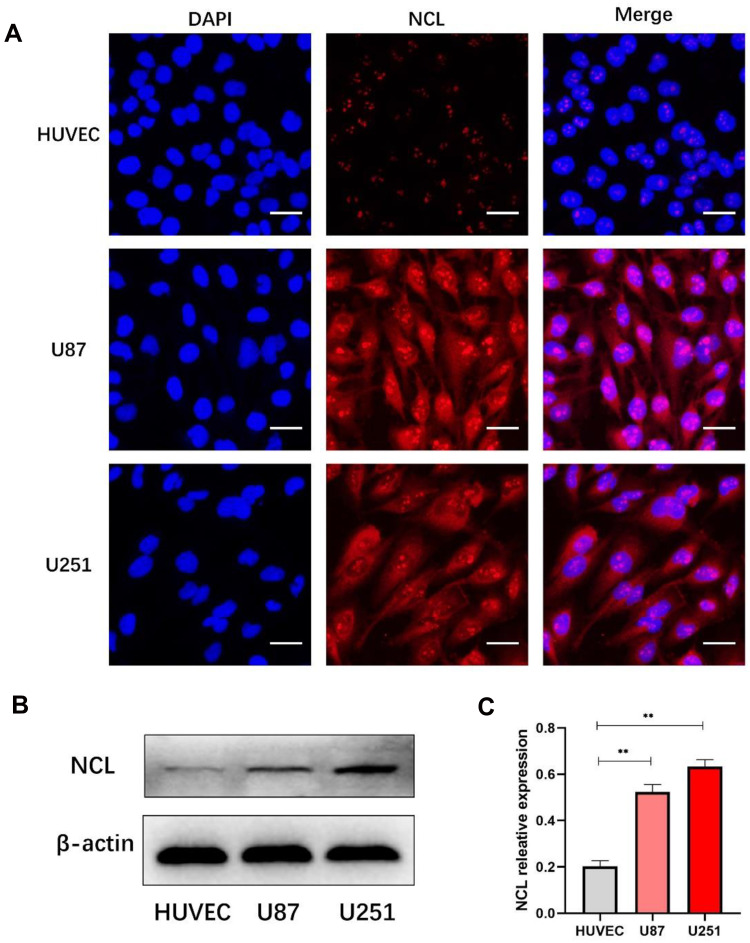
siRNA, a small interfering RNA that can suppress the expression of survivin in glioma, was loaded into the DNA tetrahedron (TDN). To enhance the ability of active targeting of this nanoparticle, we modified one side of the DNA nanostructure with aptamer as1411 (As-TDN-R), which can selectively recognize the nucleolin in the cytomembrane of tumor cells. The modified nanoparticles were characterized by agarose gel electrophoresis, dynamic light scattering, and transmission electron microscopy. The serum stability was evaluated by agarose gel electrophoresis. Nucleolin was detected by Western blot and immunofluorescence, and targeted cellular uptake was examined by flow cytometry. The TUNEL assay, flow cytometry, and Western Blot were used to detect apoptosis in U87 cells. The gene silencing of survivin was examined by qPCR, Western Blot, and immunofluorescence.
As-TDN-R alone showed better stability towards siRNA, indicating that TDN was a good siRNA protector. Compared with TDN alone, there was increased intercellular uptake of As-TDN-R by U87 cells, evidenced by overexpressed nucleolin in glioma cell lines. TUNEL assay, flow cytometry, and Western Blot revealed increased apoptosis in the As-TDN-R group. The downregulation of survivin protein and mRNA expression levels indicated that As-TDN-R effectively silenced the target gene.
The novel nanoparticle can serve as a good carrier for targeting siRNA delivery in glioma. Further exploration of the DNA nanostructure can greatly promote the application of DNA-based drug systems in glioma.
RNA 干扰是治疗神经胶质瘤的一种很有前途的疗法。然而,RNA 的不稳定性和缺乏肿瘤靶向性限制了 RNA 干扰在神经胶质瘤治疗中的应用。在这里,我们报告了一种新型的 DNA 四面体,它可以有效地将小干扰 RNA 递送到神经胶质瘤细胞并诱导细胞凋亡。
将可以抑制神经胶质瘤中生存素表达的小干扰 RNA(siRNA)载入 DNA 四面体(TDN)中。为了增强该纳米颗粒主动靶向的能力,我们用适体 as1411(As-TDN-R)修饰了 DNA 纳米结构的一侧,该适体能选择性地识别肿瘤细胞细胞质中的核仁蛋白。通过琼脂糖凝胶电泳、动态光散射和透射电子显微镜对修饰后的纳米粒子进行了表征。通过琼脂糖凝胶电泳评估了血清稳定性。通过 Western blot 和免疫荧光检测核仁蛋白的表达,通过流式细胞术检测靶向细胞摄取。通过 TUNEL 检测、流式细胞术和 Western blot 检测 U87 细胞的凋亡。通过 qPCR、Western blot 和免疫荧光检测生存素基因的沉默。
As-TDN-R 单独对 siRNA 具有更好的稳定性,表明 TDN 是一种很好的 siRNA 保护剂。与 TDN 单独相比,As-TDN-R 增加了 U87 细胞的细胞内摄取,这表明在神经胶质瘤细胞系中核仁蛋白表达增加。TUNEL 检测、流式细胞术和 Western blot 检测均显示 As-TDN-R 组细胞凋亡增加。生存素蛋白和 mRNA 表达水平的下调表明 As-TDN-R 能有效沉默靶基因。
新型纳米颗粒可作为神经胶质瘤靶向 siRNA 递药的良好载体。进一步探索 DNA 纳米结构可以极大地促进 DNA 基药物系统在神经胶质瘤中的应用。