Kataoka Hajime
Internal Medicine, Nishida Hospital Oita Japan.
Circ Rep. 2020 Jun 2;2(7):357-363. doi: 10.1253/circrep.CR-20-0018.
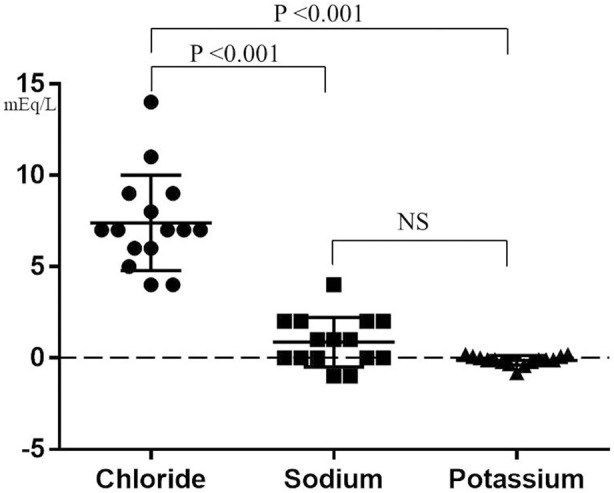
There is scant clinical data of electrolyte analyses in the pleural fluid under heart failure (HF) pathophysiology. This study retrospectively analyzed data from 17 consecutive patients who presented with pleural effusion and underwent thoracentesis. A diagnosis of worsening HF was established by clinical criteria (presentation, echocardiography, serum B-type natriuretic peptide, and response to therapy). Samples of non-heparinized pleural fluid and peripheral venous blood, obtained within 2 h of each other, were subjected to biochemical analysis. The source of pleural effusion was determined as transudate or exudate according to Light's criteria. Fifteen patients (53% men; mean [±SD] age 85±11 years) had HF-associated pleural effusion, 10 of whom had transudative effusion and 5 who had exudative effusion (fulfilling only 1 [n=4] or both [n=1] lactate dehydrogenase criteria). The effusion-serum gradient (calculated by subtracting the serum electrolyte concentration from the effusion electrolyte concentration) was significantly higher for chloride (mean [±SD] 7.4±2.6 mEq/L; range 4-14 mEq/L) than sodium (0.9±1.4 mEq/L; ranging from -1 to 4 mEq/L) and potassium (-0.1±0.3 mEq/L; ranging from -0.8 to 0.2 mEq/L; P<0.001 for each). In HF-associated pleural effusion, the chloride concentration is higher in the pleural effusion than the serum, indicating that chloride may have an important role in the formation and retention of body fluid in the pleural space.
在心力衰竭(HF)病理生理状态下,关于胸腔积液电解质分析的临床数据很少。本研究回顾性分析了17例连续出现胸腔积液并接受胸腔穿刺术患者的数据。根据临床标准(临床表现、超声心动图、血清B型利钠肽及治疗反应)确立心力衰竭加重的诊断。在彼此2小时内获取的非肝素化胸腔积液和外周静脉血样本进行生化分析。根据Light标准确定胸腔积液的来源为漏出液或渗出液。15例患者(53%为男性;平均[±标准差]年龄85±11岁)有HF相关胸腔积液,其中10例为漏出性积液,5例为渗出性积液(仅满足1项[n = 4]或2项[n = 1]乳酸脱氢酶标准)。氯化物的积液 - 血清梯度(通过从积液电解质浓度中减去血清电解质浓度计算得出)显著高于钠(平均[±标准差]7.4±2.6 mEq/L;范围4 - 14 mEq/L)和钾(0.9±1.4 mEq/L;范围 - 1至4 mEq/L)(钾为 - 0.1±0.3 mEq/L;范围 - 0.8至0.2 mEq/L;每项P<0.001)。在HF相关胸腔积液中,胸腔积液中的氯化物浓度高于血清,表明氯化物可能在胸腔内体液的形成和潴留中起重要作用。