MRC Unit for Lifelong Health and Ageing at UCL, University College London, London, United Kingdom.
Dementia Research Centre, UCL Queen Square Institute of Neurology, University College London, London, United Kingdom.
Ann Clin Transl Neurol. 2021 Apr;8(4):842-856. doi: 10.1002/acn3.51331. Epub 2021 Mar 11.
To assess associations between head injury (HI) with loss of consciousness (LOC), ageing and markers of later-life cerebral pathology; and to explore whether those effects may help explain subtle cognitive deficits in dementia-free individuals.
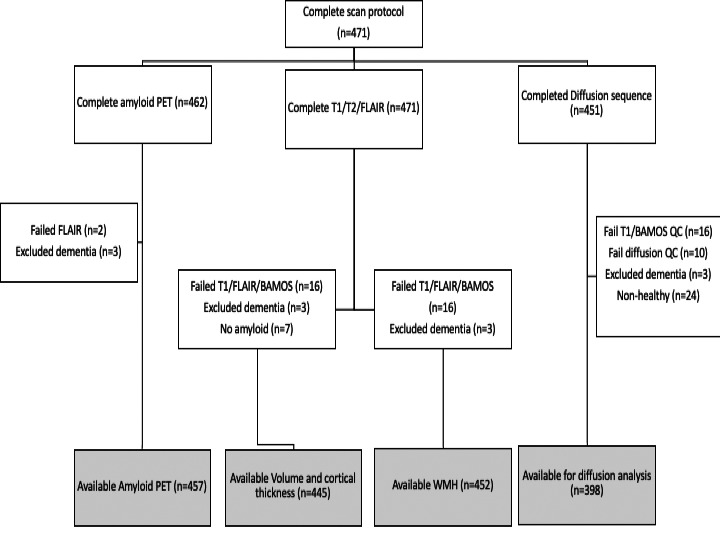
Participants (n = 502, age = 69-71) from the 1946 British Birth Cohort underwent cognitive testing (subtests of Preclinical Alzheimer Cognitive Composite), F-florbetapir Aβ-PET and MR imaging. Measures include Aβ-PET status, brain, hippocampal and white matter hyperintensity (WMH) volumes, normal appearing white matter (NAWM) microstructure, Alzheimer's disease (AD)-related cortical thickness, and serum neurofilament light chain (NFL). LOC HI metrics include HI occurring: (i) >15 years prior to the scan (ii) anytime up to age 71.
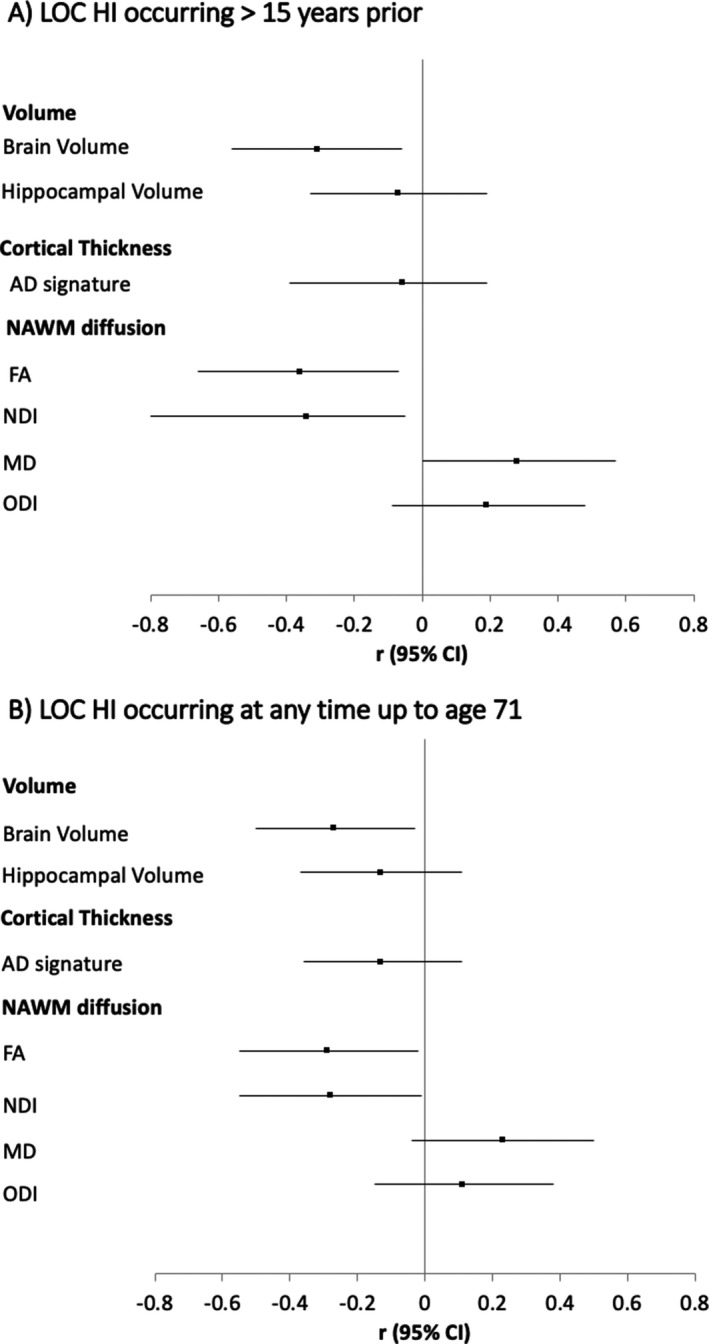
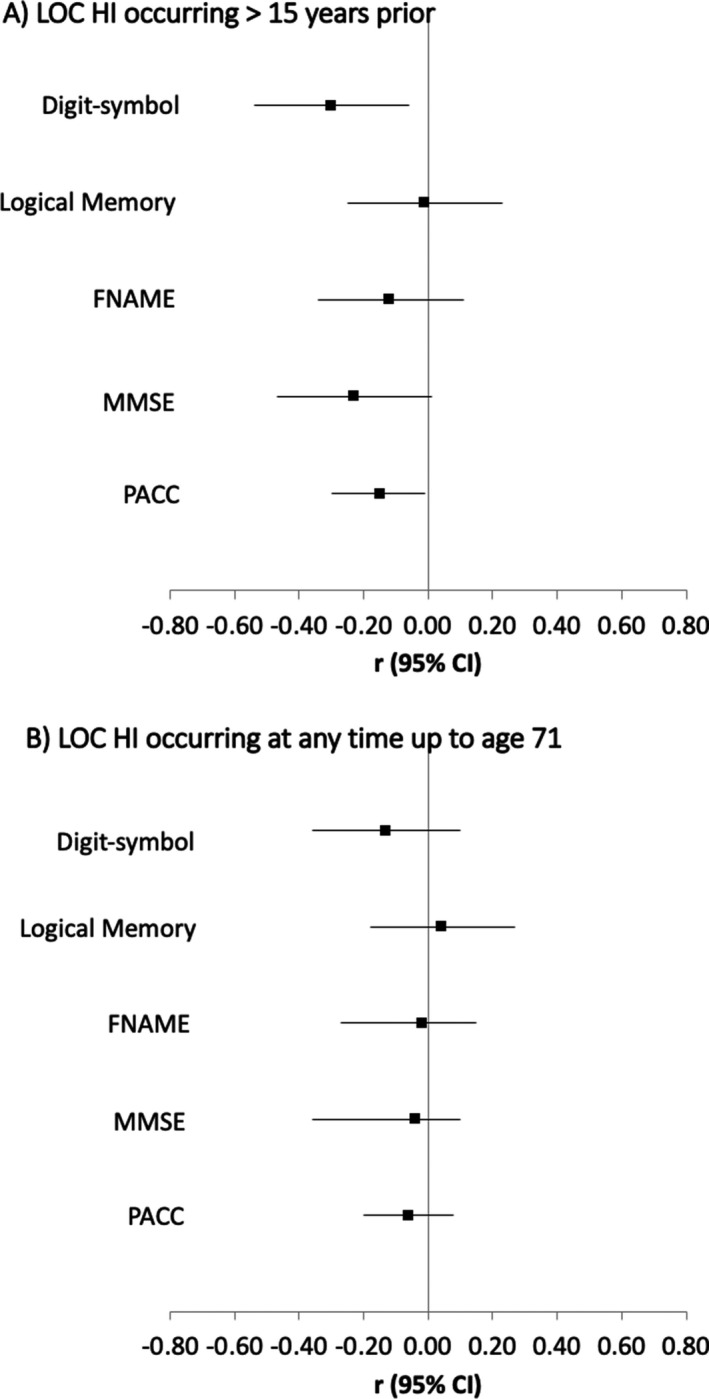
Compared to those with no evidence of an LOC HI, only those reporting an LOC HI>15 years prior (16%, n = 80) performed worse on cognitive tests at age 69-71, taking into account premorbid cognition, particularly on the digit-symbol substitution test (DSST). Smaller brain volume (BV) and adverse NAWM microstructural integrity explained 30% and 16% of the relationship between HI and DSST, respectively. We found no evidence that LOC HI was associated with Aβ load, hippocampal volume, WMH volume, AD-related cortical thickness or NFL (all p > 0.01).
Having a LOC HI aged 50's and younger was linked with lower later-life cognitive function at age ~70 than expected. This may reflect a damaging but small impact of HI; explained in part by smaller BV and different microstructure pathways but not via pathology related to AD (amyloid, hippocampal volume, AD cortical thickness) or ongoing neurodegeneration (serum NFL).
评估头部损伤(HI)伴意识丧失(LOC)、年龄与晚年脑部病理学标志物之间的关联;并探讨这些影响是否有助于解释无痴呆个体的轻微认知缺陷。
来自 1946 年英国出生队列的 502 名参与者(年龄 69-71 岁)接受了认知测试(临床前阿尔茨海默病认知综合测试的子测试)、F-氟比拉替 Aβ-PET 和磁共振成像。测量指标包括 Aβ-PET 状态、脑、海马和白质高信号(WMH)体积、正常表现白质(NAWM)微观结构、阿尔茨海默病(AD)相关皮质厚度和血清神经丝轻链(NFL)。LOC HI 指标包括:(i)在扫描前>15 年发生的 HI(ii)至 71 岁时发生的 HI。
与没有 LOC HI 证据的参与者相比,只有那些报告 LOC HI>15 年前(16%,n=80)的人在 69-71 岁时的认知测试中表现更差,考虑到了发病前的认知能力,尤其是在数字符号替代测试(DSST)中。较小的脑容量(BV)和不良的 NAWM 微观结构完整性分别解释了 HI 与 DSST 之间关系的 30%和 16%。我们没有发现 LOC HI 与 Aβ 负荷、海马体积、WMH 体积、AD 相关皮质厚度或 NFL 之间存在关联的证据(所有 p>0.01)。
50 岁及以下发生 LOC HI 与 70 岁左右的晚年认知功能下降有关,这一发现比预期更为明显。这可能反映了 HI 的破坏性但较小的影响;部分原因是 BV 较小和不同的微观结构途径,但与 AD 相关的病理学(淀粉样蛋白、海马体积、AD 皮质厚度)或持续的神经退行性变(血清 NFL)无关。