D'Alessandro Roberto, Falsetti Paolo, Conticini Edoardo, Al Khayyat Suhel Gabriele, Bardelli Marco, Baldi Caterina, Gentileschi Stefano, Cantarini Luca, Frediani Bruno
Department of Medicine, Surgery and Neurosciences, Rheumatology Unit, University of Siena, Italy.
Reumatologia. 2021;59(1):23-26. doi: 10.5114/reum.2021.103646. Epub 2021 Feb 28.
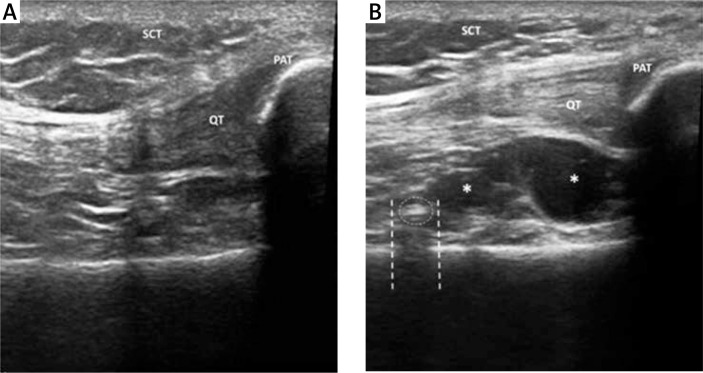
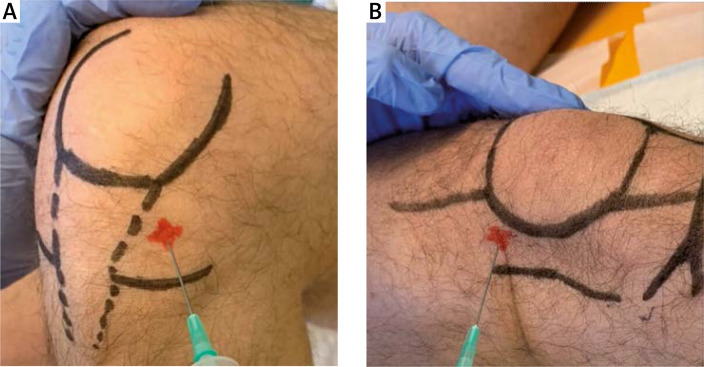
To evaluate differences of injection related pain, and the accuracy of the techniques in two groups of overweight patients, performing the anterolateral approach for one group (G1) and the superolateral approach for the second group (G2).
In the study, 126 knee joints from 86 osteoarthritis (OA) patients were evaluated. Inclusion criteria were body mass index (BMI) ≥ 25, absence of effusion and coagulopathy. Pain evaluation during injection was evaluated with Visual Analogue Scale (VAS), while accuracy of the procedure was evaluated with ultrasound (US).
The patients' mean age was 69.9 ±9.01, VAS for G1 group was 1.71 ±1.89, for G2 group was 1.74 ±1.31. Mean BMI was 29.69 ±2.86, for G1 group was 28.29 ±3.29, for G2 group was 30.32 ±2.41. No adverse events (AE) occurred in both studied groups. The accuracy rate of the procedure was 69.1% for G1 (38/55 knees), 95.7% for G2 (68/71 knees). No significant difference was found in VAS pain score between G1 and G2 group ( = 0.45). We found the significant correlation between BMI and VAS pain score in anterolateral accesses (G1) ( = 0.51; < 0.005). No correlation was found between age and VAS pain score in anterolateral access (G1). For the superolateral access (G2), no correlation was found for age or BMI and VAS pain score.
Hyaluronic acid injection is safe therapeutic option for knee OA with no significant differences between anterolateral and superolateral approaches in terms of pain in overweight patients. However, higher BMI seems to be a predictor of pain in anterolateral access, and the superolateral approach should be preferred in this group of patients.
评估两组超重患者在采用前外侧入路(G1组)和上外侧入路(G2组)进行注射时与注射相关的疼痛差异以及技术的准确性。
本研究评估了86例骨关节炎(OA)患者的126个膝关节。纳入标准为体重指数(BMI)≥25、无积液且无凝血病。注射期间的疼痛评估采用视觉模拟量表(VAS),而操作的准确性则通过超声(US)进行评估。
患者的平均年龄为69.9±9.01岁,G1组的VAS评分为1.71±1.89,G2组为1.74±1.31。平均BMI为29.69±2.86,G1组为28.29±3.29,G2组为30.32±2.41。两组均未发生不良事件(AE)。G1组的操作准确率为69.1%(55个膝关节中的38个),G2组为95.7%(71个膝关节中的68个)。G1组和G2组之间的VAS疼痛评分无显著差异(P=0.45)。我们发现前外侧入路(G1)中BMI与VAS疼痛评分之间存在显著相关性(r=0.51;P<0.005)。在前外侧入路(G1)中,年龄与VAS疼痛评分之间未发现相关性。对于上外侧入路(G2),年龄、BMI与VAS疼痛评分之间均未发现相关性。
透明质酸注射是膝关节OA的安全治疗选择,对于超重患者,前外侧入路和上外侧入路在疼痛方面无显著差异。然而,较高的BMI似乎是前外侧入路疼痛的一个预测因素,在这类患者中应优先选择上外侧入路。