Qin Xu-Ke, Du Yang, Liu Xiu-Heng, Wang Lei
Department of Urology, Renmin Hospital of Wuhan University, Wuhan, China.
Front Oncol. 2021 Feb 23;10:616185. doi: 10.3389/fonc.2020.616185. eCollection 2020.
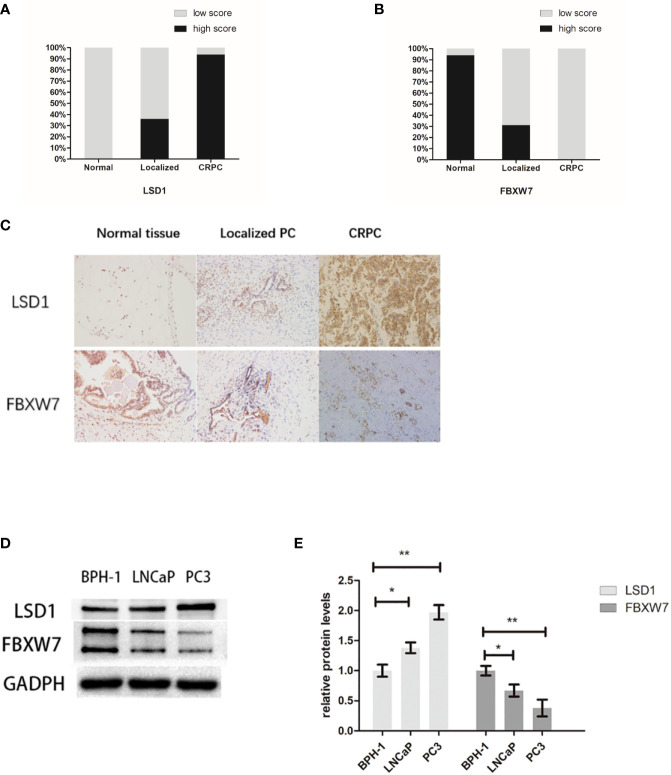
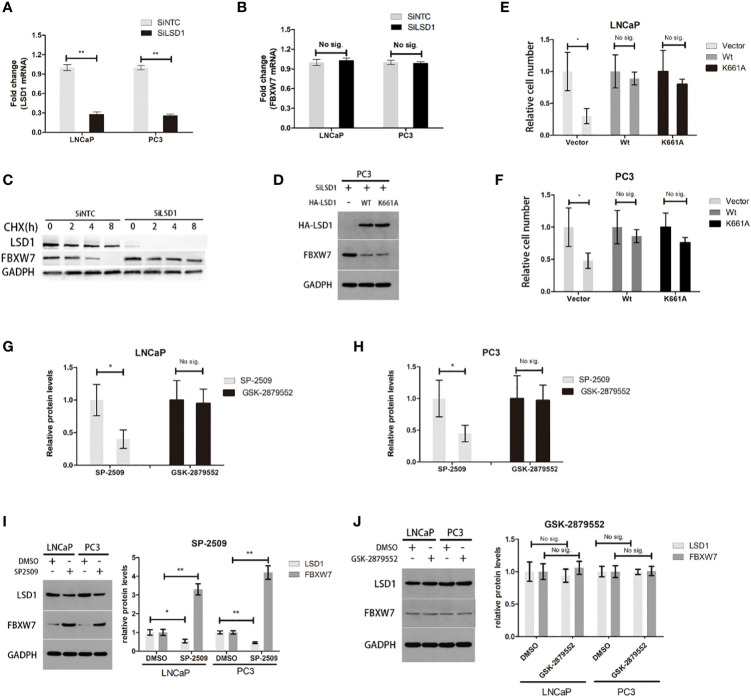
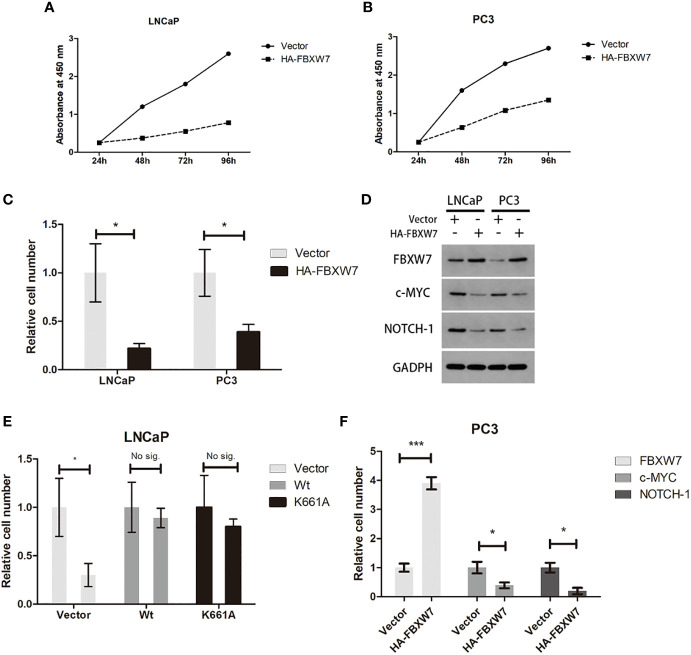
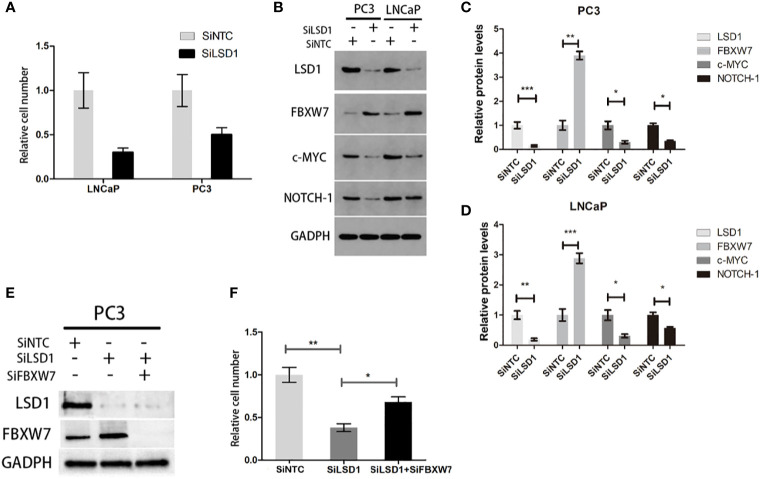
Prostate cancer (PCa) is the most common cancer in men and the fifth leading cause of cancer death worldwide. Unfortunately, castration-resistant prostate cancer (CRPCa) is incurable with surgical treat and prone to drug resistance. Therefore, it is of great importance to find a new target for treatment. LSD1 is up-regulated in PCa and related with prognosis. The high-expression LSD1 has been shown to be a potential target for treatment and is widely studied for its demethylase-activity. However, its demethylation-independent function remains to be elusive in PCa. Recent study shows that LSD1 can destabilize cancer suppressor protein FBXW7 without demethylation-function. Hence, we hope to investigate the impact of non-canonical function of LSD1 on PCa cell survival. We over-expressed FBXW7 gene through plasmid vector in LNCaP and PC3 cell lines and the result shows that up-regulated FBXW7 can suppress the viability of PC cell through suppressing oncoproteins, such as c-MYC, NOTCH-1. After FBXW7 function experiment on PC cell, we knock-down LSD1 gene in the same kinds of cell lines. In western blot assay, we detected that down-regulation of LSD1 will cause the increasing of FBXW7 protein level and decreasing of its targeting oncoproteins. And mRNA level of FBXW7 did not change significantly after LSD1 knock-down, which means LSD1 may destabilize FBXW7 by protein-protein interactions. Moreover, exogenous wild type LSD1 and catalytically deficient mutant K661A both can abrogate previous effect of LSD1 knock-down. Consequently, LSD1 may promote PC cell survival by destabilizing FBXW7 without its demethylase-activity. Next, we compared two kinds inhibitors, and found that SP-2509 (Allosteric inhibitor) treatment suppress the cancer cell survival by blocking the LSD1-FBXW7 interaction, which is an effect that GSK-2879552 (catalytic inhibitor) cannot achieve. This work revealed a pivotal function of LSD1 in PCa, and indicated a new direction of LSD1 inhibitor research for PCa treatment.
前列腺癌(PCa)是男性中最常见的癌症,也是全球癌症死亡的第五大主要原因。不幸的是,去势抵抗性前列腺癌(CRPCa)无法通过手术治愈且容易产生耐药性。因此,找到新的治疗靶点至关重要。赖氨酸特异性去甲基化酶1(LSD1)在前列腺癌中表达上调且与预后相关。高表达的LSD1已被证明是一个潜在的治疗靶点,并因其去甲基酶活性而受到广泛研究。然而,其非去甲基化功能在前列腺癌中仍不清楚。最近的研究表明,LSD1可以在不具有去甲基化功能的情况下使抑癌蛋白F-box和WD重复结构域蛋白7(FBXW7)不稳定。因此,我们希望研究LSD1的非经典功能对前列腺癌细胞存活的影响。我们通过质粒载体在LNCaP和PC3细胞系中过表达FBXW7基因,结果表明上调的FBXW7可以通过抑制癌蛋白,如c-MYC、Notch-1来抑制前列腺癌细胞的活力。在对前列腺癌细胞进行FBXW7功能实验后,我们在同类型细胞系中敲低LSD1基因。在蛋白质免疫印迹分析中,我们检测到LSD1的下调会导致FBXW7蛋白水平升高及其靶向癌蛋白水平降低。LSD1敲低后FBXW7的mRNA水平没有显著变化,这意味着LSD1可能通过蛋白质-蛋白质相互作用使FBXW7不稳定。此外,外源性野生型LSD1和催化缺陷突变体K661A都可以消除先前LSD1敲低的作用。因此,LSD1可能在不具有去甲基酶活性的情况下通过使FBXW7不稳定来促进前列腺癌细胞的存活。接下来,我们比较了两种抑制剂,发现SP-2509(变构抑制剂)处理通过阻断LSD1-FBXW7相互作用来抑制癌细胞存活,这是GSK-2879552(催化抑制剂)无法实现的效果。这项工作揭示了LSD1在前列腺癌中的关键作用,并为前列腺癌治疗的LSD1抑制剂研究指明了新方向。