Chen Yu, Deng Juan, Liu Yu, Wang Hao, Zhao Sha, He Yayi, Zhou Caicun
Department of Orthopedic, Spine Center, Shanghai Changzheng Hospital, Shanghai, China.
Department of Medical Oncology, Shanghai Pulmonary Hospital, Tongji University Medical School Cancer Institute, Tongji University School of Medicine, Shanghai, China.
Ann Transl Med. 2021 Feb;9(3):206. doi: 10.21037/atm-20-2925.
Most lung cancer patients are diagnosed at an advanced stage with metastases. There was no population-based data on metastases in non-small cell lung cancer (NSCLC) patients with epidermal growth factor receptor () mutation. This study focused on the metastases in NSCLC patients with mutation.
In our research, we retrospectively studied 365 NSCLC patients with mutation ( positive-mutant group) were not resistant to first-generation TKIs and 316 NSCLC patients with T790M mutation (T790M-mutant group) who were resistant to first-generation TKIs. In the study, we also investigated sex, smoking status, age at diagnosis, histology, T, N, and M stage, and mutation status. In addition, we analyzed metastatic sites in stage IV patients.
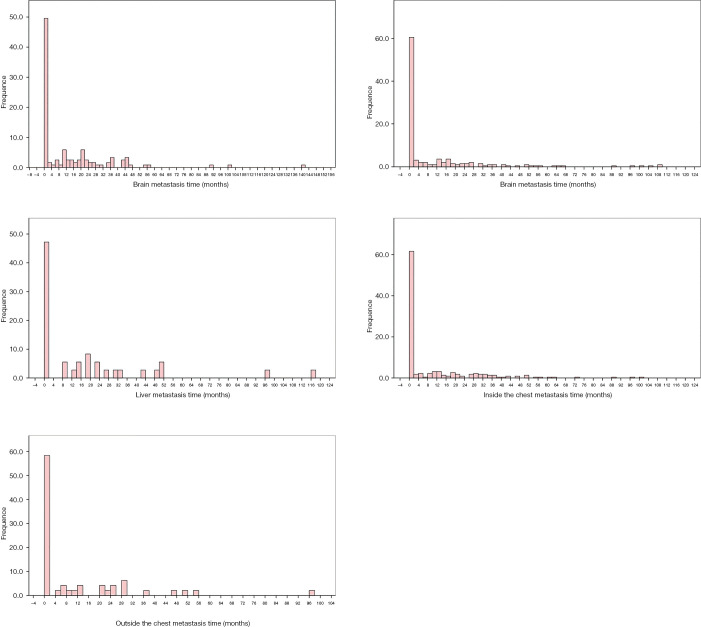
Among the positive-mutant group, 248 (67.95%) patients were stage IV disease. Among them, 41 patients had brain metastases, 86 patients had bone metastases, 16 patients had liver metastases, 168 patients had intrapulmonary metastases, and 39 patients had metastases in other sites. Among the T790M-mutant group, 277 (87.66%) patients were stage IV disease. Among them, 158 patients had brain metastases, 82 patients had bone metastases, 241 patients had liver metastases, 53 patients had intrapulmonary metastases, and 229 patients had metastases in other sites. We also found that lung cancer patients in the T790M-mutant group had higher incidences of the brain (P<0.001), bone (P<0.001), liver (P=0.001), and intrapulmonary metastases (P<0.001). Moreover, wherever the metastatic site was, the metastasis time all centrally distributed in the first two months after diagnosis.
For patients with metastatic lung cancer, most metastases happened before diagnosis, which indicated that metastases related to driving mutations, such as positive mutation or T790M mutation, but not to the survival time. Lung cancer patients with T790M mutation were more likely to metastasize before the diagnosis.
大多数肺癌患者在晚期出现转移时被诊断出来。目前尚无基于人群的非小细胞肺癌(NSCLC)表皮生长因子受体()突变患者转移情况的数据。本研究聚焦于具有突变的NSCLC患者的转移情况。
在我们的研究中,我们回顾性研究了365例对第一代TKIs不耐药的具有突变的NSCLC患者(阳性突变组)和316例对第一代TKIs耐药的具有T790M突变的NSCLC患者(T790M突变组)。在研究中,我们还调查了性别、吸烟状况、诊断时的年龄、组织学、T、N和M分期以及突变状态。此外,我们分析了IV期患者的转移部位。
在阳性突变组中,248例(67.95%)患者为IV期疾病。其中,41例有脑转移,86例有骨转移,16例有肝转移,168例有肺内转移,39例有其他部位转移。在T790M突变组中,277例(87.66%)患者为IV期疾病。其中,158例有脑转移,82例有骨转移,241例有肝转移,53例有肺内转移,229例有其他部位转移。我们还发现T790M突变组的肺癌患者脑转移(P<0.001)、骨转移(P<0.001)、肝转移(P=0.001)和肺内转移(P<0.001)的发生率更高。此外,无论转移部位在哪里,转移时间都集中分布在诊断后的前两个月。
对于转移性肺癌患者,大多数转移发生在诊断之前,这表明转移与驱动突变有关,如阳性突变或T790M突变,但与生存时间无关。具有T790M突变的肺癌患者在诊断前更易发生转移。