Cao Sheng, Deng Qing, Wang Yijia, Zhou Yanxiang, Zhou Qing
Department of Ultrasound Imaging, Renmin Hospital of Wuhan University, Wuhan, China.
Ann Transl Med. 2021 Feb;9(3):221. doi: 10.21037/atm-20-839.
The present study aimed to determine whether ultrasound-targeted microbubble destruction (UTMD)-mediated angiopoietin 1 () gene transfection can improve angiogenesis and potentially reverse left ventricular (LV) structural and sympathetic nerve remodeling in canines with myocardial infarction (MI).
Thirty dogs were randomly divided into groups (n=10/group) as follows: the MI group (MI dogs without UTMD treatment), the UTMD group (MI dogs with UTMD-mediated negative control plasmid treatment), and the UTMD- group (MI dogs with UTMD-mediated plasmid treatment). LV dimensions, systolic function, and synchrony were used to reflect the structural remodeling. The density of tyrosine hydroxylase (TH)- and growth-associated protein 43 (GAP43)-positive nerve fibers were calculated to assess the sympathetic nerve remodeling.
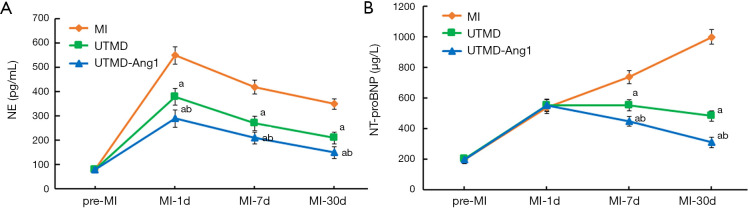
One month after treatment, the UTMD- group showed lower LV end-diastolic dimension (LVEDD: 31.2±2.3 mm) and higher LV ejection fraction (LVEF: 44.6%±4.3%) than the MI group (LVEDD: 34.5±2.2 mm, t=2.282, P=0.014; LVEF: 37.3%±3.1%, t=3.718, P=0.003) and the UTMD group (LVEDD: 34.1±2.8 mm, t=2.264, P=0.040; LVEF: 39.3%±4.5%, t=2.408, P=0.030). LV synchrony was higher in the UTMD- group compared with the MI group by 2-dimensional speckle-tracking echocardiography. Angiogenic density was higher in the UTMD group than the MI group but was highest in the UTMD- group according to immunohistochemistry of CD31 and α-smooth muscle actin staining. The density of TH- and GAP43-positive nerve fibers were decreased in the UTMD- group (TH: 1,928.2±376.6 μm/mm; GAP43: 2,090.8±329.2 μm/mm) compared with the MI group (TH: 2916.5±558.4 μm/mm, t=4.069, P=0.001; GAP43: 3,275.4±548.6 μm/mm, t=5.153, P=0.000) and the UTMD group (TH: 2,552.7±408.1 μm/mm, t=3.181, P=0.007; GAP43: 2,630.5±419.3 μm/mm, t=2.863, P=0.013). The relative and sarcoplasmic reticulum Ca-ATPase 2a protein levels were significantly higher in the UTMD- group than the UTMD and MI groups by Western blot, while the phospholamban levels exhibited the opposite trend. Plasma norepinephrine and N-terminal pro-B-type-natriuretic peptide were significantly reduced in the UTMD- group from day 1 to 1 month after MI.
UTMD-mediated transfection can promote angiogenesis, reverse LV structural and sympathetic nerve remodeling, and improve LV synchrony after MI.
本研究旨在确定超声靶向微泡破坏(UTMD)介导的血管生成素1()基因转染是否能改善血管生成,并可能逆转心肌梗死(MI)犬的左心室(LV)结构和交感神经重塑。
30只犬随机分为3组(每组n = 10):MI组(未接受UTMD治疗的MI犬)、UTMD组(接受UTMD介导的阴性对照质粒治疗的MI犬)和UTMD-组(接受UTMD介导的质粒治疗的MI犬)。左心室尺寸、收缩功能和同步性用于反映结构重塑。计算酪氨酸羟化酶(TH)和生长相关蛋白43(GAP43)阳性神经纤维的密度以评估交感神经重塑。
治疗1个月后,UTMD-组的左心室舒张末期内径(LVEDD:31.2±2.3 mm)低于MI组(LVEDD:34.5±2.2 mm,t = 2.282,P = 0.014)和UTMD组(LVEDD:34.1±2.8 mm,t = 2.264,P = 0.040),左心室射血分数(LVEF:44.6%±4.3%)高于MI组(LVEF:37.3%±3.1%,t = 3.718,P = 0.003)和UTMD组(LVEF:39.3%±4.5%,t = 2.408,P = 0.030)。二维斑点追踪超声心动图显示,UTMD-组的左心室同步性高于MI组。根据CD31和α平滑肌肌动蛋白染色的免疫组织化学结果,UTMD组的血管生成密度高于MI组,但UTMD-组最高。与MI组(TH:2916.5±558.4 μm/mm,t = 4.069,P = 0.001;GAP43:3275.4±548.6 μm/mm,t = 5.153,P = 0.000)和UTMD组(TH:2552.7±408.1 μm/mm,t = 3.181,P = 0.007;GAP43:2630.5±419.3 μm/mm,t = 2.863,P = 0.013)相比,UTMD-组的TH和GAP43阳性神经纤维密度降低(TH:1928.2±376.6 μm/mm;GAP43:2090.8±329.2 μm/mm)。Western blot结果显示,UTMD-组的相对和肌浆网Ca-ATP酶2a蛋白水平显著高于UTMD组和MI组,而受磷蛋白水平则呈相反趋势。MI后1天至1个月,UTMD-组的血浆去甲肾上腺素和N末端B型利钠肽原显著降低。
UTMD介导的转染可促进血管生成,逆转MI后的左心室结构和交感神经重塑,并改善左心室同步性。