Liu Jiayong, Fan Zhengfu, Bai Chujie, Li Shu, Xue Ruifeng, Gao Tian, Zhang Lu, Tan Zhichao, Fang Zhiwei
Department of Bone and Soft Tissue Tumor, Peking University Cancer Hospital, Key laboratory of Carcinogenesis and Translational Research (Ministry of Education/Beijing), Beijing, China.
Ann Transl Med. 2021 Feb;9(4):339. doi: 10.21037/atm-21-49.
The goal of this study was to retrospectively analyze the efficacy and safety of pembrolizumab in the real-world treatment of soft tissue sarcoma (STS).
We analyzed 38 patients who suffered from STS and received pembrolizumab treatment from July 2017 to December 2018 in our hospital. We investigated the influence of clinical characteristics, treatment timing, and treatment protocol on objective response rate (ORR). We also investigated the factors affecting overall survival (OS) and progression-free survival (PFS), as well as the occurrence of severe adverse events (SAEs).
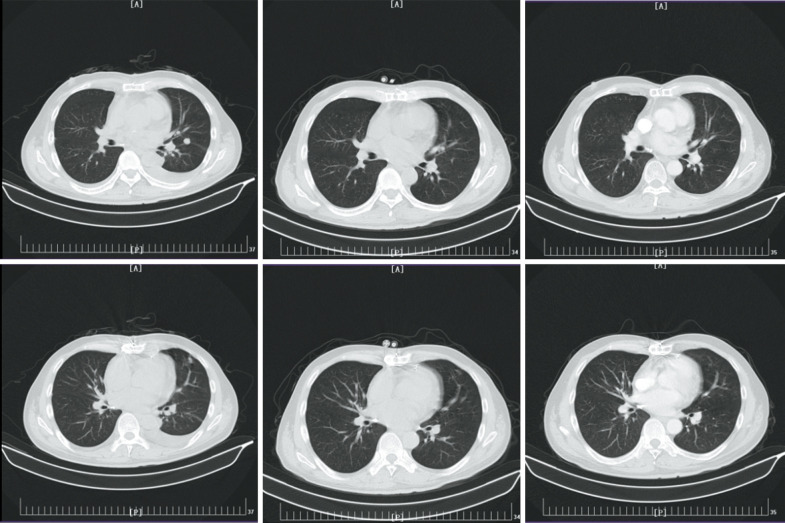
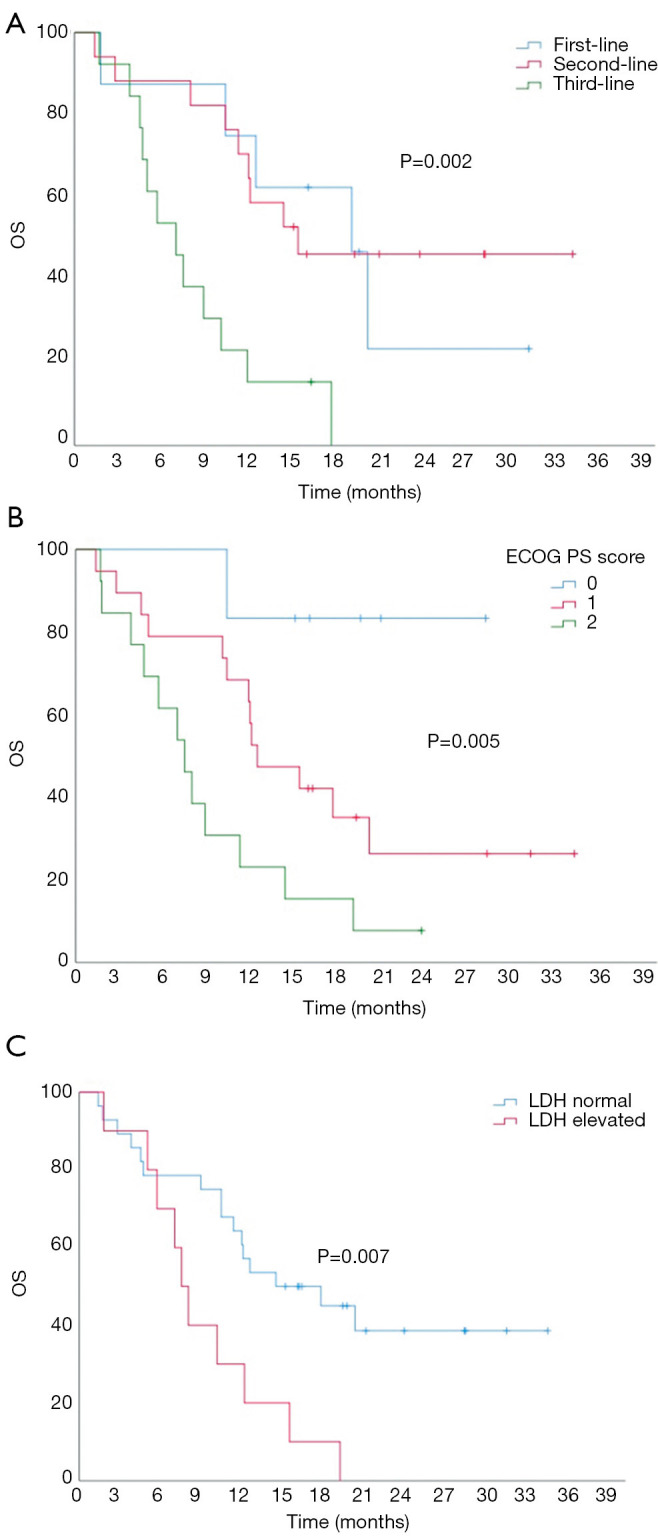
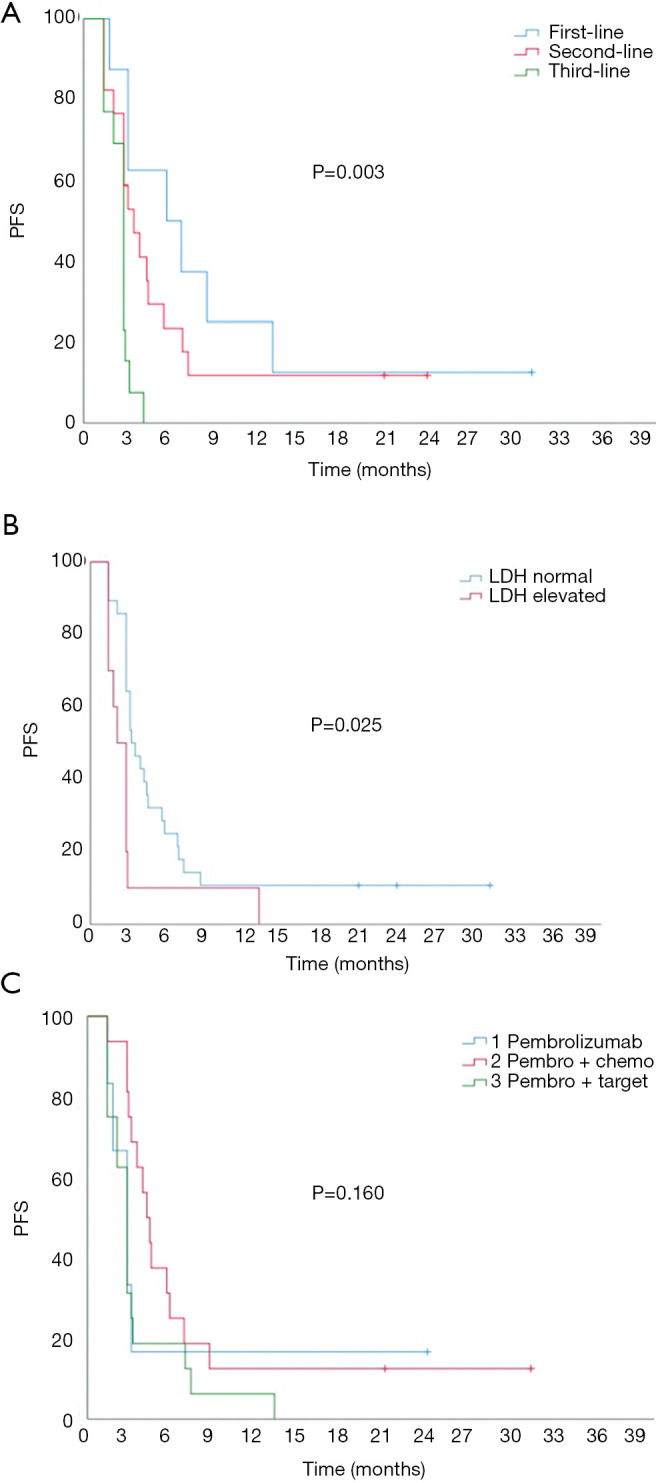
The overall ORR was 19.4% (7/36). The ORRs of patients who received pembrolizumab treatment as first-line, second-line, and third-line therapy were 42.9% (3/7), 25.0% (4/16), and 0% (0/13), respectively, which showed marginal significance (P=0.052). Four patients (11.1%) maintained a complete response (CR) or partial response (PR) for at least 6 months with pembrolizumab monotherapy, or after withdrawal of chemotherapy or targeted therapy regimens. The median PFS was 2.9 months [95% confidence interval (CI): 2.4-3.4 months] and the median OS was 12.0 months (95% CI: 10.2-13.8 months). Cox regression analysis showed that treatment time was an independent factor affecting PFS (P=0.041), while Eastern Cooperative Oncology Group (ECOG) performance status (PS) score was the only independent factor affecting OS (P=0.028).
In the real world, the effectiveness of pembrolizumab in the treatment of STS was low. Some subtypes showed a limited response to pembrolizumab, including alveolar soft part sarcoma (ASPS), undifferentiated pleomorphic sarcoma (UPS), exoskeletal chondrosarcoma (ESCS), and angiosarcoma (AS), while the response in leiomyosarcoma (LMS) was low. Combination therapy may increase the risk of SAEs, especially when combined with pazopanib.
本研究的目的是回顾性分析帕博利珠单抗在软组织肉瘤(STS)实际治疗中的疗效和安全性。
我们分析了2017年7月至2018年12月在我院接受帕博利珠单抗治疗的38例STS患者。我们研究了临床特征、治疗时机和治疗方案对客观缓解率(ORR)的影响。我们还研究了影响总生存期(OS)和无进展生存期(PFS)的因素,以及严重不良事件(SAE)的发生情况。
总体ORR为19.4%(7/36)。接受帕博利珠单抗一线、二线和三线治疗的患者的ORR分别为42.9%(3/7)、25.0%(4/16)和0%(0/13),差异具有边缘显著性(P=0.052)。4例患者(11.1%)接受帕博利珠单抗单药治疗,或在停用化疗或靶向治疗方案后,维持完全缓解(CR)或部分缓解(PR)至少6个月。中位PFS为2.9个月[95%置信区间(CI):2.4 - 3.4个月],中位OS为12.0个月(95%CI:10.2 - 13.8个月)。Cox回归分析显示,治疗时间是影响PFS的独立因素(P=0.041),而东部肿瘤协作组(ECOG)体能状态(PS)评分是影响OS的唯一独立因素(P=0.028)。
在现实世界中,帕博利珠单抗治疗STS的有效性较低。一些亚型对帕博利珠单抗反应有限,包括肺泡软组织肉瘤(ASPS)、未分化多形性肉瘤(UPS)、骨外软骨肉瘤(ESCS)和血管肉瘤(AS),而平滑肌肉瘤(LMS)的反应较低。联合治疗可能会增加SAE的风险,尤其是与帕唑帕尼联合时。