Department of Clinical Science, University of Bergen, Jonas Lies veg 87, 5021, Bergen, Hordaland, Norway.
Department of Heart Disease, Haukeland University Hospital, Bergen, Norway.
Int J Cardiovasc Imaging. 2021 Jul;37(7):2111-2123. doi: 10.1007/s10554-021-02200-8. Epub 2021 Mar 12.
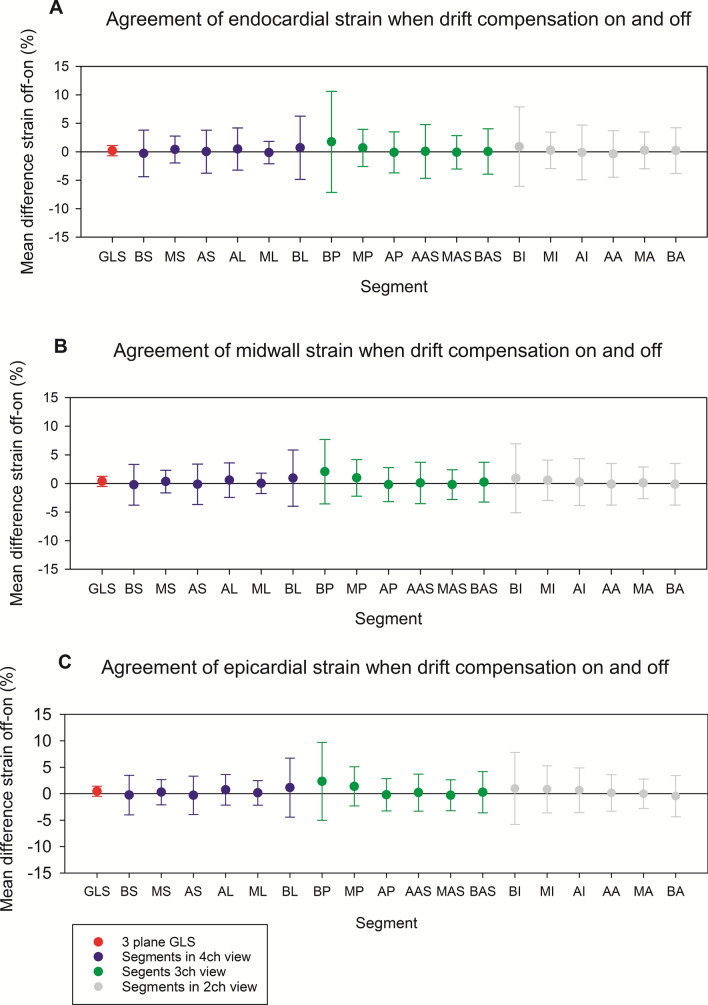
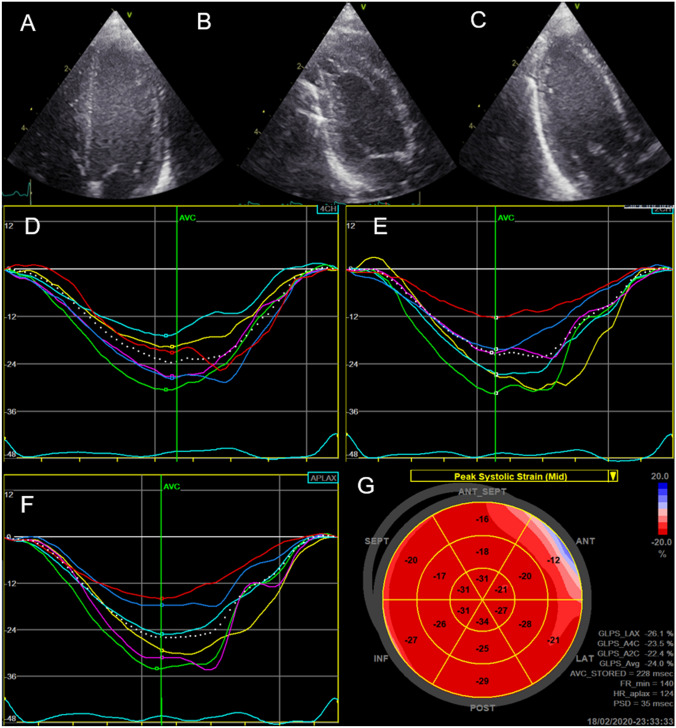
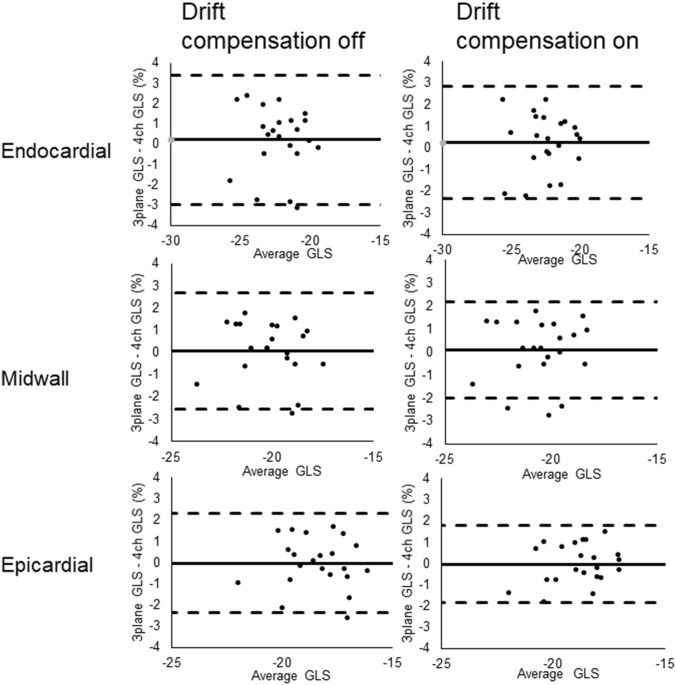
The aims of this study was to assess the effect of using a four chamber versus a three plane model on speckle tracking derived global longitudinal strain, the effects of drift compensation, the effect of assessing strain in different layers and finally the interplay between these aspects for the assessment of strain in neonates. Speckle tracking derived longitudinal strain was obtained from 22 healthy neonates. ANOVA, Bland-Altman analyses, coefficients of variation and assessment of intraclass correlation coefficients were conducted to assess the effect of the abovementioned aspects as well as assess both inter-observer and intra-observer variability. Neither the use of the three plane model versus the four chamber model nor the use of drift compensation had a substantial effect on global longitudinal strain (less than 1%, depending on which layer was being assessed). A gradient was seen with increasing strain from the epicardial to endocardial layers, similar to what is seen in older subjects. Finally, drift compensation introduced more discrepancy in segmental strain values compared to global longitudinal strain. Global longitudinal strain in healthy neonates remains reasonably consistent regardless of whether the three plane or four chamber model is used and whether drift compensation is applied. Its value increases when one moves from the endocardial to the epicardial layer. Finally, drift compensation introduces more discrepancy for regional measures of longitudinal strain compared to global longitudinal strain.
本研究旨在评估使用四腔心模型与三平面模型对斑点追踪技术获取的整体纵向应变的影响,以及漂移补偿的作用、评估不同层面应变的效果,最后评估这些方面对新生儿应变评估的相互影响。本研究纳入了 22 例健康新生儿。采用方差分析、Bland-Altman 分析、变异系数和组内相关系数评估上述各方面的影响,以及评估观察者间和观察者内的变异性。无论是使用三平面模型还是四腔心模型,亦或是使用漂移补偿,对整体纵向应变的影响都不大(取决于所评估的层面,影响小于 1%)。从心外膜到心内膜层,应变逐渐增加,与老年患者相似。最后,与整体纵向应变相比,漂移补偿会导致节段应变值的差异更大。在健康新生儿中,无论使用三平面模型还是四腔心模型,以及是否应用漂移补偿,整体纵向应变都相当一致。当从心内膜层移动到心外膜层时,应变值会增加。最后,与整体纵向应变相比,漂移补偿会导致纵向应变的局部测量值的差异更大。