Wyoming Cooperative Fish and Wildlife Research Unit, Department of Zoology and Physiology, University of Wyoming, 1000 E. University Avenue, Laramie, Laramie, Wyoming, 82701, USA.
Program in Ecology, University of Wyoming, 1000 E. University Avenue, Laramie, Laramie, Wyoming, 82071, USA.
Ecology. 2021 Jun;102(6):e03334. doi: 10.1002/ecy.3334. Epub 2021 Apr 30.
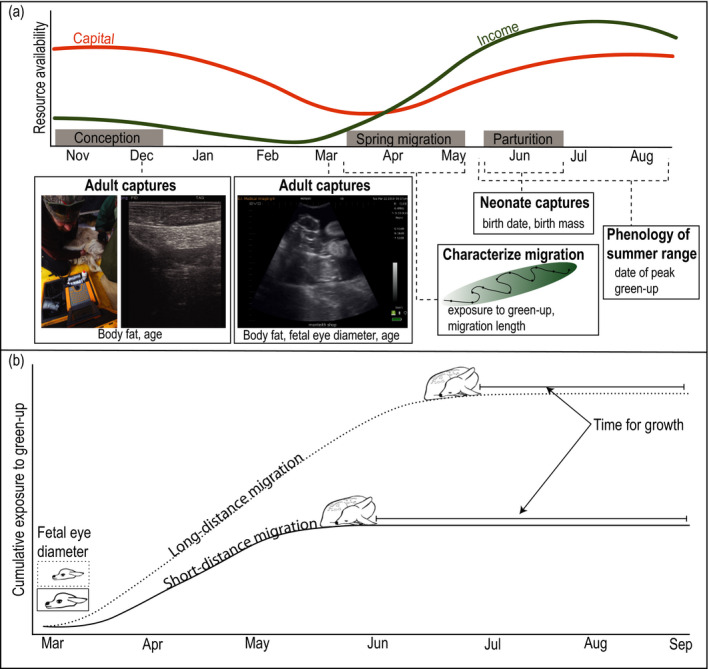
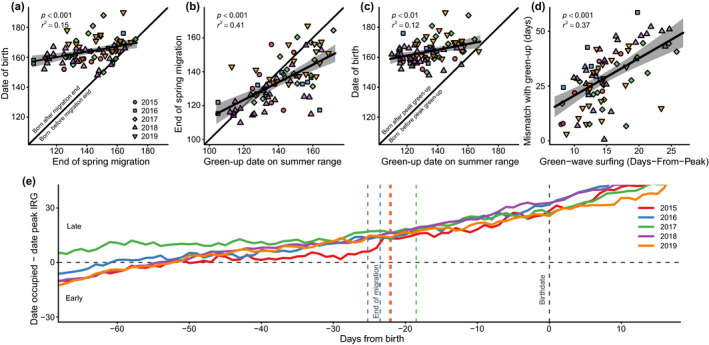
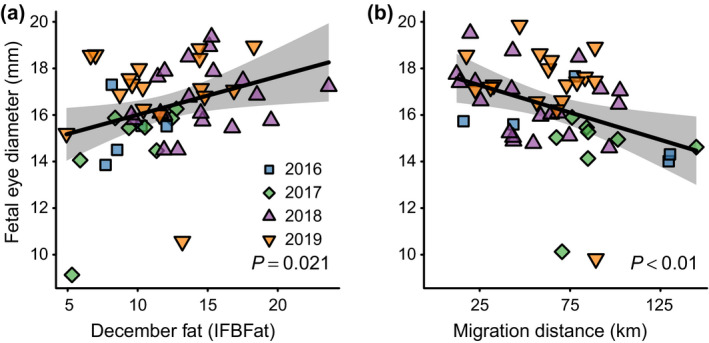
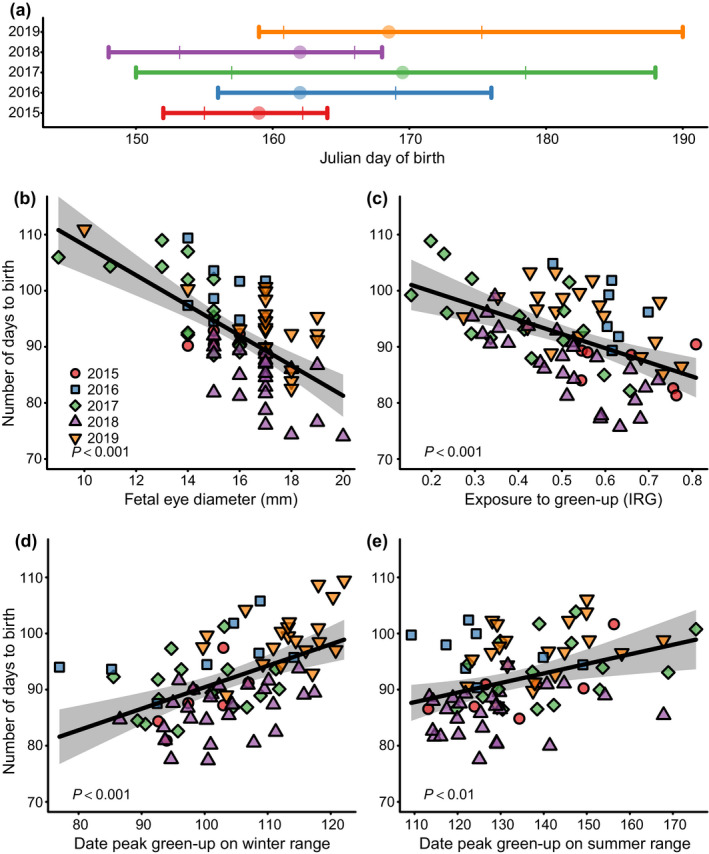
Birth timing is a key life-history characteristic that influences fitness and population performance. For migratory animals, however, appropriately timing birth on one seasonal range may be constrained by events occurring during other parts of the migratory cycle. We investigated how the use of capital and income resources may facilitate flexibility in reproductive phenology of migratory mule deer in western Wyoming, USA, over a 5-yr period (2015-2019). Specifically, we examined how seasonal interactions affected three interrelated life-history characteristics: fetal development, birth mass, and birth timing. Females in good nutritional condition at the onset of winter and those that migrated short distances had more developed fetuses (measured as fetal eye diameter in March). Variation in parturition date was explained largely by fetal development; however, there were up to 16 d of plasticity in expected birth date. Plasticity in expected birth date was shaped by income resources in the form of exposure to spring green-up. Although individuals that experienced greater exposure to spring green-up were able to advance expected birth date, being born early or late with respect to fetal development had no effect on birth mass of offspring. Furthermore, we investigated the trade-offs migrating mule deer face by evaluating support for existing theory that predicts that births should be matched to local peaks in resource availability at the birth site. In contrast to this prediction, only long-distance migrants that paced migration with the flush of spring green-up, giving birth shortly after ending migration, were able to match birth with spring green-up. Shorter-distance migrants completed migration sooner and gave birth earlier, seemingly trading off more time for offspring to grow and develop over greater access to resources. Thus, movement tactic had profound downstream effects on birth timing. These findings highlight a need to reconsider classical theory on optimal birth timing, which has focused solely on conditions at the birth site.
生育时间是影响适应能力和种群表现的关键生活史特征。然而,对于迁徙动物来说,在一个季节性范围内适时生育可能会受到迁徙周期其他部分发生的事件的限制。我们研究了在美国怀俄明州西部的迁徙骡鹿中,资本和收入资源的使用如何促进其繁殖生理时相的灵活性,研究期为 5 年(2015-2019 年)。具体来说,我们研究了季节性相互作用如何影响三个相互关联的生活史特征:胎儿发育、出生体重和出生时间。在冬季开始时营养状况良好的雌性和迁徙距离较短的雌性胎儿发育得更好(以 3 月的胎儿眼睛直径衡量)。分娩日期的变化主要由胎儿发育解释;然而,预期分娩日期的可塑性最高可达 16 天。预期分娩日期的可塑性由收入资源的形式,即对春季植被萌动的暴露所决定。尽管接触春季植被萌动的个体能够提前预期的分娩日期,但相对于胎儿发育而言,提前或延迟出生对后代的出生体重没有影响。此外,我们通过评估现有的理论预测来研究迁徙骡鹿面临的权衡,该理论预测分娩应该与出生地的资源可用性的局部峰值相匹配。与这一预测相反,只有与春季植被萌动同步迁徙的长距离迁徙者,即在结束迁徙后不久分娩,才能使分娩与春季植被萌动相匹配。短距离迁徙者更早地完成迁徙并更早地分娩,似乎是在更长时间内获得更多资源的同时,为后代的生长和发育交换了更多的时间。因此,运动策略对出生时间有深远的下游影响。这些发现强调需要重新考虑关于最佳生育时间的经典理论,该理论仅关注生育地的条件。