University of Health Sciences, Faculty of Medicine, Kanuni Sultan Suleyman Hospital, Department of Anesthesiology & Reanimation, Istanbul, Turkey.
University of Health Sciences, Faculty of Medicine, Kanuni Sultan Suleyman Hospital, Department of Radiology, Istanbul, Turkey.
Braz J Anesthesiol. 2021 Jan-Feb;71(1):11-16. doi: 10.1016/j.bjane.2020.12.002. Epub 2020 Dec 26.
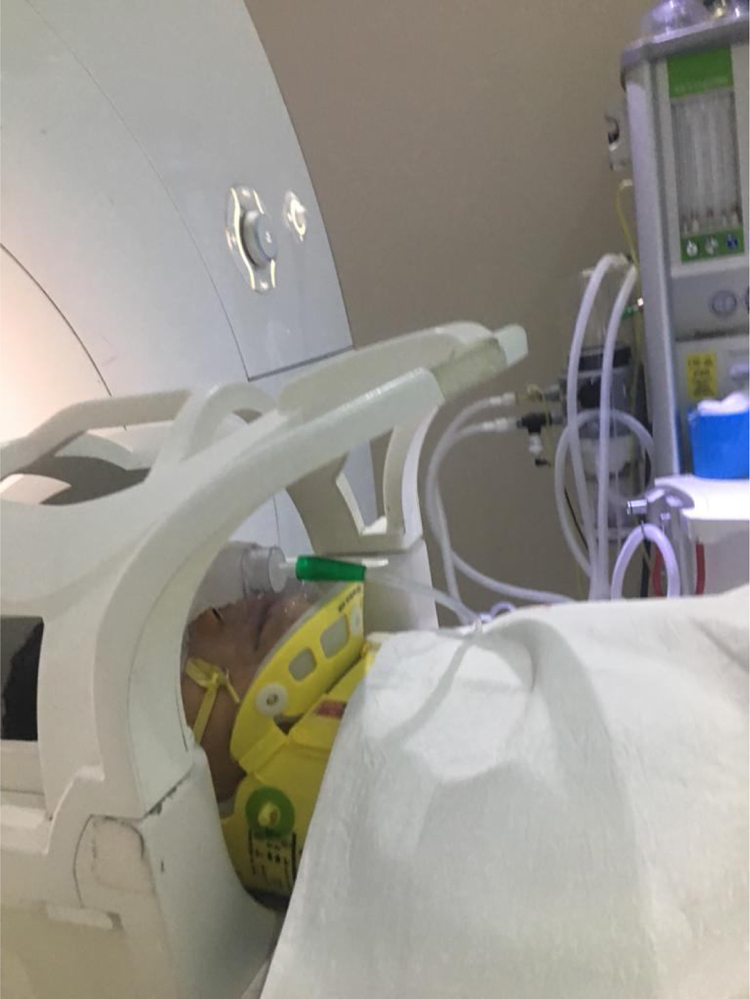
Maneuvers precluding the downward shift of the mandibula and providing slight extension of the head have been shown to increase upper airway dimensions. This study aimed to investigate the role of Neck Collars (NC) in maintaining airway patency during Magnetic Resonance Imaging (MRI) examination in a pediatric population aged between 0 and 16 years.
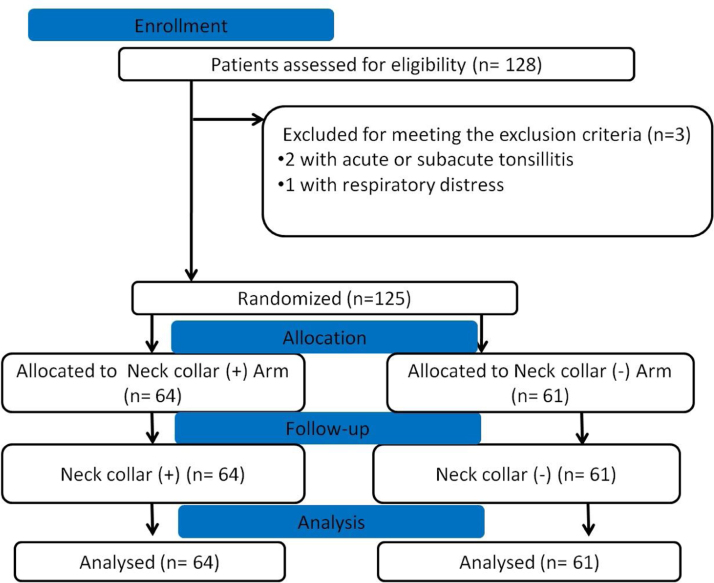
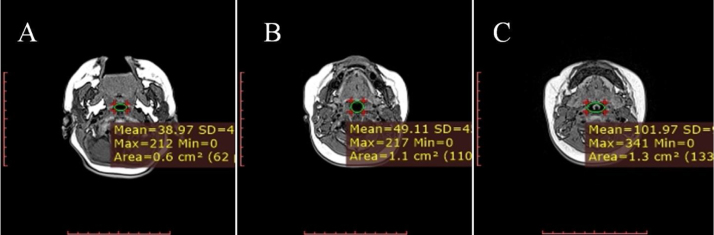
One hundred twenty-five children were recruited in this prospective study. Subjects were randomly assigned to NC group (NC+) or standard imaging group (NC-). Measurements of anteroposterior and transverse dimensions and cross-sectional area were performed to determine the upper airway size at three distinct levels: soft palate, base of the tongue, and tip of the epiglottis.
The anteroposterior diameter and cross-sectional area at the levels of base of the tongue and soft palate were significantly higher in NC+ patients compared to NC- patients. However, anteroposterior dimensions and cross-sectional areas at the epiglottis level were similar in the two groups. When patients were analyzed according to age groups of 0-2, 2-8, and 8-16 years, the anteroposterior diameter and cross-sectional area at the levels of base of the tongue and soft palate were significantly higher in NC+ patients compared to NC- patients in all age groups.
This study clearly demonstrates that the application of a NC may improve retropalatal end and retroglossal airway dimensions in a pediatric population undergoing MRI examination and receiving sedation in supine position.
已证实,防止下颌下降并使头部轻微伸展的操作可增加上呼吸道的尺寸。本研究旨在探讨在 0 至 16 岁儿童行磁共振成像(MRI)检查时,颈托(NC)在维持气道通畅方面的作用。
本前瞻性研究纳入了 125 名儿童。受试者被随机分配到 NC 组(NC+)或标准成像组(NC-)。分别在软腭、舌骨基底和会厌尖端三个不同水平测量前后径和横径及横截面积,以确定上呼吸道的大小。
与 NC-患者相比,NC+患者的舌骨基底和软腭水平的前后径和横截面积明显更大。然而,两组患者的会厌水平的前后径和横截面积相似。当根据 0-2 岁、2-8 岁和 8-16 岁的年龄组对患者进行分析时,与 NC-患者相比,NC+患者在所有年龄组的舌骨基底和软腭水平的前后径和横截面积均明显更大。
本研究清楚地表明,在仰卧位接受镇静并接受 MRI 检查的儿科人群中,应用 NC 可能会改善腭后和会厌后气道的尺寸。