Department of Nuclear Medicine, Medical University Innsbruck, Innsbruck, Austria.
Department of Nuclear Medicine, Medical University Innsbruck, Innsbruck, Austria;
J Nucl Med. 2021 Nov;62(11):1550-1557. doi: 10.2967/jnumed.120.261866. Epub 2021 Mar 12.
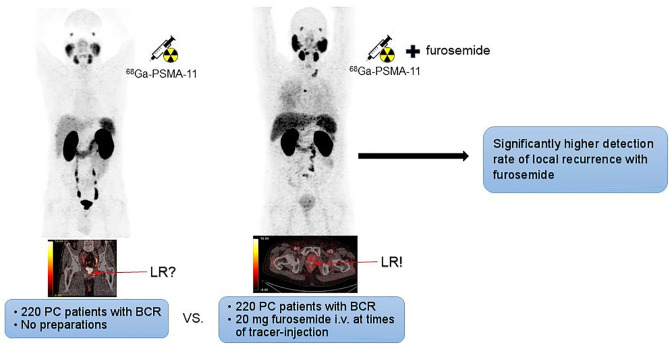
The aim of this study was twofold. First, we aimed to assess the impact of forced diuresis with early furosemide injection on the detection rate of local recurrence in prostate cancer patients with biochemical recurrence referred for Ga-labeled Glu-NH-CO-NH-Lys(Ahx)-HBED-CC (Ga-PSMA-11) PET/CT. Second, we determined whether intravenous administration of furosemide shortly after tracer injection increases renal washout of Ga-PSMA-11 before it binds to the PSMA receptor with possible influence on biodistribution and intensity of tracer uptake in organs with physiologic tracer accumulation. In a retrospective analysis, 2 different groups with 220 prostate cancer patients each, referred for Ga-PSMA-11 PET/CT because of biochemical recurrence after primary therapy, were compared: patients in group 1 (median prostate-specific antigen, 1.30 ng/mL) received no preparation before imaging, whereas patients in group 2 (median prostate-specific antigen, 0.82 ng/mL) were injected with 20 mg of furosemide and 500 mL of sodium chloride (NaCl 0.9%) immediately after tracer injection. The presence of local recurrence was assessed visually. In addition, the intensity of tracer accumulation in organs with physiologic tracer uptake was evaluated. The detection rate of lesions judged positive for local recurrence was significantly higher in patients receiving furosemide than in patients without preparation: 56 cases (25.5%) versus 38 cases (17.3%), respectively ( = 0.048). Median maximum SUVs (SUV) of organs with physiologic uptake of Ga-PSMA-11 in groups 1 and 2 were urinary bladder (63.0 vs. 8.9), kidney (55.6 vs. 54.5), liver (9.9 vs. 9.4), spleen (11.2 vs. 11.9), small bowel (16.2 vs. 17.1), parotid gland (19.2 vs. 19.6), lacrimal gland (8.9 vs. 10.9), blood-pool activity (2.2 vs. 2.3), muscle (1.0 vs. 1.1), and bone (1.6 vs. 1.6). Apart from bladder activity, no significant reduction of tracer accumulation was found in the patient group receiving furosemide. Injection of 20 mg of furosemide at the time point of radiotracer administration significantly increases the detection rate of local recurrence in prostate cancer patients with biochemical recurrence referred for Ga-PSMA-11 PET/CT. As intensity of Ga-PSMA-11 uptake in organs with physiologic uptake is not significantly reduced, a negative impact of early furosemide injection on targeting properties and biodistribution of Ga-PSMA-11 seems unlikely.
本研究旨在实现两个目标。首先,我们旨在评估在因初治后生化复发而接受 Ga 标记的 Glu-NH-CO-NH-Lys(Ahx)-HBED-CC(Ga-PSMA-11)PET/CT 检查的前列腺癌患者中,早期注射呋塞米进行强制性利尿对局部复发检测率的影响。其次,我们确定在示踪剂注射后不久静脉内给予呋塞米是否会增加 Ga-PSMA-11 的肾洗脱,从而可能影响具有生理性示踪剂蓄积的器官中的示踪剂摄取的生物分布和强度。 在一项回顾性分析中,比较了因初治后生化复发而接受 Ga-PSMA-11 PET/CT 检查的 220 例前列腺癌患者的 2 个不同组,每组 220 例:组 1 中的患者(中位前列腺特异性抗原,1.30ng/mL)在成像前未接受任何准备,而组 2 中的患者(中位前列腺特异性抗原,0.82ng/mL)在示踪剂注射后立即接受 20mg 呋塞米和 500mL 氯化钠(0.9%NaCl)。通过视觉评估局部复发的存在。此外,还评估了具有生理性示踪剂摄取的器官中示踪剂摄取的强度。 接受呋塞米治疗的患者中局部复发判断为阳性的病变检出率明显高于未接受准备的患者:56 例(25.5%)比 38 例(17.3%)( = 0.048)。组 1 和 2 中具有生理性摄取 Ga-PSMA-11 的器官的最大 SUV 中位数分别为膀胱(63.0 比 8.9)、肾脏(55.6 比 54.5)、肝脏(9.9 比 9.4)、脾脏(11.2 比 11.9)、小肠(16.2 比 17.1)、腮腺(19.2 比 19.6)、泪腺(8.9 比 10.9)、血池活性(2.2 比 2.3)、肌肉(1.0 比 1.1)和骨骼(1.6 比 1.6)。除了膀胱活性外,接受呋塞米治疗的患者组中未发现示踪剂摄取的明显减少。 在放射性示踪剂给药时注射 20mg 呋塞米可显著提高因生化复发而接受 Ga-PSMA-11 PET/CT 检查的前列腺癌患者的局部复发检出率。由于具有生理性摄取的器官中 Ga-PSMA-11 摄取的强度没有明显降低,因此早期呋塞米注射似乎不太可能对 Ga-PSMA-11 的靶向特性和生物分布产生负面影响。