Frezza A M, Napolitano A, Miceli R, Badalamenti G, Brunello A, Buonomenna C, Casali P G, Caraceni A, Grignani G, Gronchi A, Infante G, Morosi C, Saita L, Simeone N, Zaffaroni N, Vincenzi B, Stacchiotti S
Medical Oncology, Fondazione IRCCS - Istituto Nazionale dei Tumori, Milan, Italy.
Medical Oncology, Università Campus Bio-Medico di Roma, Rome, Italy.
ESMO Open. 2021 Apr;6(2):100083. doi: 10.1016/j.esmoop.2021.100083. Epub 2021 Mar 10.
This multicentric, retrospective study conducted within the Italian Rare Cancer Network describes clinical features and explores their possible prognostic relevance in patients with advanced epithelioid haemangioendothelioma (EHE) started on surveillance.
We collected data on adult patients with molecularly confirmed, advanced EHE consecutively referred at five sarcoma reference centres between January 2010 and June 2018, with no evidence of progressive disease (PD) and started on surveillance. Overall survival (OS) and progression-free survival (PFS) univariable and multivariable Cox analyses were performed. In the latter, due to the low number of cases and events, penalized likelihood was applied, and variable selection was performed using a random forest model.
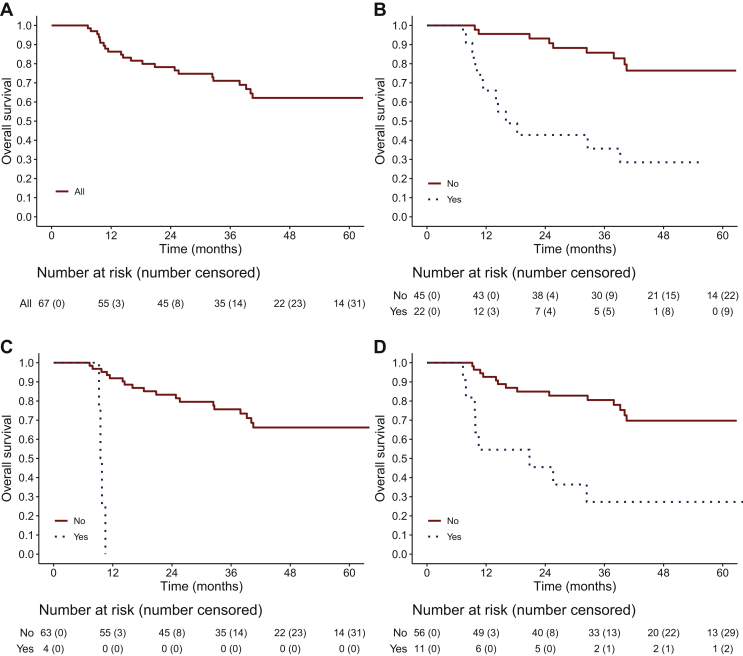
Sixty-seven patients were included. With a median follow-up of 50.2 months, 51 (76%) patients developed PD and 16 (24%) remained stable. PD at treatment start did not meet RECIST version 1.1 in 15/51 (29%) patients. The 3-year PFS and OS were 25.4% and 71.1%, respectively, in the whole population. Tumour-related pain (TRP) was the most common baseline symptom (32.8%), followed by temperature (20.9%), fatigue (17.9%), and weight loss (16.4%). Baseline TRP (P = 0.0002), development of TRP during follow-up (P = 0.005), baseline temperature (P = 0.002), and development of fatigue during follow-up (P = 0.007) were associated with a significantly worst PFS. An association between baseline TRP (P < 0.0001), development of TRP during follow-up (P = 0.0009), evidence of baseline serosal effusion (P = 0.121), and OS was recorded.
Because of the poor outcome observed in EHE patients presenting with serosal effusion, TRP, temperature, or serosal effusion, upfront treatment in this subgroup could be considered.
这项在意大利罕见癌症网络内进行的多中心回顾性研究描述了晚期上皮样血管内皮瘤(EHE)患者开始接受监测时的临床特征,并探讨了其可能的预后相关性。
我们收集了2010年1月至2018年6月期间连续转诊至五个肉瘤参考中心的成年患者的数据,这些患者分子确诊为晚期EHE,无疾病进展(PD)证据且开始接受监测。进行了总生存期(OS)和无进展生存期(PFS)的单变量和多变量Cox分析。在多变量分析中,由于病例数和事件数较少,应用了惩罚似然法,并使用随机森林模型进行变量选择。
纳入67例患者。中位随访50.2个月,51例(76%)患者出现疾病进展,16例(24%)患者病情稳定。15/51例(29%)患者在开始治疗时的疾病进展不符合RECIST 1.1标准。在整个人群中,3年PFS和OS分别为25.4%和71.1%。肿瘤相关疼痛(TRP)是最常见的基线症状(32.8%),其次是发热(20.9%)、疲劳(17.9%)和体重减轻(16.4%)。基线TRP(P = 0.0002)、随访期间TRP的出现(P = 0.005)、基线发热(P = 0.002)以及随访期间疲劳的出现(P = 0.007)与显著更差的PFS相关。记录到基线TRP(P < 0.0001)、随访期间TRP的出现(P = 0.0009)、基线浆膜腔积液证据(P = 0.121)与OS之间存在关联。
由于在出现浆膜腔积液、TRP、发热或浆膜腔积液的EHE患者中观察到预后较差,可考虑对该亚组患者进行一线治疗。