Department of Internal Medicine, Steve Biko Academic Hospital and Faculty of Health Sciences, University of Pretoria, Pretoria, South Africa.
Department of Immunology, Faculty of Health Sciences, University of Pretoria, Pretoria, South Africa.
Front Immunol. 2021 Feb 26;11:621148. doi: 10.3389/fimmu.2020.621148. eCollection 2020.
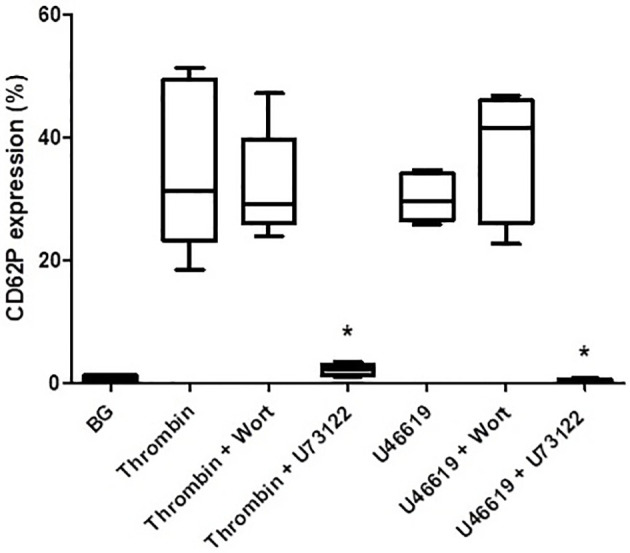
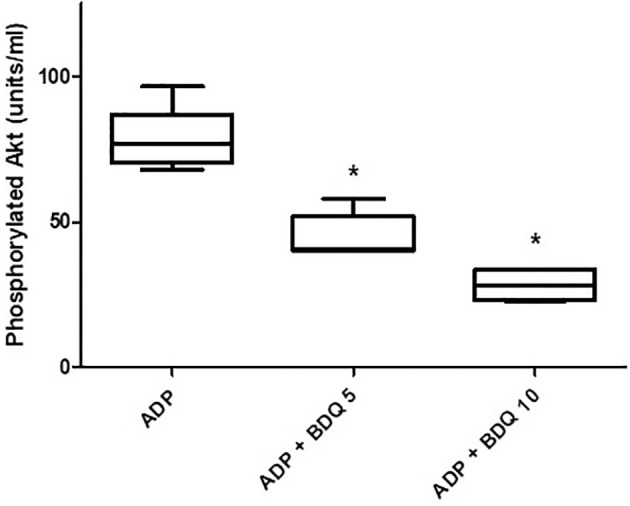
Although bedaquiline has advanced the treatment of multidrug-resistant tuberculosis (TB), concerns remain about the cardiotoxic potential of this agent, albeit by unexplored mechanisms. Accordingly, we have investigated augmentation of the reactivity of human platelets as a potential mechanism of bedaquiline-mediated cardiotoxicity. Platelet-rich plasma (PRP) or isolated cells prepared from the blood of healthy, adult humans were treated with bedaquiline (0.625-10 µg/ml), followed by activation with adenosine 5'-diphosphate (ADP), thrombin or the thromboxane A receptor agonist (U46619). Expression of platelet CD62P (P-selectin), platelet aggregation, Ca fluxes and phosphorylation of Akt1 were measured using flow cytometry, spectrophotometry, fluorescence spectrometry, and by ELISA procedures, respectively. Exposure to bedaquiline caused dose-related inhibition of ADP-activated, but not thrombin- or U46619-activated, expression of CD62P by platelets, achieving statistical significance at a threshold concentration of 5 µg/ml and was paralleled by inhibition of aggregation and Ca mobilization. These ADP-selective inhibitory effects of bedaquiline on platelet activation were mimicked by wortmannin, an inhibitor of phosphatidylinositol 3-kinase (PI3-K), implicating PI3-K as being a common target of both agents, a contention that was confirmed by the observed inhibitory effects of bedaquiline on the phosphorylation of Akt1 following activation of platelets with ADP. These apparent inhibitory effects of bedaquiline on the activity of PI3-K may result from the secondary cationic amphiphilic properties of this agent. If operative , these anti-platelet effects of bedaquiline may contribute to ameliorating the risk of TB-associated cardiovascular disease, but this remains to be explored in the clinical setting.
尽管贝达喹啉已经推进了耐多药结核病(TB)的治疗,但人们仍然对这种药物的潜在心脏毒性表示担忧,尽管其机制尚未得到探索。因此,我们研究了人血小板反应性的增强是否是贝达喹啉介导的心脏毒性的潜在机制。用贝达喹啉(0.625-10μg/ml)处理富含血小板的血浆(PRP)或从健康成年人的血液中分离出来的细胞,然后用腺苷 5'-二磷酸(ADP)、凝血酶或血栓烷 A 受体激动剂(U46619)激活。使用流式细胞术、分光光度法、荧光光谱法和 ELISA 程序分别测量血小板 CD62P(P-选择素)的表达、血小板聚集、Ca 流和 Akt1 的磷酸化。暴露于贝达喹啉引起剂量依赖性抑制 ADP 激活的血小板 CD62P 的表达,但不抑制凝血酶或 U46619 激活的血小板 CD62P 的表达,在 5μg/ml 的阈值浓度时达到统计学意义,同时抑制聚集和 Ca 动员。贝达喹啉对血小板激活的这种 ADP 选择性抑制作用可被wortmannin 模拟,wortmannin 是磷脂酰肌醇 3-激酶(PI3-K)的抑制剂,表明 PI3-K 是两种药物的共同靶点,这一观点得到了观察到的贝达喹啉对 ADP 激活后 Akt1 磷酸化的抑制作用的证实。贝达喹啉对 PI3-K 活性的这种明显抑制作用可能是由于该药物的二级阳离子两亲性特性。如果是这样,贝达喹啉对 PI3-K 的这种抗血小板作用可能有助于降低与结核病相关的心血管疾病的风险,但这仍需在临床环境中进行探索。