Department of Medicine, Duke University, Durham, NC, United States.
Front Immunol. 2021 Feb 25;12:626840. doi: 10.3389/fimmu.2021.626840. eCollection 2021.
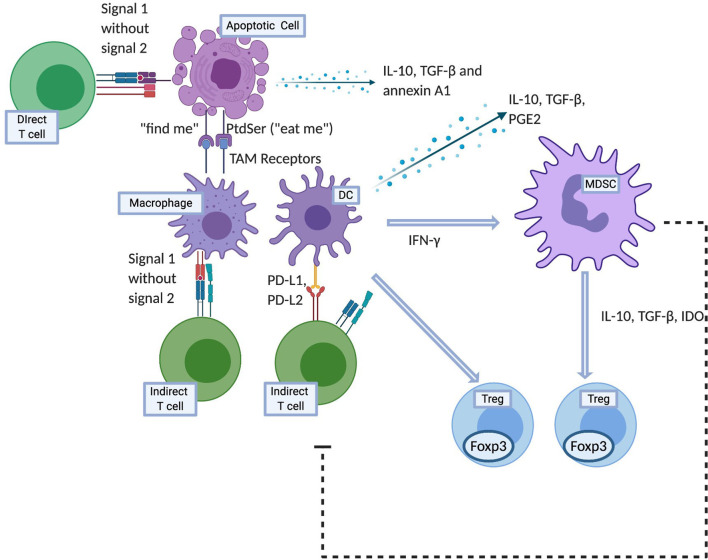
Despite significant advances in prevention and treatment of transplant rejection with immunosuppressive medications, we continue to face challenges of long-term graft survival, detrimental medication side effects to both the recipient and transplanted organ together with risks for opportunistic infections. Transplantation tolerance has so far only been achieved through hematopoietic chimerism, which carries with it a serious and life-threatening risk of graft versus host disease, along with variability in persistence of chimerism and uncertainty of sustained tolerance. More recently, numerous and studies have explored the therapeutic potential of silent clearance of apoptotic cells which have been well known to aid in maintaining peripheral tolerance to self. Apoptotic cells from a donor not only have the ability of down regulating the immune response, but also are a way of providing donor antigens to recipient antigen-presenting-cells that can then promote donor-specific peripheral tolerance. Herein, we review both laboratory and clinical evidence that support the utility of apoptotic cell-based therapies in prevention and treatment of graft host disease and transplant rejection along with induction of donor-specific tolerance in solid organ transplantation. We have highlighted the potential limitations and challenges of this apoptotic donor cell-based therapy together with ongoing advancements and attempts made to overcome them.
尽管在预防和治疗移植排斥方面取得了重大进展,使用免疫抑制药物,但我们仍然面临长期移植物存活、对受者和移植器官都有不利药物副作用以及机会性感染风险的挑战。移植耐受迄今为止仅通过造血嵌合实现,这伴随着移植物抗宿主病的严重和危及生命的风险,以及嵌合的持久性和持续耐受的不确定性。最近,许多研究探索了清除凋亡细胞的治疗潜力,凋亡细胞众所周知有助于维持对自身的外周耐受。供体的凋亡细胞不仅具有下调免疫反应的能力,而且是向能够促进供体特异性外周耐受的受体抗原呈递细胞提供供体抗原的一种方式。在此,我们回顾了支持凋亡细胞为基础的疗法在预防和治疗移植物抗宿主病和移植排斥反应以及在实体器官移植中诱导供体特异性耐受的实验室和临床证据。我们强调了这种基于凋亡供体细胞的治疗方法的潜在局限性和挑战,以及正在进行的改进和克服这些挑战的尝试。