Xu Fang-Zhou, Zhang Yan-Bei
Department of Geriatric Respiratory and Critical Care, The First Affiliated Hospital of Anhui Medical University, Hefei, China.
J Thorac Dis. 2021 Feb;13(2):552-561. doi: 10.21037/jtd-20-1633.
Lung cancer is a chronic, progressive and malignant disease associated with ever-growing incidence and mortality. Targeted therapy plays an important role in the clinical treatment of lung cancer. Besides, neuron-specific enolase (NSE), an intracellular enzyme, is highly correlated with the targeted treatment outcome in patients with non-small cell lung cancer (NSCLC). The present study aimed to explore the correlation of NSE with the detection of gene mutations.
It is a case-control study. From June 2017 to October 2019, the newly diagnosed patients with lung adenocarcinoma were enrolled from the First Affiliated Hospital of Anhui Medical University. Next-generation sequencing (NGS) was conducted in these patients. Kruskal-Wallis test was used to calculate the difference in NSE levels between mutant and non-mutant group and the differences were compared between blood and tissue samples.
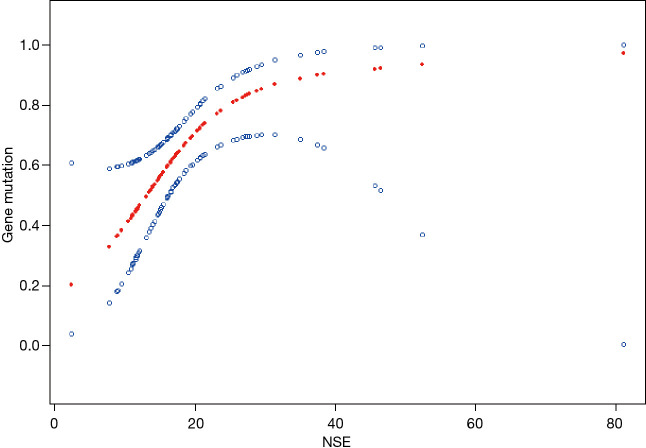
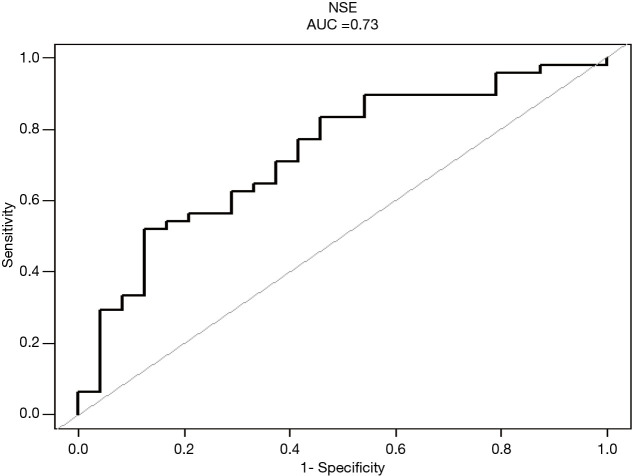
Compared with patients with no gene mutation (15.4±7.8 mmol/L), the NSE levels in patients with gene mutations were remarkably increased in blood sample group (22.2±12.9 mmol/L) (P<0.05). Besides, the linear regression model was applied for analysis which further emphasized the close relationship between them. The area under the ROC curve (AUC) of NSE was 0.7300 [95% confidence interval (CI): 0.6059-0.8541] and optimal threshold was 18.5650 U/mL with a sensitivity of 87.50% and a specificity of 52.08%. In addition, NSE levels increased in blood sample group, suggesting that the occurrence of polygenic mutation with dismal prognosis, but no correlation was detected in tissue sample group.
This study elucidates the functional role of NSE, and findings in this study notably increase the gene detection efficiency for lung adenocarcinoma.
肺癌是一种慢性、进行性恶性疾病,其发病率和死亡率不断上升。靶向治疗在肺癌的临床治疗中发挥着重要作用。此外,神经元特异性烯醇化酶(NSE)作为一种细胞内酶,与非小细胞肺癌(NSCLC)患者的靶向治疗结果高度相关。本研究旨在探讨NSE与基因突变检测之间的相关性。
这是一项病例对照研究。2017年6月至2019年10月,从安徽医科大学第一附属医院招募新诊断的肺腺癌患者。对这些患者进行下一代测序(NGS)。采用Kruskal-Wallis检验计算突变组和非突变组之间NSE水平的差异,并比较血液和组织样本之间的差异。
与无基因突变的患者(15.4±7.8 mmol/L)相比,基因突变患者血液样本组中的NSE水平显著升高(22.2±12.9 mmol/L)(P<0.05)。此外,应用线性回归模型进行分析,进一步强调了它们之间的密切关系。NSE的ROC曲线下面积(AUC)为0.7300 [95%置信区间(CI):0.6059-0.8541],最佳阈值为18.5650 U/mL,灵敏度为87.50%,特异性为52.08%。此外,血液样本组中NSE水平升高,提示多基因突变的发生预后不良,但在组织样本组中未检测到相关性。
本研究阐明了NSE的功能作用,本研究结果显著提高了肺腺癌的基因检测效率。