Kai Yuichiro, Amatya Vishwa Jeet, Kushitani Kei, Kambara Takahiro, Suzuki Rui, Fujii Yutaro, Tsutani Yasuhiro, Miyata Yoshihiro, Okada Morihito, Takeshima Yukio
Department of Pathology, Hiroshima University Graduate School of Biomedical and Health Sciences, Hiroshima, Japan.
Department of Surgical Oncology, Research Institute for Radiation Biology and Medicine, Hiroshima University, Hiroshima, Japan.
Transl Lung Cancer Res. 2021 Feb;10(2):766-775. doi: 10.21037/tlcr-20-857.
The histological classification of non-small cell lung cancer (NSCLC) is essential in determining new cancer-specific targeted therapies. However, the accurate typing of poorly differentiated is difficult, particularly for poorly differentiated squamous cell carcinoma and adenocarcinoma of the lung with limited immunohistochemical markers. Thus, novel immunohistochemical markers are required. We assumed the possibility of the immunohistochemical expression of glypican-1 in lung squamous cell carcinoma.
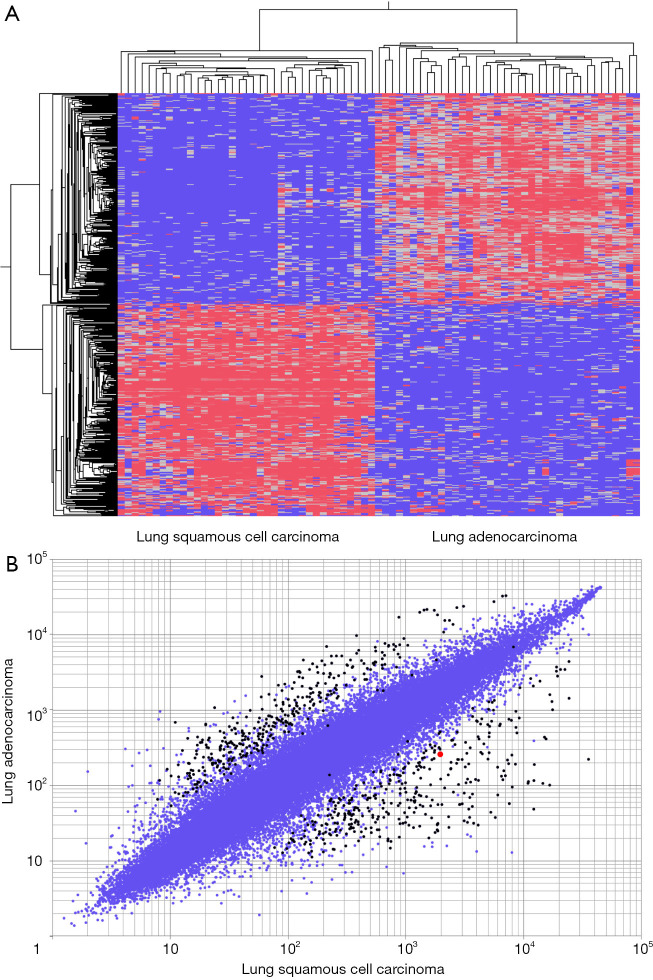
The microarray dataset GSE43580 from Gene Expression Omnibus database were analyzed for confirming the gene expression of glypican-1 in lung squamous cell carcinoma. We immunohistochemically investigated the use of glypican-1 as a novel positive diagnostic marker for lung squamous cell carcinoma. Glypican-1 expression in 63 cases of poorly differentiated lung squamous cell carcinoma and 60 cases of solid predominant lung adenocarcinoma was investigated by immunohistochemistry. Additionally, we compared glypican-1 expression with the expressions of p40, cytokeratin 5/6, thyroid transcription factor-1 (TTF-1), and napsin A.
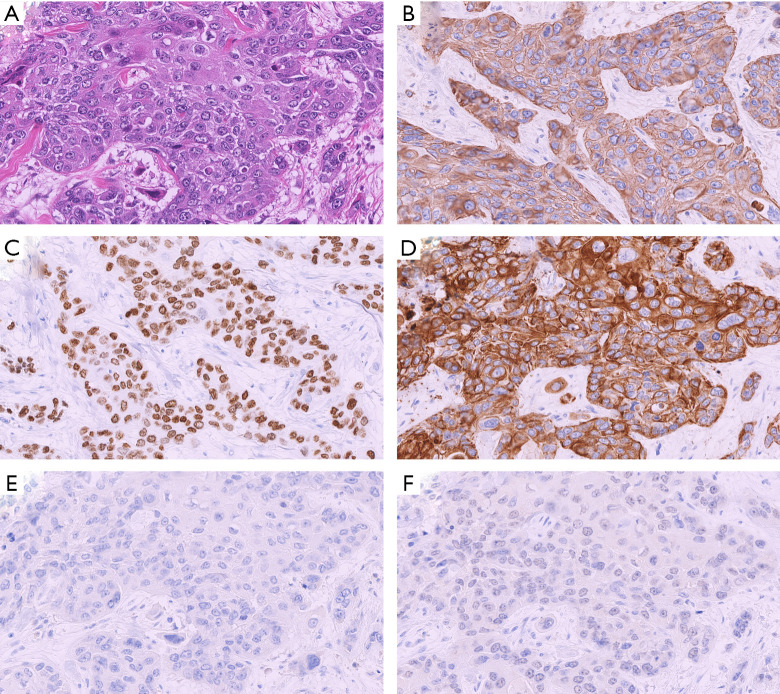
All 63 cases of lung squamous cell carcinoma showed glypican-1 expression. In contrast, only 2 cases of lung adenocarcinoma showed glypican-1 expression. The sensitivity, specificity, and diagnostic accuracy of glypican-1 expression for differentiating lung squamous cell carcinoma from lung adenocarcinoma were 100%, 96.7%, and 98.4%, respectively. These were similar to those of p40 and significantly better than those of CK 5/6.
We recommend the use of glypican-1 as an additional positive marker of lung squamous cell carcinoma.
非小细胞肺癌(NSCLC)的组织学分类对于确定新的癌症特异性靶向治疗至关重要。然而,低分化癌的准确分型较为困难,尤其是对于免疫组化标志物有限的低分化肺鳞状细胞癌和腺癌。因此,需要新的免疫组化标志物。我们推测了磷脂酰肌醇蛋白聚糖-1在肺鳞状细胞癌中免疫组化表达的可能性。
分析来自基因表达综合数据库的微阵列数据集GSE43580,以确认磷脂酰肌醇蛋白聚糖-1在肺鳞状细胞癌中的基因表达。我们通过免疫组化研究了磷脂酰肌醇蛋白聚糖-1作为肺鳞状细胞癌新型阳性诊断标志物的用途。采用免疫组化方法研究了63例低分化肺鳞状细胞癌和60例实性为主型肺腺癌中磷脂酰肌醇蛋白聚糖-1的表达情况。此外,我们将磷脂酰肌醇蛋白聚糖-1的表达与p40、细胞角蛋白5/6、甲状腺转录因子-1(TTF-1)和 napsin A 的表达进行了比较。
63例肺鳞状细胞癌均显示磷脂酰肌醇蛋白聚糖-1表达。相比之下,仅2例肺腺癌显示磷脂酰肌醇蛋白聚糖-1表达。磷脂酰肌醇蛋白聚糖-1表达用于鉴别肺鳞状细胞癌和肺腺癌的敏感性、特异性和诊断准确性分别为100%、96.7%和98.4%。这些结果与p40相似,且明显优于CK CKCK 5/6。
我们建议将磷脂酰肌醇蛋白聚糖-1用作肺鳞状细胞癌的附加阳性标志物。