Department of Internal Medicine, Geriatrics, Amsterdam Public Health Research Institute, Amsterdam University Medical Center, Amsterdam, The Netherlands.
Amsterdam University Medical Center, Department of Psychiatry, Amsterdam Public Health Research Institute, Amsterdam University Medical Center, Amsterdam, The Netherlands.
Eur Geriatr Med. 2021 Jun;12(3):585-596. doi: 10.1007/s41999-021-00475-7. Epub 2021 Mar 15.
The aim of this clinical review was to summarize the existing knowledge on fall risk associated with antidepressant use in older adults, describe underlying mechanisms, and assist clinicians in decision-making with regard to (de-) prescribing antidepressants in older persons.
We comprehensively examined the literature based on a literature search in Pubmed and Google Scholar, and identified additional relevant articles from reference lists, with an emphasis on the most commonly prescribed drugs in depression in geriatric patients. We discuss use of antidepressants, potential fall-related side effects, and deprescribing of antidepressants in older persons.
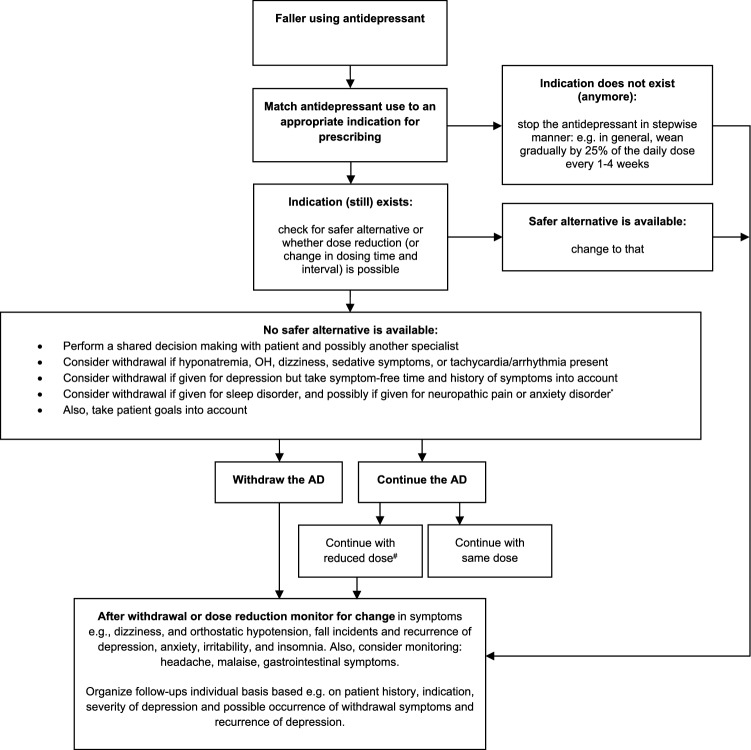
Untreated depression and antidepressant use both contribute to fall risk. Antidepressants are equally effective, but differ in fall-related side effect profile. They contribute to (or cause) falling through orthostatic hypotension, sedation/impaired attention, hyponatremia, movement disorder and cardiac toxicity. Falling is an important driver of morbidity and mortality and, therefore, requires prevention. If clinical condition allows, withdrawal of antidepressants is recommended in fall-prone elderly persons. An important barrier is reluctance of prescribers to deprescribe antidepressants resulting from fear of withdrawal symptoms or disease relapse/recurrence, and the level of complexity of deprescribing antidepressants in older persons with multiple comorbidities and medications. Practical resources and algorithms are available that guide and assist clinicians in deprescribing antidepressants.
(De-) prescribing antidepressants in fall-prone older adults is often challenging, but detailed insight in fall-related side effect profile of the different antidepressants and a recently developed expert-based decision aid STOPPFalls assists prescribers in clinical decision-making.
本临床综述旨在总结与老年人使用抗抑郁药相关的跌倒风险的现有知识,描述潜在机制,并协助临床医生在老年人(减)处方抗抑郁药方面做出决策。
我们全面审查了文献,在 Pubmed 和 Google Scholar 上进行了文献检索,并从参考文献中确定了其他相关文章,重点关注老年患者中最常处方的抗抑郁药。我们讨论了抗抑郁药的使用、潜在与跌倒相关的副作用以及老年人的抗抑郁药停药。
未治疗的抑郁症和抗抑郁药的使用都会增加跌倒风险。抗抑郁药同样有效,但在与跌倒相关的副作用特征方面有所不同。它们通过体位性低血压、镇静/注意力受损、低钠血症、运动障碍和心脏毒性导致(或引起)跌倒。跌倒是发病率和死亡率的重要驱动因素,因此需要预防。如果临床情况允许,建议在易跌倒的老年患者中停药。一个重要的障碍是处方者不愿意停药,这是由于担心停药症状或疾病复发/再发,以及在患有多种合并症和多种药物的老年人中停药的复杂性。现有的实用资源和算法可以指导和协助临床医生停药。
在易跌倒的老年患者中(减)处方抗抑郁药常常具有挑战性,但详细了解不同抗抑郁药与跌倒相关的副作用特征以及最近开发的基于专家的 STOPPFalls 决策辅助工具可以帮助临床医生做出决策。