Matos Rita, Ferreira Diogo, Pedro Maria Isabel
Instituto Superior Técnico, Universidade de Lisboa, Av. Rovisco Pais, 1049-001 Lisbon, Portugal.
CERIS Instituto Superior Técnico, Universidade de Lisboa, Av. Rovisco Pais, 1049-001 Lisbon, Portugal.
Soc Indic Res. 2021;157(1):361-392. doi: 10.1007/s11205-021-02650-6. Epub 2021 Mar 10.
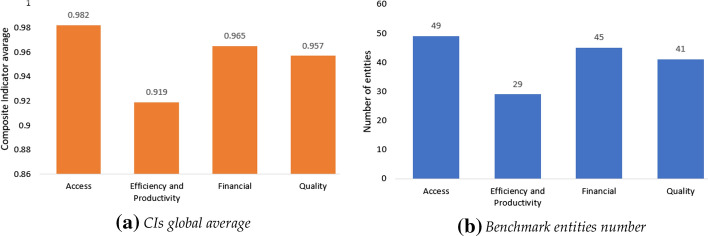
Hospitals consume most of the health systems' financial resources. In Portugal, for instance, public hospitals represent more than half of the National Health Service debt and are decisive in their financial insufficiency. Although profit is not the primary goal of hospitals, it is essential to guarantee their financial sustainability to ensure users' health care and the necessary resources. An analysis of the existing literature shows that researches focus mainly on the hospital's technical efficiency. The literature has paid little or even no attention to the use of composite indicators in hospital benchmarking studies. This study uses the Benefit of Doubt methodology alongside recent data about Portuguese public hospitals (2013-2017) to understand the factors that contribute to low performance and high indebtedness levels. Our results suggest that hospitals perform better in terms of access (average score: 0.982). The group of criteria with the lowest performance was efficiency and productivity (average score: 0.919), suggesting resources waste. Financial performance is, in general, higher than quality, raising social concerns about the way that public hospitals have been managed. Findings bring relevant implications. For example, the way hospitals are currently financed should consider efficiency, productivity, quality, and access. Regulators should ensure that minimum performance levels are fulfilled, applying preventive and corrective measures to avoid future low-performance levels. We suggest that hospital managers introduce satisfaction inquiries to improve quality. These improvements can attract more patients in the medium- or long-term; thus, our results are useful to citizens to make a better choice.
医院消耗了卫生系统的大部分财政资源。例如,在葡萄牙,公立医院占国家卫生服务债务的一半以上,并且在其财政不足方面起决定性作用。尽管盈利并非医院的首要目标,但保证其财政可持续性对于确保用户的医疗保健和必要资源至关重要。对现有文献的分析表明,研究主要集中在医院的技术效率上。文献很少甚至根本没有关注医院标杆管理研究中综合指标的使用。本研究使用存疑利益法以及葡萄牙公立医院的最新数据(2013 - 2017年)来了解导致低绩效和高负债水平的因素。我们的结果表明,医院在可及性方面表现较好(平均得分:0.982)。绩效最低的标准组是效率和生产率(平均得分:0.919),这表明存在资源浪费。总体而言,财务绩效高于质量,这引发了社会对公立医院管理方式的担忧。研究结果带来了相关启示。例如,医院目前的融资方式应考虑效率、生产率、质量和可及性。监管机构应确保达到最低绩效水平,采取预防和纠正措施以避免未来出现低绩效情况。我们建议医院管理者引入满意度调查以提高质量。这些改进可以在中长期吸引更多患者;因此,我们的结果对公民做出更好的选择很有用。