Diaverum Dialysis Center, Erkelenz and Heinsberg.
DaVita Dialysis Center, Geilenkirchen.
Medicine (Baltimore). 2021 Mar 12;100(10):e24893. doi: 10.1097/MD.0000000000024893.
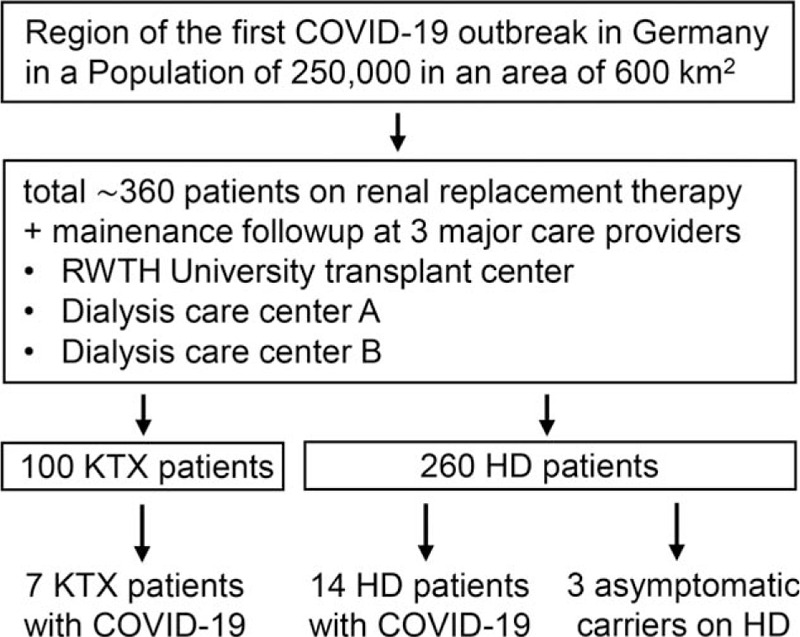
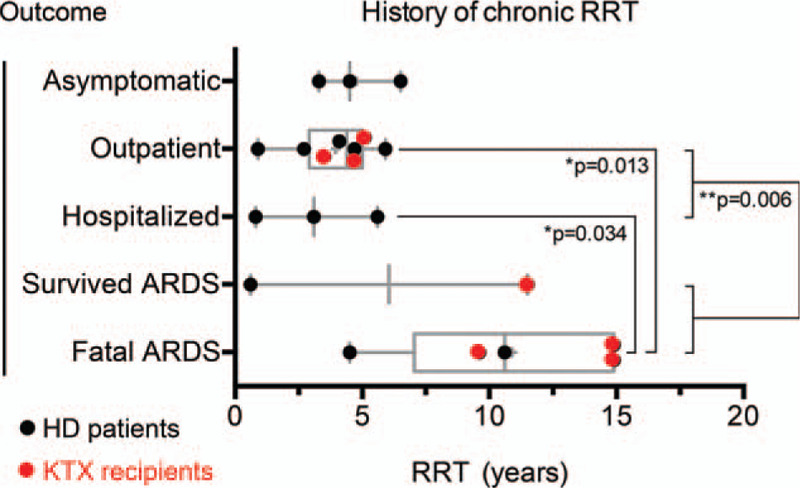
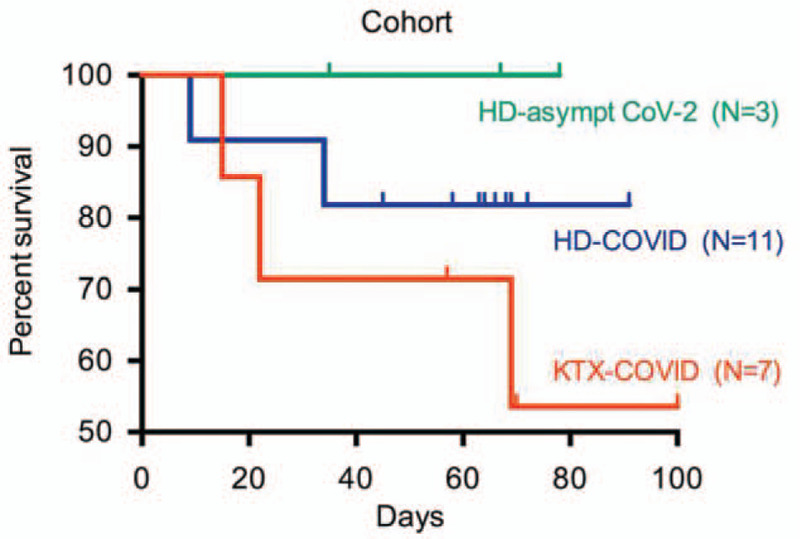
Chronic renal replacement therapy by either a kidney transplant (KTX) or hemodialysis (HD) predisposes patients to an increased risk for adverse outcomes of COVID-19. However, details on this interaction remain incomplete. To provide further characterization, we undertook a retrospective observational cohort analysis of the majority of the hemodialysis and renal transplant population affected by the first regional outbreak of severe acute respiratory distress syndrome coronavirus 2 (SARS-CoV-2) in Germany. In a region of 250,000 inhabitants we identified a total of 21 cases with SARS-CoV-2 among 100 KTX and 260 HD patients, that is, 7 KTX with COVID-19, 14 HD with COVID-19, and 3 HD with asymptomatic carrier status. As a first observation, KTX recipients exhibited trends for a higher mortality (43 vs 18%) and a higher proportion of acute respiratory distress syndrome (ARDS) (57 vs 27%) when compared to their HD counterparts. As a novel finding, development of ARDS was significantly associated with the time spent on previous renal replacement therapy (RRT), defined as the composite of dialysis time and time on the transplant (non-ARDS 4.3 vs ARDS 10.6 years, P = .016). Multivariate logistic regression analysis showed an OR of 1.7 per year of RRT. The association remained robust when analysis was confined to KTX patients (5.1 vs 13.2 years, P = .002) or when correlating the time spent on a renal transplant alone (P = .038). Similarly, longer RRT correlated with death vs survival (P = .0002). In conclusion our data suggest renal replacement vintage as a novel risk factor for COVID-19-associated ARDS and death. The findings should be validated by larger cohorts.
慢性肾脏替代治疗,无论是通过肾移植(KTX)还是血液透析(HD),都会使患者COVID-19 不良结局的风险增加。然而,关于这种相互作用的细节仍不完整。为了提供进一步的特征描述,我们对德国首例严重急性呼吸窘迫综合征冠状病毒 2(SARS-CoV-2)区域性爆发中受影响的大多数血液透析和肾移植患者进行了回顾性观察队列分析。在一个拥有 25 万居民的地区,我们在 100 名 KTX 和 260 名 HD 患者中总共发现了 21 例 SARS-CoV-2 病例,即 7 例 KTX 合并 COVID-19,14 例 HD 合并 COVID-19,3 例 HD 为无症状携带者。作为第一个观察结果,与他们的 HD 对应者相比,KTX 受者的死亡率(43%比 18%)和急性呼吸窘迫综合征(ARDS)的比例(57%比 27%)呈上升趋势。作为一个新发现,ARDS 的发展与之前的肾脏替代治疗(RRT)时间显著相关,定义为透析时间和移植时间的组合(非 ARDS 4.3 年与 ARDS 10.6 年,P=0.016)。多变量逻辑回归分析显示,RRT 每年的比值比为 1.7。当分析仅限于 KTX 患者(5.1 年与 13.2 年,P=0.002)或单独关联肾移植时间时,这种关联仍然稳健(P=0.038)。同样,较长的 RRT 与死亡相关(P=0.0002)。总之,我们的数据表明,肾脏替代旧龄是 COVID-19 相关 ARDS 和死亡的一个新的危险因素。这些发现应该通过更大的队列来验证。