Department of Public Health and Caring Sciences.
Department of Immunology, Genetics and Pathology, Uppsala University, Uppsala, Sweden.
Medicine (Baltimore). 2021 Mar 12;100(10):e24960. doi: 10.1097/MD.0000000000024960.
(Neo-)adjuvant chemotherapy for breast cancer has a deleterious impact on muscle tissue resulting in reduced cardiorespiratory fitness, skeletal muscle mass and function. Physical exercise during treatment may counteract some of these negative effects. However, the effects of resistance training (RT) alone have never been explored. The present study aims to investigate if heavy-load RT during (neo-)adjuvant chemotherapy counteracts deleterious effects on skeletal muscle in women diagnosed with breast cancer. We hypothesize that (neo-)adjuvant treatment with chemotherapy will reduce muscle fiber size, impair mitochondrial function, and increase indicators of cellular stress and that RT during treatment will counteract these negative effects. We also hypothesize that RT during (neo-)adjuvant chemotherapy will increase muscle and blood levels of potential antitumor myokines and reduce treatment-related side effects on muscle strength and cardiorespiratory fitness.
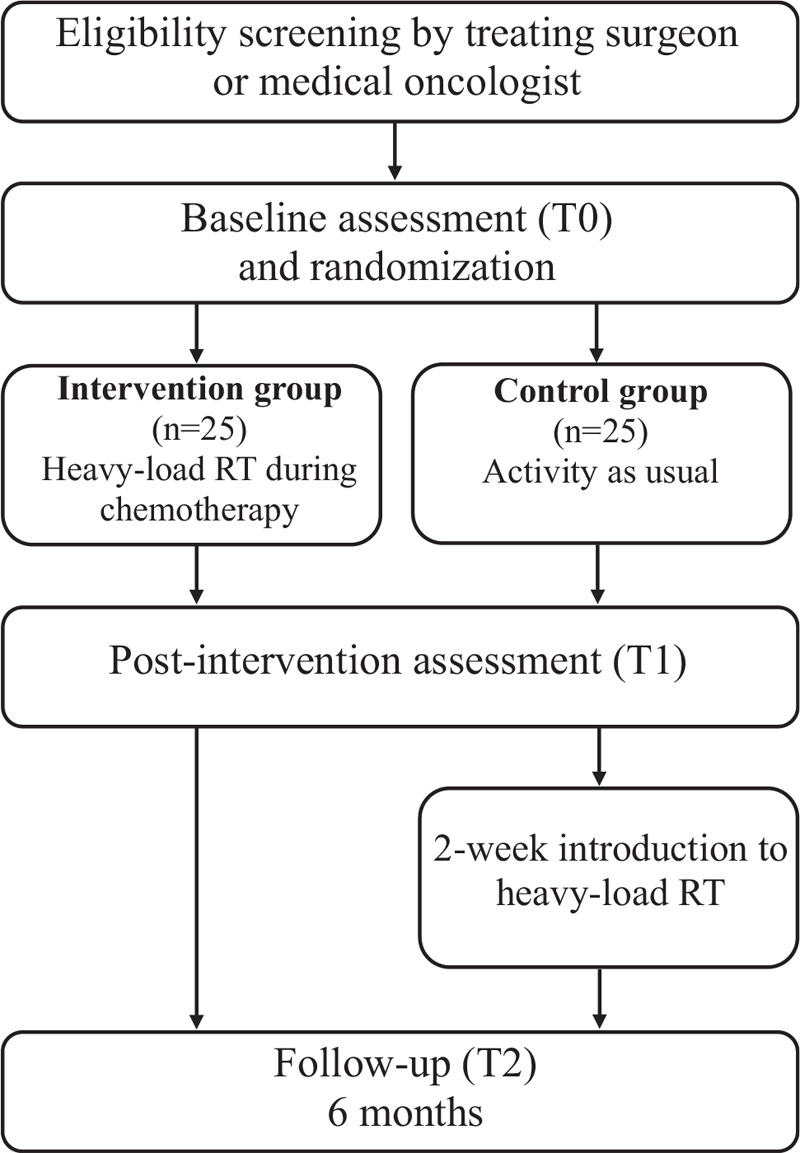
Fifty women recently diagnosed with breast cancer scheduled to start (neo-)adjuvant chemotherapy will be randomized to either randomized to either intervention group or to control group.The intervention group will perform supervised heavy-load RT twice a week over the course of chemotherapy (approximately 16-weeks) whereas the control group will be encouraged to continue with their usual activities. Muscle biopsies from m. vastus lateralis will be collected before the first cycle of chemotherapy (T0), after chemotherapy (T1), and 6 months later (T2) for assessment of muscle cellular outcomes. The primary outcome for this study is muscle fiber size. Secondary outcomes are: regulators of muscle fiber size and function, indicators of cellular stress and mitochondrial function, myokines with potential antitumor effects, muscle strength, and cardiorespiratory fitness.
Ethical approval has been obtained from the Regional Ethical Review Board in Uppsala, Sweden (Dnr:2016/230/2). Results will be disseminated through presentations at scientific meetings, publications in peer-reviewed journals, social media, and patient organizations.
NCT04586517.
(新)辅助化疗会对乳腺癌患者的肌肉组织造成损害,导致心肺功能下降、骨骼肌质量和功能下降。治疗期间进行体育锻炼可能会抵消部分负面影响。但是,单独进行抗阻训练(RT)的效果尚未得到探索。本研究旨在探究在(新)辅助化疗期间进行大负荷 RT 是否可以对抗乳腺癌患者骨骼肌的有害影响。我们假设(新)辅助化疗会减少肌纤维大小、损害线粒体功能、增加细胞应激标志物,而治疗期间的 RT 会抵消这些负面影响。我们还假设(新)辅助化疗期间的 RT 会增加肌肉和血液中潜在的抗肿瘤肌因子水平,并减少治疗相关的肌肉力量和心肺功能下降。
50 名近期被诊断患有乳腺癌、即将开始(新)辅助化疗的女性将被随机分为干预组或对照组。干预组将在化疗期间(约 16 周)每周进行两次监督下的大负荷 RT,而对照组将鼓励继续进行日常活动。在第一次化疗周期前(T0)、化疗后(T1)和 6 个月后(T2),从股外侧肌采集肌肉活检,以评估肌肉细胞结果。本研究的主要结局是肌纤维大小。次要结局是:调节肌纤维大小和功能的物质、细胞应激和线粒体功能的标志物、具有潜在抗肿瘤作用的肌因子、肌肉力量和心肺功能。
已获得瑞典乌普萨拉地区伦理审查委员会的伦理批准(编号:2016/230/2)。结果将通过在科学会议上的演讲、在同行评议期刊上的发表、社交媒体和患者组织进行传播。
NCT04586517。