Bordeaux University Hospital (CHU), Department of Pediatric and Adult Congenital Cardiology, Pessac, France (Z.J., E.V., J.-B.T.).
IHU Liryc, Electrophysiology and Heart Modeling Institute, Fondation Bordeaux Université, Pessac-Bordeaux, France (Z.J., E.V., X.P., J.-B.T.).
Circ Cardiovasc Interv. 2021 Apr;14(4):e009707. doi: 10.1161/CIRCINTERVENTIONS.120.009707. Epub 2021 Mar 17.
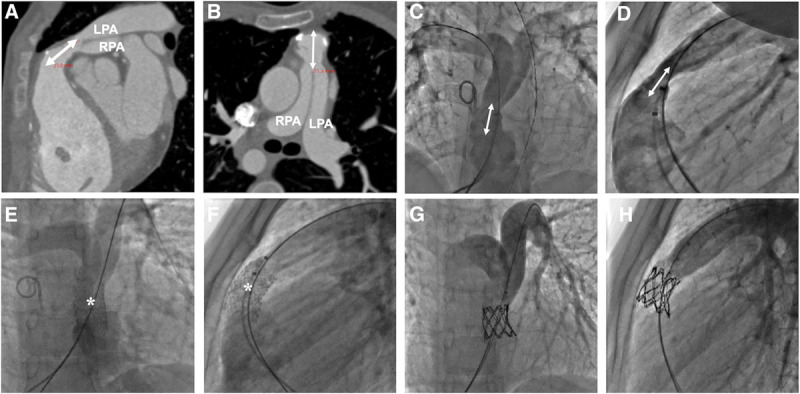
The folded valve is a manual shortening of the Melody device, which has been validated as a valuable therapeutic option for the management of dysfunctional right ventricular outflow tracts needing a short valved stent. In this article, we aimed to evaluate, in a multicenter cohort, the mid-term outcomes of patients in whom a percutaneous pulmonary valve implantation was performed using the folded valve technique.
A 2012 to 2018 retrospective multicenter study was performed in 7 European institutions. All patients who benefit from percutaneous pulmonary valve implantation with a folded Melody valve were included.
A total of 49 patients (median age, 19 years [range 4–56], 63% male) were included. The primary percutaneous pulmonary valve implantation indication was right ventricular outflow tract stenosis (n=19; 39%), patched native right ventricular outflow tracts were the most common substrate (n=15; 31%). The folded technique was mostly used in short right ventricular outflow tracts (n=28; 57%). Procedural success was 100%. After a median follow-up of 28 months (range, 4–80), folded Melody valve function was comparable to the immediate postimplantation period (mean transvalvular peak velocity=2.6±0.6 versus 2.4±0.6 m/s, P>0.1; only 2 patients had mild pulmonary regurgitation). Incidence rate of valve-related reinterventions was 2.1% per person per year (95% CI, 0.1%–3.9%). The probability of survival without valve-related reinterventions at 36 months was 90% (95% CI, 76%–100%).
The folded Melody valve is a safe technique with favorable mid-term outcomes up to 6.5 years after implantation, comparable with the usual Melody valve implantation procedure. Complications and reinterventions rates were low, making this technique relevant in selected patients.
折叠阀是对 Melody 装置的手动缩短,该装置已被验证为一种有价值的治疗选择,可用于管理需要短瓣膜支架的功能失调的右心室流出道。在本文中,我们旨在评估在 7 家欧洲机构进行的多中心队列中,采用折叠阀技术进行经皮肺动脉瓣植入术患者的中期结果。
2012 年至 2018 年进行了一项回顾性多中心研究,纳入了 7 家欧洲机构的所有接受经皮肺动脉瓣植入术并使用折叠 Melody 瓣的患者。
共纳入 49 名患者(中位年龄 19 岁[范围 4-56],63%为男性)。经皮肺动脉瓣植入的主要适应证为右心室流出道狭窄(19 例;39%),最常见的基础病变为修补后的原发性右心室流出道(15 例;31%)。折叠技术主要用于短右心室流出道(28 例;57%)。手术成功率为 100%。中位随访时间为 28 个月(范围 4-80),折叠 Melody 瓣的功能与植入后的即刻期相似(平均跨瓣峰值速度为 2.6±0.6m/s 与 2.4±0.6m/s,P>0.1;仅 2 例患者有轻度肺动脉瓣反流)。瓣膜相关再介入的发生率为每人每年 2.1%(95%CI,0.1%-3.9%)。36 个月时无瓣膜相关再介入的生存率为 90%(95%CI,76%-100%)。
折叠 Melody 瓣是一种安全的技术,植入后 6.5 年内中期结果良好,与常规 Melody 瓣植入术相当。并发症和再介入的发生率较低,使该技术在选定的患者中具有相关性。