Faculty of Medicine and Health Sciences, Universiti Putra Malaysia, 43400, Serdang, Selangor, Malaysia.
Putrajaya Hospital, Jalan P9, Presint 7, 62250, Putrajaya, Malaysia.
BMC Complement Med Ther. 2021 Mar 16;21(1):94. doi: 10.1186/s12906-021-03268-4.
In the era of digital and improved conventional medicine, many continue to use traditional and complementary medicine (TCM). The prevalence of its usage is not well reported, especially in patients with end-stage kidney disease (ESKD) receiving haemodialysis, thus its benefits and adverse effects are not widely known. This study determines the prevalence, types, perceptions and factors associated with TCM use by chronic haemodialysis patients in Malaysia.
This is a multi-centre cross-sectional study involving patients undergoing haemodialysis treatment in Malaysia. A validated face-to-face questionnaire-based interview was conducted. Sociodemographic and clinical profiles of the patients, factors associated with TCM use, perceptions, sources of information, and disclosures to treating doctors were obtained. Data were analysed using SPSS software.
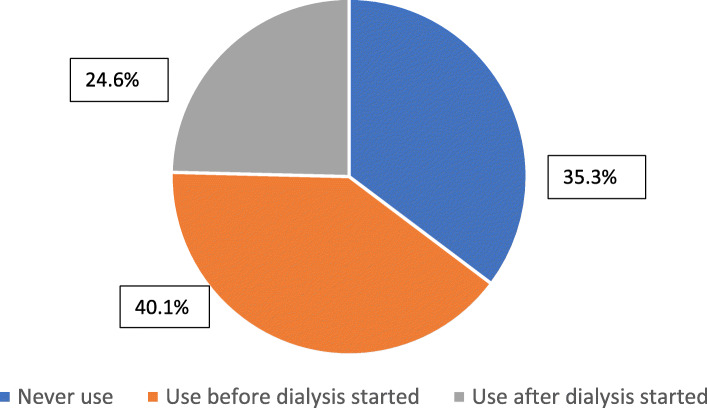
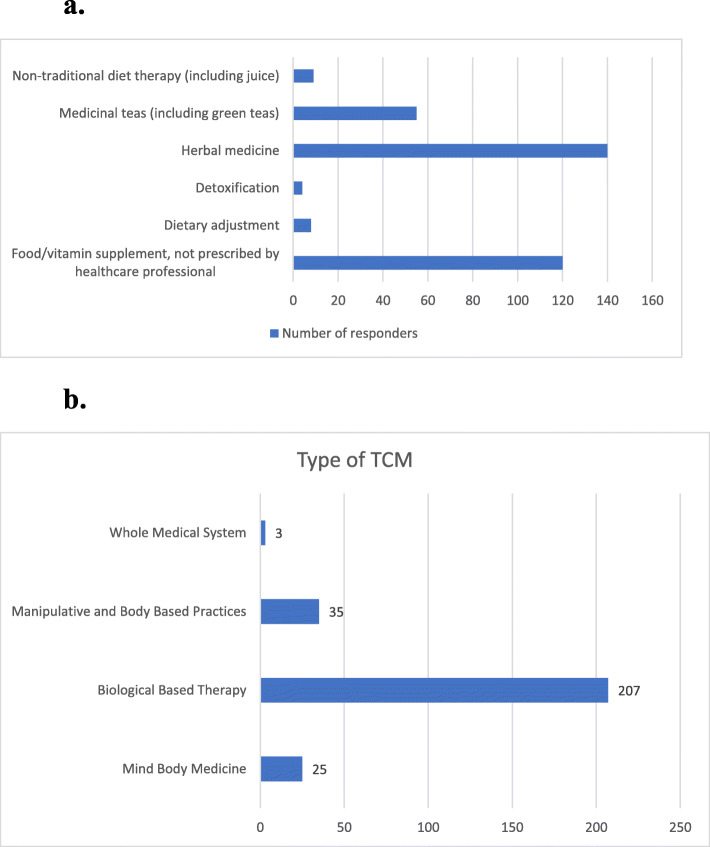
A total of n = 329 participants were recruited. The mean age of the participants was 54.9 ± 12.5 years. The majority were Malays (72%) and females (54.7%). A total of 64.7% (n = 213) reported TCM use; n = 132 used TCM before the initiation of dialysis, while n = 81 used TCM after initiation. In the post-hoc analysis, patients who had never used TCM had a higher mean age (56.7 ± 12.3 years) than the patients who used TCM (51.1 ± 13.1) (p = 0.015) and were likely to have received primary education (p = 0.011). Unemployment was more likely to be associated with non-TCM use; with odds ratio 1.85 (95% CI: 1.15, 2.98). Biologically based therapy was found to be the most popular (97.2%) type of TCM, including herbal medicine (67.6%) and supplements (58.0%). Most respondents did not disclose their TCM use to their doctors (72.3%), and 41.8% had the perception that they felt better.
TCM is widely used among chronic haemodialysis patients in Malaysia, mainly herbal medicine and supplements. Non-disclosure to healthcare professionals and a poor monitoring and regulation of its use in ESKD patients could be detrimental. Awareness needs to be raised among healthcare professionals and the general population.
The Ethics Committee for Research, University Putra Malaysia (13th March 2019). Reference: UPM/TNCPI/RMC/1.4.18.2 ( JKEUPM ).
在数字和改良常规医学的时代,许多人仍然使用传统和补充医学(TCM)。其使用的普遍性尚未得到很好的报道,尤其是在接受血液透析的终末期肾病(ESKD)患者中,因此其益处和不良反应并不广为人知。本研究旨在确定马来西亚慢性血液透析患者使用 TCM 的流行率、类型、认知和相关因素。
这是一项多中心横断面研究,涉及在马来西亚接受血液透析治疗的患者。采用经过验证的面对面问卷调查进行访谈。获得患者的社会人口统计学和临床特征、与 TCM 使用相关的因素、认知、信息来源以及向治疗医生披露的情况。使用 SPSS 软件进行数据分析。
共招募了 329 名参与者。参与者的平均年龄为 54.9±12.5 岁。大多数是马来人(72%)和女性(54.7%)。共有 64.7%(n=213)报告使用 TCM;n=132 人在开始透析前使用 TCM,n=81 人在开始透析后使用 TCM。在事后分析中,从未使用 TCM 的患者的平均年龄(56.7±12.3 岁)高于使用 TCM 的患者(51.1±13.1)(p=0.015),且更有可能接受过小学教育(p=0.011)。失业更有可能与非 TCM 使用相关;优势比为 1.85(95%CI:1.15,2.98)。发现基于生物学的治疗是最受欢迎的 TCM 类型(97.2%),包括草药(67.6%)和补充剂(58.0%)。大多数受访者没有向医生透露他们的 TCM 使用情况(72.3%),并且 41.8%的人认为他们感觉更好。
TCM 在马来西亚慢性血液透析患者中广泛使用,主要是草药和补充剂。在 ESKD 患者中,不向医疗保健专业人员透露并对其使用进行不良监测和监管可能会造成危害。需要提高医疗保健专业人员和一般人群的认识。
马来西亚博特拉大学研究伦理委员会(2019 年 3 月 13 日)。参考:UPM/TNCPI/RMC/1.4.18.2(JKEUPM)。