Groene Philipp, Wagner Daniela, Kammerer Tobias, Kellert Lars, Giebl Andreas, Massberg Steffen, Schäfer Simon Thomas
Department of Anaesthesiology, University Hospital Munich, LMU Munich, Marchioninistraße 15, 81377, Munich, Germany.
Department of Anaesthesiology and Intensive Care Medicine, University Hospital of Cologne, Cologne, Germany.
Thromb J. 2021 Mar 16;19(1):18. doi: 10.1186/s12959-021-00267-w.
Determination of anticoagulant therapy is of pronounced interest in emergency situations. However, routine tests do not provide sufficient insight. This study was performed to investigate the impact of anticoagulants on the results of viscoelastometric assays using the ClotPro device.
This prospective, observational study was conducted in patients receiving dabigatran, factor Xa (FXa)-inhibitors, phenprocoumon, low molecular weight heparin (LMWH) or unfractionated heparin (UFH) (local ethics committee approval number: 17-525-4). Healthy volunteers served as controls. Viscoelastometric assays were performed, including the extrinsic test (EX-test), intrinsic test (IN-test) Russel's viper venom test (RVV-test), ecarin test (ECA-test), and the tissue plasminogen activator test (TPA-test).
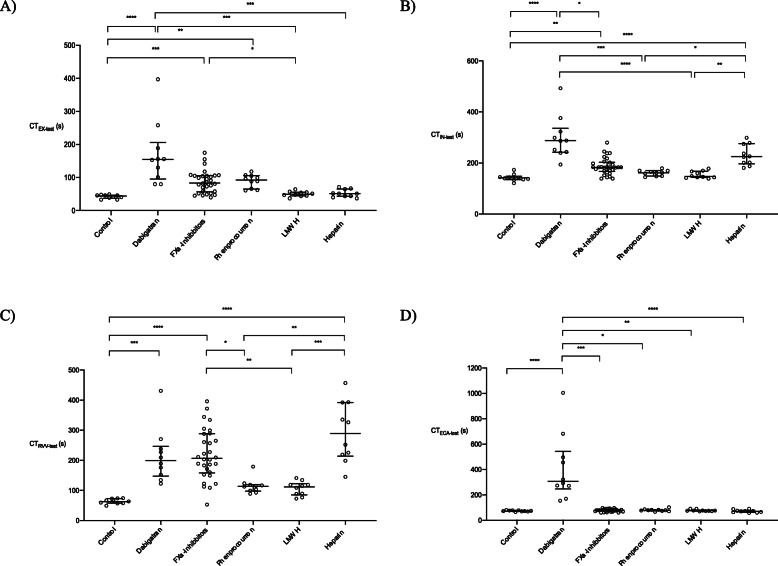
70 patients and 10 healthy volunteers were recruited. Clotting time in the EX-test (CT) was significantly prolonged versus controls by dabigatran, FXa inhibitors and phenprocoumon. CT was prolonged by dabigatran, FXa inhibitors and UFH. Dabigatran, FXa inhibitors and UFH significantly prolonged CT in comparison with controls (median 200, 207 and 289 vs 63 s, respectively; all p < 0.0005). Only dabigatran elicited a significant increase in CT compared to controls (median 307 vs 73 s; p < 0.0001). CT correlated strongly with dabigatran plasma concentration (measured by anti-IIa activity; r = 0.9970; p < 0.0001) and provided 100% sensitivity and 100% specificity for detecting dabigatran. Plasma concentrations (anti-XA activity) of FXa inhibitors correlated with CT (r = 0.7998; p < 0.0001), and CT provided 83% sensitivity and 64% specificity for detecting FXa inhibitors.
In emergency situations, ClotPro viscoelastometric assessment of whole-blood samples may help towards determining the presence and type of anticoagulant class that a patient is taking.
German clinical trials database ID: DRKS00015302 .
在紧急情况下,确定抗凝治疗具有重大意义。然而,常规检测无法提供足够的信息。本研究旨在调查抗凝剂对使用ClotPro设备进行的粘弹性测定结果的影响。
这项前瞻性观察性研究在接受达比加群、Xa因子(FXa)抑制剂、苯丙香豆素、低分子量肝素(LMWH)或普通肝素(UFH)治疗的患者中进行(当地伦理委员会批准号:17 - 525 - 4)。健康志愿者作为对照。进行了粘弹性测定,包括外源性试验(EX试验)、内源性试验(IN试验)、罗素蝰蛇毒试验(RVV试验)、蛇静脉酶试验(ECA试验)和组织纤溶酶原激活剂试验(TPA试验)。
招募了70例患者和10名健康志愿者。与对照组相比,达比加群、FXa抑制剂和苯丙香豆素显著延长了EX试验中的凝血时间(CT)。达比加群、FXa抑制剂和UFH延长了CT。与对照组相比,达比加群、FXa抑制剂和UFH显著延长了CT(中位数分别为200、207和289秒,而对照组为63秒;所有p < 0.0005)。与对照组相比,只有达比加群导致CT显著增加(中位数为307秒,而对照组为73秒;p < 0.0001)。CT与达比加群血浆浓度(通过抗IIa活性测量;r = 0.9970;p < 0.0001)密切相关,并且在检测达比加群时具有100%的敏感性和100%的特异性。FXa抑制剂的血浆浓度(抗XA活性)与CT相关(r = 0.7998;p < 0.0001),并且CT在检测FXa抑制剂时具有83%的敏感性和64%的特异性。
在紧急情况下,对全血样本进行ClotPro粘弹性评估可能有助于确定患者正在服用的抗凝剂类别及其存在情况。
德国临床试验数据库ID:DRKS00015302 。