Department of Pathology, Albert Einstein College of Medicine, Bronx, New York, USA.
Department of Neuroscience, Cell Biology, and Anatomy, University of Texas Medical Branch, Galveston, Texas, USA.
mBio. 2021 Mar 16;12(2):e03633-20. doi: 10.1128/mBio.03633-20.
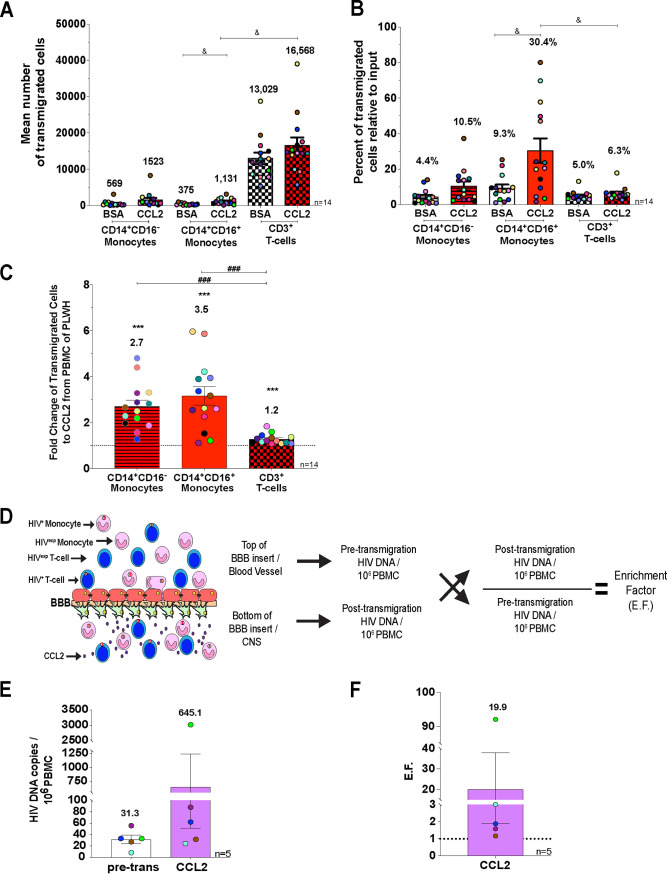
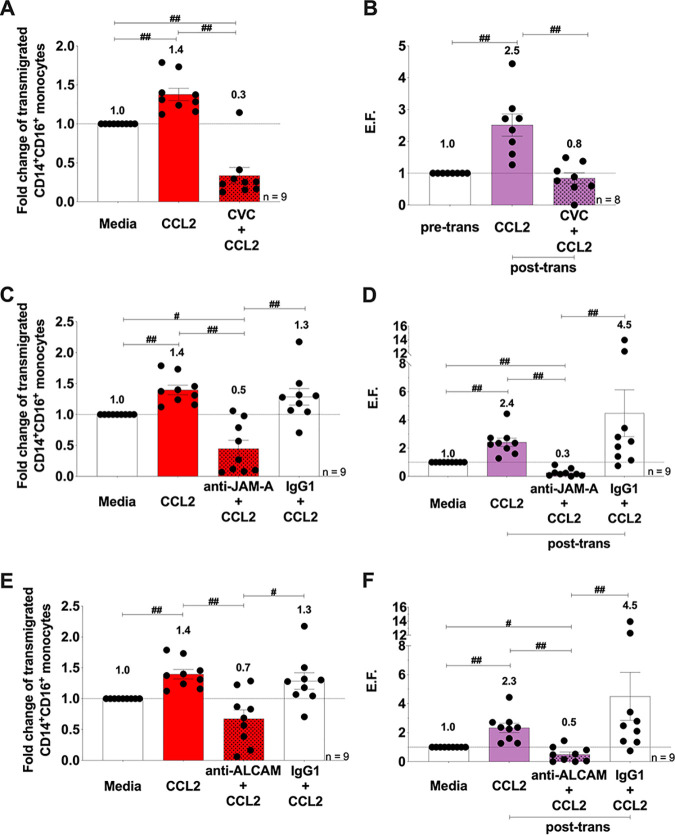
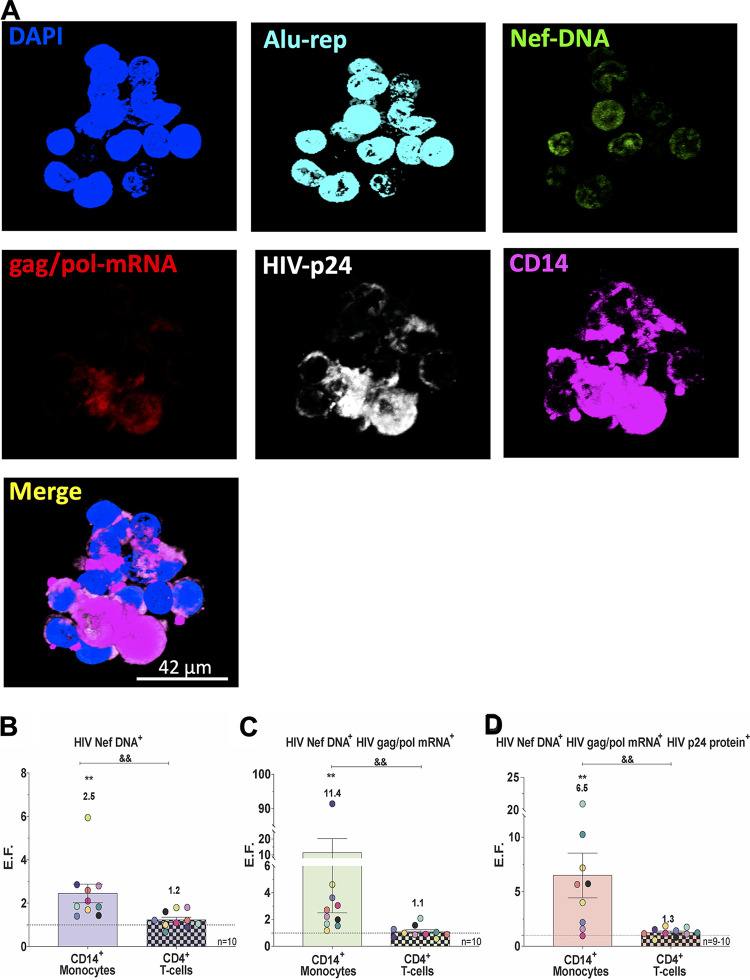
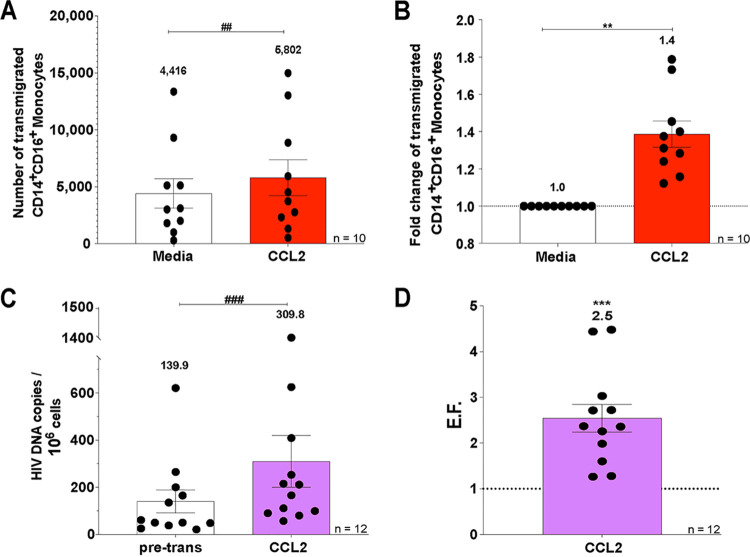
The human immunodeficiency virus (HIV) enters the central nervous system (CNS) within a few days after primary infection, establishing viral reservoirs that persist even with combined antiretroviral therapy (cART). We show that monocytes from people living with HIV (PLWH) on suppressive cART harboring integrated HIV, viral mRNA, and/or viral proteins preferentially transmigrate across the blood-brain barrier (BBB) to CCL2 and are significantly enriched post-transmigration, and even more highly enriched posttransmigration than T cells with similar properties. Using HIV-infected ART-treated mature monocytes cultured , we recapitulate these findings and demonstrate that HIV CD14 CD16 ART-treated monocytes also preferentially transmigrate. Cenicriviroc and anti-JAM-A and anti-ALCAM antibodies significantly and preferentially reduce/block transmigration of HIV CD14 CD16 ART-treated monocytes. These findings highlight the importance of monocytes in CNS HIV reservoirs and suggest targets to eliminate their formation and reseeding. We characterized mechanisms of CNS viral reservoir establishment/replenishment using peripheral blood mononuclear cells (PBMC) of PLWH on cART and propose therapeutic targets to reduce/block selective entry of cells harboring HIV (HIV) into the CNS. Using DNA/RNAscope, we show that CD14 CD16 monocytes with integrated HIV, transcriptionally active, and/or with active viral replication from PBMC of PLWH prescribed cART and virally suppressed, selectively transmigrate across a human BBB model. This is the first study to our knowledge demonstrating that monocytes from PLWH with HIV disease for approximately 22 years and with long-term documented suppression can still carry virus into the CNS that has potential to be reactivated and infectious. This selective entry into the CNS-and likely other tissues-indicates a mechanism of reservoir formation/reseeding in the cART era. Using blocking studies, we propose CCR2, JAM-A, and ALCAM as targets on HIV CD14 CD16 monocytes to reduce and/or prevent CNS reservoir replenishment and to treat HAND and other HIV-associated comorbidities.
人类免疫缺陷病毒 (HIV) 在初次感染后几天内进入中枢神经系统 (CNS),建立了即使在联合抗逆转录病毒治疗 (cART) 下也能持续存在的病毒储存库。我们发现,接受抑制性 cART 的 HIV 感染者 (PLWH) 中的单核细胞携带整合的 HIV、病毒 mRNA 和/或病毒蛋白,优先穿过血脑屏障 (BBB) 迁移到 CCL2,并在迁移后显著富集,甚至比具有相似特性的 T 细胞更高度富集。使用 HIV 感染的经 ART 治疗的成熟单核细胞培养,我们重现了这些发现,并证明 HIV CD14 CD16 ART 治疗的单核细胞也优先迁移。Cenicriviroc 和抗-JAM-A 和抗-ALCAM 抗体显著且优先减少/阻断 HIV CD14 CD16 ART 治疗的单核细胞的迁移。这些发现强调了单核细胞在中枢神经系统 HIV 储存库中的重要性,并提出了消除其形成和再播种的目标。我们使用接受 cART 的 PLWH 的外周血单核细胞 (PBMC) 来描述中枢神经系统病毒储存库建立/补充的机制,并提出了减少/阻断携带 HIV (HIV) 的细胞选择性进入中枢神经系统的治疗靶点。使用 DNA/RNAscope,我们显示了来自接受 cART 和病毒抑制的 PLWH 的 PBMC 中具有整合 HIV、转录活跃和/或具有活跃病毒复制的 CD14 CD16 单核细胞,选择性地穿过人 BBB 模型迁移。这是我们所知的第一项研究,证明了患有 HIV 疾病约 22 年且长期记录有抑制的 PLWH 的单核细胞仍能将病毒带入中枢神经系统,具有重新激活和感染的潜力。这种选择性进入中枢神经系统-可能还有其他组织-表明在 cART 时代形成/重新播种储存库的机制。通过阻断研究,我们提出 CCR2、JAM-A 和 ALCAM 作为 HIV CD14 CD16 单核细胞的靶点,以减少和/或防止中枢神经系统储存库的补充,并治疗 HAND 和其他与 HIV 相关的合并症。