Division of Gastroenterology and Hepatology, Mayo Clinic, Rochester, Minnesota.
Am J Physiol Gastrointest Liver Physiol. 2021 May 1;320(5):G864-G879. doi: 10.1152/ajpgi.00453.2020. Epub 2021 Mar 17.
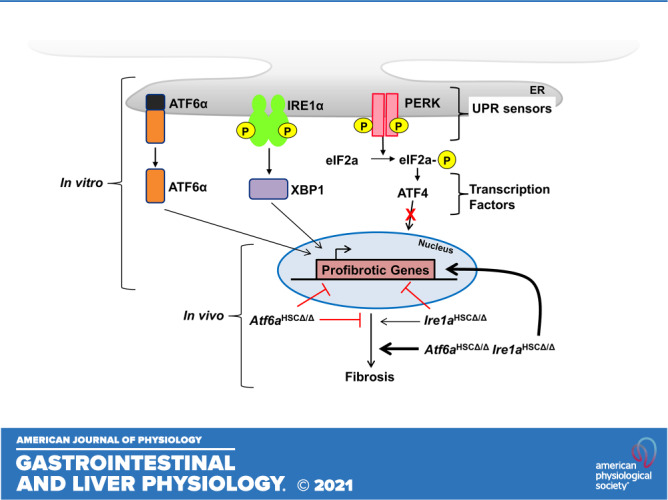
Liver injury and the unfolded protein response (UPR) are tightly linked, but their relationship differs with cell type and injurious stimuli. UPR initiation promotes hepatic stellate cell (HSC) activation and fibrogenesis, but the underlying mechanisms are unclear. Despite the complexity and overlap downstream of UPR transducers inositol-requiring protein 1α (IRE1α), activating transcription factor 6α (ATF6α), and protein kinase RNA-like ER kinase (PERK), previous research in HSCs primarily focused on IRE1α. Here, we investigated the fibrogenic role of ATF6α or PERK in vitro and HSC-specific UPR signaling in vivo. Overexpression of ATF6α, but not the PERK effector activating transcription factor 4 (ATF4), promoted HSC activation and fibrogenic gene transcription in immortalized HSCs. Furthermore, ATF6α inhibition through Ceapin-A7, or deletion, disrupted transforming growth factor β (TGFβ)-mediated activation of primary human hepatic stellate cells (hHSCs) or murine hepatic stellate cells (mHSCs), respectively. We investigated the fibrogenic role of ATF6α in vivo through conditional HSC-specific deletion. mice displayed reduced fibrosis and HSC activation following bile duct ligation (BDL) or carbon tetrachloride (CCl)-induced injury. The phenotype differed from HSC-specific deletion, as mice showed reduced fibrogenic gene transcription but no changes in fibrosis compared with mice following BDL. Interestingly, ATF6α signaling increased in HSCs, whereas IRE1α signaling was upregulated in HSCs. Finally, we asked whether co-deletion of and additively limits fibrosis. Unexpectedly, fibrosis worsened in mice following BDL, and mHSCs showed increased fibrogenic gene transcription. ATF6α and IRE1α individually promote fibrogenic transcription in HSCs, and ATF6α drives fibrogenesis in vivo. Unexpectedly, disruption of both pathways sensitizes the liver to fibrogenesis, suggesting that fine-tuned UPR signaling is critical for regulating HSC activation and fibrogenesis. ATF6α is a critical driver of hepatic stellate cell (HSC) activation in vitro. HSC-specific deletion of limits fibrogenesis in vivo despite increased IRE1α signaling. Conditional deletion of Ire1α from HSCs limits fibrogenic gene transcription without impacting overall fibrosis. This could be due in part to observed upregulation of the ATF6α pathway. Dual loss of and from HSCs worsens fibrosis in vivo through enhanced HSC activation.
肝损伤与未折叠蛋白反应(UPR)密切相关,但它们的关系因细胞类型和损伤刺激而异。UPR 的启动促进肝星状细胞(HSC)的激活和纤维化,但潜在机制尚不清楚。尽管 UPR 传感器肌醇需求蛋白 1α(IRE1α)、激活转录因子 6α(ATF6α)和蛋白激酶 RNA 样内质网激酶(PERK)下游的复杂性和重叠,但之前在 HSCs 中的研究主要集中在 IRE1α 上。在这里,我们研究了 ATF6α 或 PERK 在体外的促纤维化作用以及体内 HSC 特异性 UPR 信号。ATF6α 的过表达,但不是 PERK 效应物激活转录因子 4(ATF4)的过表达,促进了永生化 HSCs 中的 HSC 激活和纤维化基因转录。此外,通过 Ceapin-A7 抑制 ATF6α 或 HSC 特异性 缺失,分别破坏了转化生长因子 β(TGFβ)介导的原代人肝星状细胞(hHSCs)或鼠肝星状细胞(mHSCs)的激活。我们通过条件性 HSC 特异性 缺失研究了 ATF6α 在体内的促纤维化作用。 小鼠在胆管结扎(BDL)或四氯化碳(CCl)诱导损伤后显示出纤维化和 HSC 激活减少。 表型与 HSC 特异性 缺失不同,因为与 小鼠相比, 小鼠在 BDL 后纤维化基因转录减少,但纤维化无变化。有趣的是,ATF6α 信号在 HSCs 中增加,而 IRE1α 信号在 HSCs 中上调。最后,我们询问了 和 的共同缺失是否会相加限制纤维化。出乎意料的是,BDL 后 小鼠的纤维化加重, mHSCs 的纤维化基因转录增加。ATF6α 和 IRE1α 各自在 HSCs 中促进纤维化基因转录,ATF6α 在体内驱动纤维化。出乎意料的是,两条途径的破坏使肝脏对纤维化更加敏感,这表明 UPR 信号的精细调节对于调节 HSC 激活和纤维化至关重要。ATF6α 是体外 HSC 激活的关键驱动因素。尽管 IRE1α 信号增加,但 HSC 特异性缺失 限制了体内纤维化的形成。从 HSCs 中条件性缺失 Ire1α 不会影响整体纤维化,但会限制纤维化基因转录。这部分可能是由于观察到 ATF6α 途径的上调。HSCs 中的 和 双重缺失通过增强 HSC 激活使体内纤维化恶化。