Lien Wei-Chih, Wang Wei-Ming, Wang Jung-Der, Wang Fuhmei
Department of Physical Medicine and Rehabilitation, National Cheng Kung University Hospital, College of Medicine, National Cheng Kung University, Tainan, 704, Taiwan.
Department of Physical Medicine and Rehabilitation, College of Medicine, National Cheng Kung University, Tainan, 701, Taiwan.
BMC Neurol. 2021 Mar 17;21(1):117. doi: 10.1186/s12883-021-02141-8.
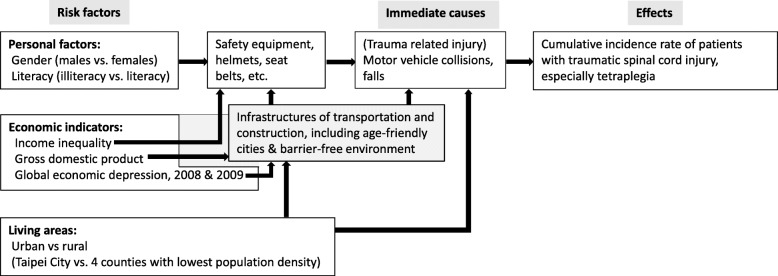
Economic performance may affect public health parameters. This study aimed to determine the time trend of incidence of traumatic spinal cord injury (SCI) and its association with income, presented by GDP (gross domestic product) per capita.
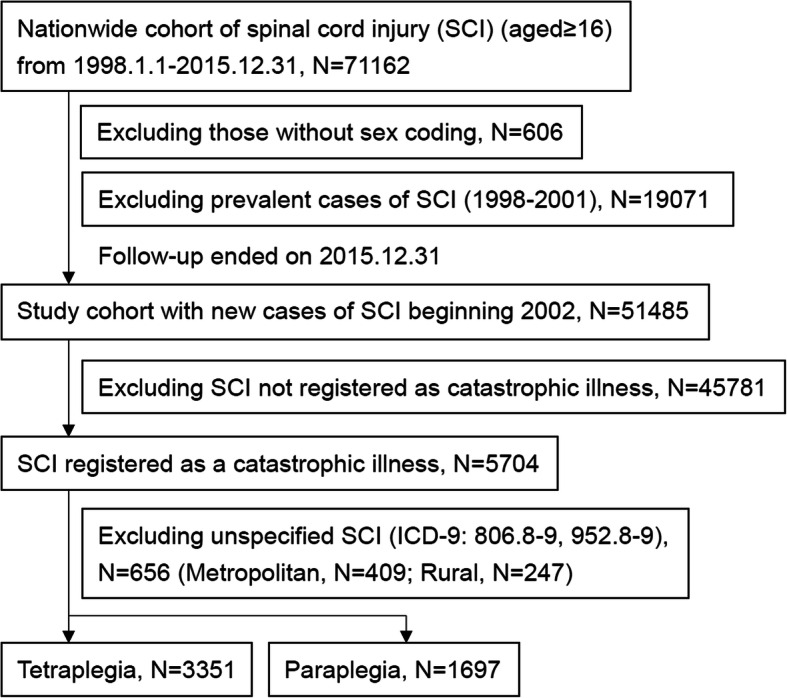
This study was a retrospective observational study in Taiwan. Newly diagnosed SCI patients with moderate to severe disability from 2002 to 2015 were identified from the reimbursement database of the National Health Insurance (NHI) system (1998-2015). CIR (cumulative incidence rate, aged 16-99 years, per 10 person-years) and CIR (aged 16-59 years) of SCI from 2002 to 2015 were measured.
There were 5048 newly diagnosed SCI patients during the study period. After controlling the factors of sex, urbanization level, literacy, income inequality, and global financial crisis (mixed effects models), the CIR of SCI, traumatic SCI, motor vehicle (MV)-related SCI, fall-related SCI, tetraplegia, traumatic tetraplegia, MV-related tetraplegia, and fall-related tetraplegia were inversely associated with GDP per capita; the β coefficients ranged from - 4.85 (95% confidence interval - 7.09 to - 2.6) for total SCI to - 0.8 (- 1.3 to - 0.29) for fall-related tetraplegia. We restricted our comparison to Taipei City and the 4 lowest densely populated counties, which also corroborated with the above results. The income elasticity analysis revealed when GDP per capita increased by 1%, the total SCI decreased by 1.39‰; which was also associated with a decrease of 1.34‰, 1.55‰, 1.36‰, 1.46‰, 1.54‰, 1.54‰, and 1.62‰ for traumatic SCI, MV-related SCI, fall-related SCI, tetraplegia, traumatic tetraplegia, MV-related tetraplegia, and fall-related tetraplegia respectively. The β coefficients show that the compared areas of urbanization level were also inversely correlated with CIR in the SCI population.
We conclude that the incidence of tetraplegia of traumatic SCI in Taiwan decreases with good economic performance, which may be resulted from the provision of public goods and services, possibly through improvements in the infrastructure of transportation and construction.
经济表现可能会影响公共卫生参数。本研究旨在确定创伤性脊髓损伤(SCI)发病率的时间趋势及其与以人均国内生产总值(GDP)表示的收入之间的关联。
本研究是一项在台湾进行的回顾性观察性研究。从国民健康保险(NHI)系统(1998 - 2015年)的报销数据库中识别出2002年至2015年新诊断的中度至重度残疾的SCI患者。测量了2002年至2015年SCI的累积发病率(CIR,16 - 99岁,每10人年)和CIR(16 - 59岁)。
研究期间有5048例新诊断的SCI患者。在控制了性别、城市化水平、识字率、收入不平等和全球金融危机等因素(混合效应模型)后,SCI、创伤性SCI、机动车(MV)相关SCI、跌倒相关SCI、四肢瘫痪、创伤性四肢瘫痪、MV相关四肢瘫痪和跌倒相关四肢瘫痪的CIR与人均GDP呈负相关;β系数范围从总SCI的 - 4.85(95%置信区间 - 7.09至 - 2.6)到跌倒相关四肢瘫痪的 - 0.8( - 1.3至 - 0.29)。我们将比较范围限制在台北市和人口密度最低的4个县,这也证实了上述结果。收入弹性分析显示,人均GDP每增加1%,总SCI下降1.39‰;创伤性SCI、MV相关SCI、跌倒相关SCI、四肢瘫痪、创伤性四肢瘫痪、MV相关四肢瘫痪和跌倒相关四肢瘫痪分别下降1.34‰、1.55‰、1.36‰、1.46‰、1.54‰、1.54‰和1.62‰。β系数表明,城市化水平的比较区域在SCI人群中也与CIR呈负相关。
我们得出结论,台湾创伤性SCI的四肢瘫痪发病率随着良好的经济表现而下降,这可能是由于公共物品和服务的提供,可能是通过改善交通和建筑基础设施实现的。