El-Sheikh Mohamed A, Thomas Jacob, Arif Ibrahim A, El-Sheikh Hady M
Botany & Microbiology Department, College of Science, King Saud University, P.O. Box 2455, 11451 Riyadh, Saudi Arabia.
Botany & Microbiology Department, Faculty of Science, Damanhour University, Damanhour, Egypt.
Saudi J Biol Sci. 2021 Mar;28(3):1503-1513. doi: 10.1016/j.sjbs.2020.12.002. Epub 2020 Dec 8.
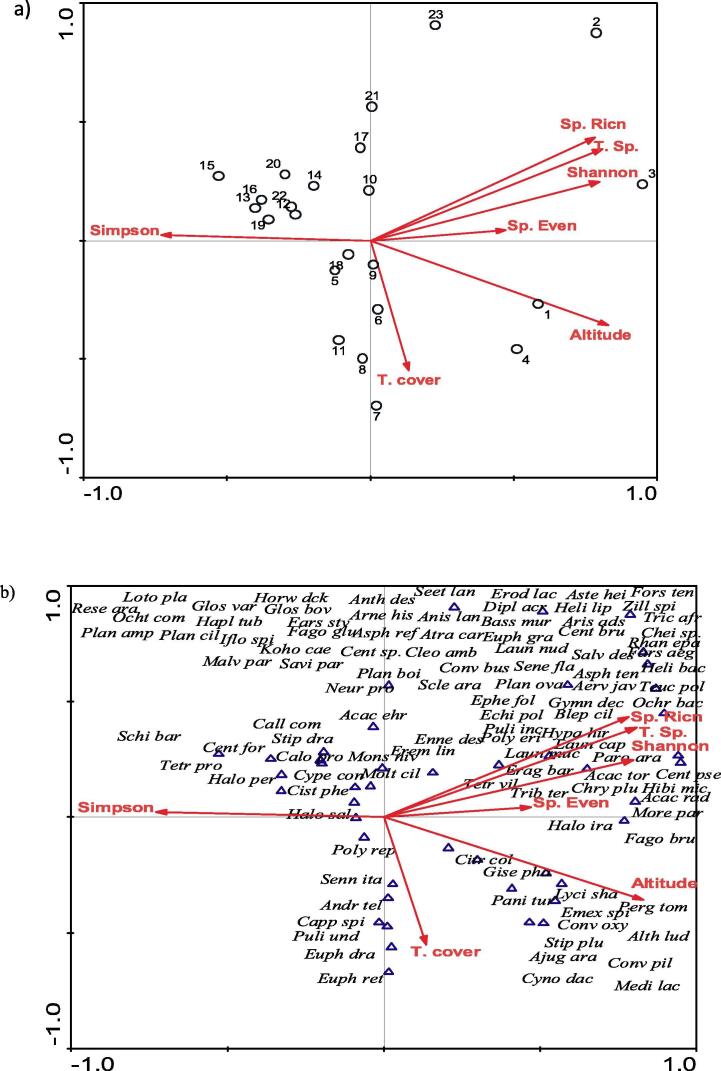
Sand seas of Saudi Arabia cover about one-third of the Arabian Peninsula and are still poorly explored in scientific literature. This study aimed to address the floristic structure and association diversity of the inland sand seas in central Saudi Arabia after 20 years of protection. Twenty-three relevés were selected in Nafud Al-Urayq reserve to cover different sandy dune variations. These relevés are subjected to floristic and multivariate analysis of classification with TWINSPAN and ordination with DECORANA & CANOCO techniques. One hundred thirty-five species belonging to 108 genera in 37 families have been recorded. Annual and perennial species are equally represented. Four vegetation groups (i.e., plant associations) are identified as the following: VG I (--), VG II (-), VG III (--), and VG IV (-). The association of VG I inhabited in the wadi and non-dune or shallow sand habitat had the high species diversity indices (i.e., total species, species richness, species evenness and Shannon index). In contrast, the association of VG II inhabited hyper-arid and salinized habitat and had low species diversity indices. These associations are discussed and illustrated in accordance with competition and adaptation. The advantages of inland sand dune vegetation therefore apply specifically to habitat management and the conservation of plants. These studies extend the advantages of succession of sand dunes and show that rising vegetative diversity is consistent with the combat of desertification.
沙特阿拉伯的沙漠覆盖了阿拉伯半岛约三分之一的面积,而科学文献中对其的探索仍很不足。本研究旨在探讨沙特阿拉伯中部内陆沙漠在受到20年保护后的植物区系结构和群落多样性。在努夫德·乌赖克保护区选取了23个样方,以涵盖不同的沙丘变化类型。这些样方进行了植物区系分析,并采用TWINSPAN技术进行分类多元分析,以及采用DECORANA和CANOCO技术进行排序分析。共记录了37科108属的135种植物。一年生和多年生植物种类数量相当。确定了四个植被组(即植物群落),分别为:植被组I(--)、植被组II(-)、植被组III(--)和植被组IV(-)。栖息在谷底、非沙丘或浅沙地生境的植被组I的群落具有较高的物种多样性指数(即总物种数、物种丰富度、物种均匀度和香农指数)。相比之下,栖息在极度干旱和盐碱化生境的植被组II的群落物种多样性指数较低。根据竞争和适应性对这些群落进行了讨论和说明。因此,内陆沙丘植被具有的优势特别适用于栖息地管理和植物保护。这些研究扩展了沙丘演替的优势,并表明植被多样性的增加与荒漠化防治是一致的。