Su Guobin, Song Huan, Lanka Vivekananda, Liu Xusheng, Fang Fang, Valdimarsdóttir Unnur A, Carrero Juan Jesus
National Clinical Research Center for Kidney Disease, State Key Laboratory of Organ Failure Research, Department of Nephrology, Nanfang Hospital, Southern Medical University, Guangzhou City, Guangdong Province, China.
Department of Nephrology, Guangdong Provincial Hospital of Chinese Medicine, The Second Affiliated Hospital, Guangzhou University of Chinese Medicine, Guangzhou City, Guangdong Province, China.
Kidney Int Rep. 2021 Jan 13;6(3):706-715. doi: 10.1016/j.ekir.2020.12.032. eCollection 2021 Mar.
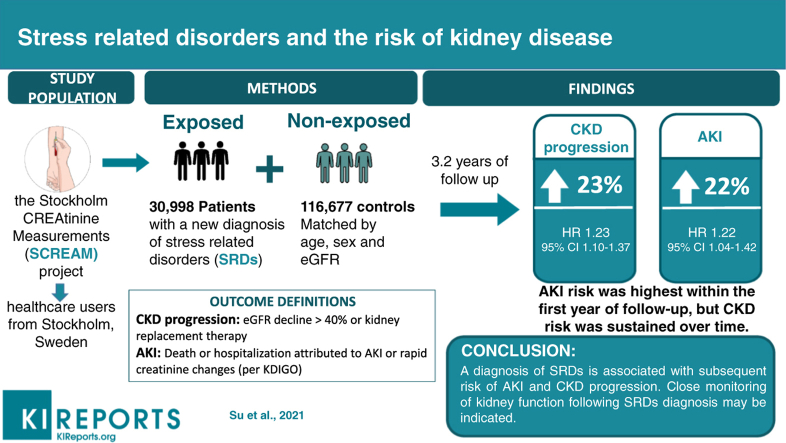
Stress related disorders (SRDs, i.e., psychiatric disorders induced by significant life stressors) increase vulnerability to health problems. Whether SRDs associate with risk of acute kidney injury (AKI) and chronic kidney disease (CKD) is unknown.
A population-matched cohort study in Sweden included 30,998 patients receiving a SRDs diagnosis and 116,677 unexposed patients matched by age, sex and estimated glomerular filtration rates (eGFR). The primary outcome was CKD progression, defined as a sustained relative decline in eGFR of more than 40% or commencement of kidney replacement therapy. The secondary outcome was AKI, defined by death or hospitalization attributed to AKI or rapid creatinine changes (increase ≥ 0.3 mg/d over 48 hours or 1.5x over 7 days). Cox models were used to estimate hazard ratios (HRs) with 95% confidence intervals (CIs).
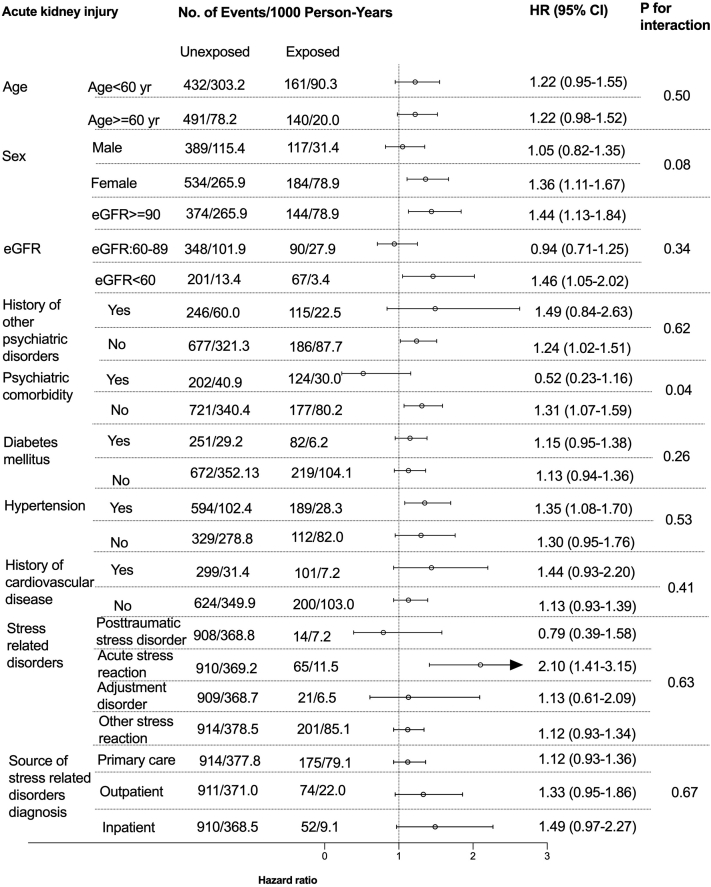
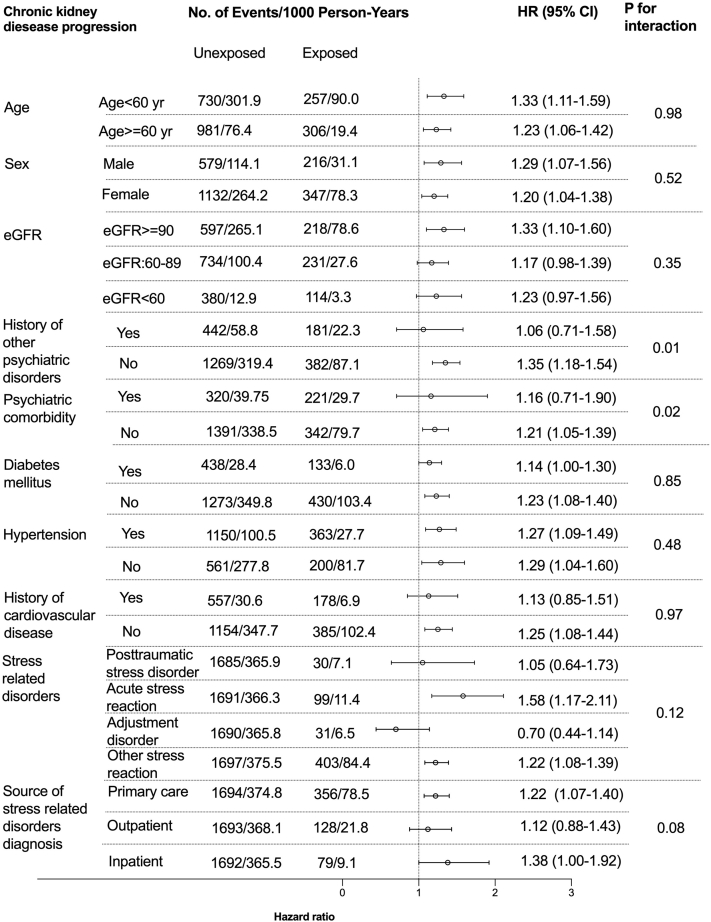
During a medium follow-up of 3.2 years, compared to the unexposed, patients with SRDs (median age 45 years, 71% women), were at increased risk of CKD progression (HR 1.23, 95% CI 1.10-1.37) and AKI (HR 1.22, 95% CI 1.04-1.42). While the HR of CKD progression remained similarly elevated during the entire follow-up period, the association with AKI was only observed during the first year after SRDs diagnosis. Results were consistent in stratified analyses, when only considering AKI-hospitalizations/death, and when disregarding eGFR measurements close to index date.
A diagnosis of SRDs is associated with subsequent risk of AKI and CKD progression. While studies should confirm this observation and characterize underlying mechanisms, close monitoring of kidney function following SRDs diagnosis may be indicated.
应激相关障碍(SRD,即由重大生活应激源诱发的精神障碍)会增加健康问题的易感性。SRD是否与急性肾损伤(AKI)和慢性肾脏病(CKD)的风险相关尚不清楚。
在瑞典进行的一项人群匹配队列研究纳入了30998例被诊断为SRD的患者以及116677例按年龄、性别和估计肾小球滤过率(eGFR)匹配的未暴露患者。主要结局是CKD进展,定义为eGFR持续相对下降超过40%或开始肾脏替代治疗。次要结局是AKI,定义为由AKI导致的死亡或住院或肌酐快速变化(48小时内增加≥0.3mg/d或7天内增加1.5倍)。使用Cox模型估计风险比(HR)及95%置信区间(CI)。
在3.2年的中位随访期内,与未暴露患者相比,SRD患者(中位年龄45岁,71%为女性)发生CKD进展(HR 1.23,95%CI 1.10 - 1.37)和AKI(HR 1.22,95%CI 1.04 - 1.42)的风险增加。虽然在整个随访期内CKD进展的HR仍同样升高,但与AKI的关联仅在SRD诊断后的第一年观察到。在分层分析中,仅考虑因AKI住院/死亡时以及不考虑接近索引日期的eGFR测量值时,结果是一致的。
SRD诊断与随后发生AKI和CKD进展的风险相关。虽然研究应证实这一观察结果并阐明潜在机制,但可能需要在SRD诊断后密切监测肾功能。