Batsuli Glaivy, Greene Amanda, Meeks Shannon L, Sidonio Robert F
Aflac Cancer and Blood Disorders Center of Children's Healthcare of Atlanta Atlanta GA USA.
Department of Pediatrics Emory University Atlanta GA USA.
Res Pract Thromb Haemost. 2021 Feb 8;5(2):342-348. doi: 10.1002/rth2.12475. eCollection 2021 Feb.
The majority of patients with hemophilia A with inhibitors who undergo immune tolerance induction (ITI) achieve successful tolerance and transition to factor VIII (FVIII) prophylaxis. A portion of these patients have switched to emicizumab for bleeding prevention. However, the risk of inhibitor relapse on emicizumab is unclear.
To evaluate the inhibitor status of patients with hemophilia A and inhibitors who achieved successful/partial tolerance after ITI and transitioned from FVIII prophylaxis to emicizumab.
This is a single-institution, retrospective review of pediatric patients with severe hemophilia A who have completed ITI with FVIII and switched to emicizumab.
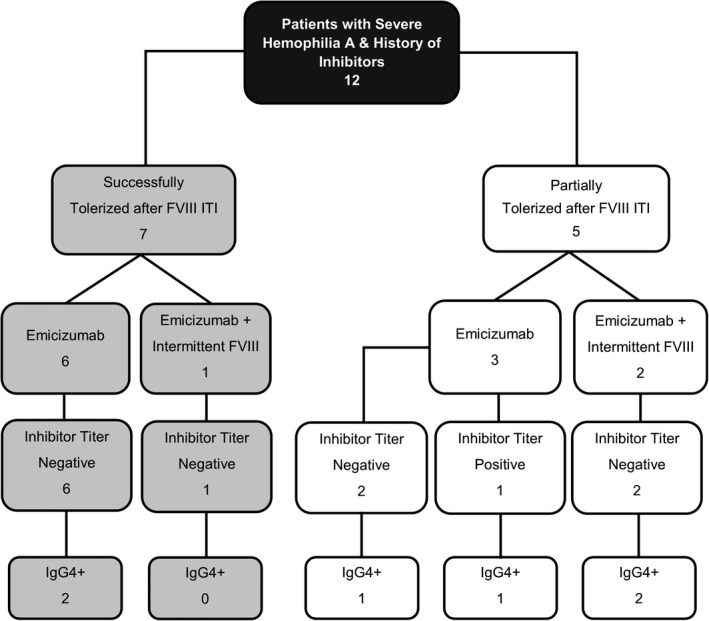
RESULTS/CONCLUSIONS: Seven successfully tolerized and five partially tolerized patients were identified. Three patients continued intermittent FVIII infusions on emicizumab at 50-70 IU/kg twice weekly, once weekly, or every other week due to concerns for inhibitor relapse or loss of recent FVIII tolerance by the treating provider. Eleven of 12 patients (92%) maintained negative inhibitor titers at a mean follow-up of 14.2 ± 6.1 months. One individual had an inhibitor relapse with a peak titer of 2.5 BU/mL. Five of the 11 patients (45%) with negative inhibitor titers had detectable nonneutralizing anti-FVIII IgG4 antibodies, but none of the patients had detectable IgG1 antibodies. There were no inhibitor recurrences in a subset of six patients after FVIII re-exposure for bleeding events or surgery. Given that the presence of an inhibitor significantly impacts factor product choice for bleeding management, ongoing inhibitor monitoring in tolerized patients with hemophilia A who transition to emicizumab is strongly recommended.
大多数接受免疫耐受诱导(ITI)的甲型血友病伴抑制剂患者实现了成功耐受并过渡到因子VIII(FVIII)预防治疗。这些患者中有一部分已改用艾美赛珠单抗预防出血。然而,艾美赛珠单抗治疗后抑制剂复发的风险尚不清楚。
评估甲型血友病伴抑制剂患者在ITI后实现成功/部分耐受并从FVIII预防治疗过渡到艾美赛珠单抗后的抑制剂状态。
这是一项单机构回顾性研究,纳入了完成FVIII免疫耐受诱导并改用艾美赛珠单抗的重度甲型血友病儿科患者。
结果/结论:共识别出7例成功耐受和5例部分耐受的患者。由于治疗医生担心抑制剂复发或近期FVIII耐受性丧失,3例患者在使用艾美赛珠单抗的同时继续每周两次、每周一次或每隔一周进行50 - 70 IU/kg的间歇性FVIII输注。12例患者中有11例(92%)在平均14.2±6.1个月的随访中保持抑制剂滴度阴性。1例患者出现抑制剂复发,峰值滴度为2.5 BU/mL。11例抑制剂滴度阴性的患者中有5例(45%)可检测到非中和性抗FVIII IgG4抗体,但所有患者均未检测到IgG1抗体。6例患者在因出血事件或手术再次暴露于FVIII后未出现抑制剂复发。鉴于抑制剂的存在会显著影响出血管理中因子产品的选择,强烈建议对过渡到艾美赛珠单抗的耐受型甲型血友病患者进行持续的抑制剂监测。