Fan Yu, Cui Shuai, Liu Houbin, Wu Pengcheng, Wang Xudong, Zhong Chengxu, Meng Yingfeng
Shale Gas Research Institute, PetroChina Southwest Oil & Gas Field Company, Chengdu, Sichuan, China.
State Key Laboratory of Oil and Gas Reservoir Geology and Exploitation, Southwest Petroleum University, Chengdu, China.
Sci Prog. 2021 Jan-Mar;104(1):368504211002330. doi: 10.1177/00368504211002330.
With the increasing drilling depth of shale formation, downhole collapse is a frequent occurrence, which often manifests as borehole wall caving.
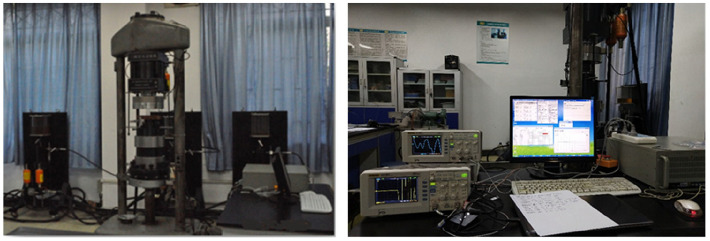
We used the deep shale of the Longmaxi Formation to conduct the mechanical loading and unloading experiments under different downhole working conditions and a theoretical evaluation method of borehole wall caving and instability was proposed.
As the confining pressure and axial load increased, the acoustic velocity increased. When a certain value was reached, the acoustic velocity of the rock mass had minimal changes. As the confining pressure continued to unload and decrease, the acoustic velocity decreased. At the moment of core failure, the acoustic velocity suddenly dropped. When the axial force of loading was constant, the unloading speed of confining pressure increased, and shale could easily be destroyed. The pressure at the well bottom changed rapidly, the likelihood of borehole wall failure increased.
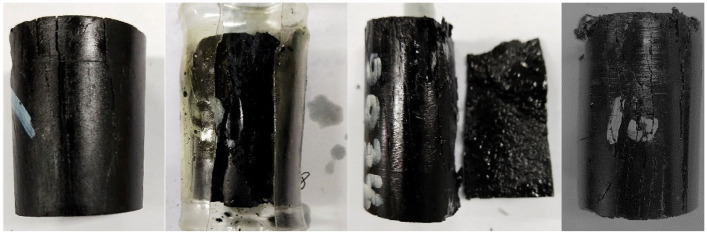
The deep shale has high brittleness. Under the bottom-hole pressure, the borehole wall rock was prone to brittle fracture failure along the parallel bedding surface. Under different working conditions, obvious changes could be observed in the pressure of the effective fluid column at the well bottom. The pressure changed rapidly, which, in turn, caused the rock at the well bottom to break down, thereby resulting in borehole wall caving. After tripping out and turning the pump off, the shale tensile stress in the upper and lower sidewalls of the horizontal well section was responsible for tensile caving.
随着页岩地层钻探深度的增加,井下坍塌频繁发生,常表现为井壁垮塌。
利用龙马溪组深层页岩进行不同井下工况下的力学加卸载试验,提出了一种井壁垮塌与失稳的理论评价方法。
随着围压和轴向载荷的增加,声速增大。当达到一定值时,岩体声速变化最小。随着围压继续卸载减小,声速降低。岩芯破坏瞬间,声速突然下降。当加载轴向力恒定时,围压卸载速度增加,页岩容易被破坏。井底压力变化迅速,井壁失稳的可能性增加。
深层页岩脆性高。在井底压力作用下,井壁岩石易沿平行层面发生脆性断裂破坏。在不同工况下,井底有效液柱压力有明显变化。压力变化迅速,进而导致井底岩石破碎,从而造成井壁垮塌。起钻停泵后,水平井段上下侧壁页岩拉应力导致拉伸垮塌。