Division of Experimental Chemotherapy, The Cancer Chemotherapy Center, Japanese Foundation for Cancer Research, Tokyo, Japan.
Division of Clinical Chemotherapy, The Cancer Chemotherapy Center, Japanese Foundation for Cancer Research, Tokyo, Japan.
Cancer Sci. 2021 Jun;112(6):2299-2313. doi: 10.1111/cas.14891. Epub 2021 Apr 5.
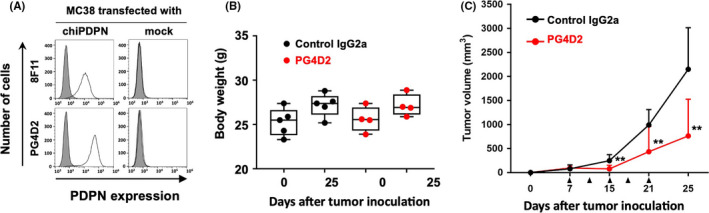
Podoplanin is a key molecule for enhancing tumor-induced platelet aggregation. Podoplanin interacts with CLEC-2 on platelets via PLatelet Aggregation-inducing domains (PLAGs). Among our generated antibodies, those targeting the fourth PLAG domain (PLAG4) strongly suppress podoplanin-CLEC-2 binding and podoplanin-expressing tumor growth and metastasis. We previously performed a single-dose toxicity study of PLAG4-targeting anti-podoplanin-neutralizing antibodies and found no acute toxicity in cynomolgus monkeys. To confirm the therapeutic efficacy and toxicity of podoplanin-targeting antibodies, a syngeneic mouse model that enables repeated dose toxicity tests is needed. Replacement of mouse PLAG1-PLAG4 domains with human homologous domains drastically decreased the platelet-aggregating activity. Therefore, we searched the critical domain of the platelet-aggregating activity in mouse podoplanin and found that the mouse PLAG4 domain played a critical role in platelet aggregation, similar to the human PLAG4 domain. Human/mouse chimeric podoplanin, in which a limited region containing mouse PLAG4 was replaced with human homologous region, exhibited a similar platelet-aggregating activity to wild-type mouse podoplanin. Thus, we generated knock-in mice with human/mouse chimeric podoplanin expression (Pdpn mice). Our previously established PLAG4-targeting antibodies could suppress human/mouse chimeric podoplanin-mediated platelet aggregation and tumor growth in Pdpn mice. Repeated treatment of Pdpn mice with antibody-dependent cell-mediated cytotoxicity activity-possessing PG4D2 antibody did not result in toxicity or changes in hematological and biochemical parameters. Our results suggest that anti-podoplanin-neutralizing antibodies could be used safely as novel anti-tumor agents. Our generated Pdpn mice are useful for investigating the efficacy and toxicity of human podoplanin-targeting drugs.
层粘连蛋白是增强肿瘤诱导血小板聚集的关键分子。层粘连蛋白通过血小板聚集诱导结构域(PLAGs)与血小板上的 CLEC-2 相互作用。在我们生成的抗体中,靶向第四 PLAG 结构域(PLAG4)的抗体强烈抑制层粘连蛋白-CLEC-2 结合以及表达层粘连蛋白的肿瘤生长和转移。我们之前对靶向层粘连蛋白的中和抗体进行了单次剂量毒性研究,在食蟹猴中未发现急性毒性。为了确认靶向层粘连蛋白的抗体的治疗效果和毒性,需要使用能够进行重复剂量毒性测试的同基因小鼠模型。用同源的人 PLAG1-PLAG4 结构域替换小鼠 PLAG1-PLAG4 结构域,极大地降低了血小板聚集活性。因此,我们搜索了小鼠层粘连蛋白中血小板聚集活性的关键结构域,发现小鼠 PLAG4 结构域在血小板聚集方面发挥了关键作用,类似于人 PLAG4 结构域。人/鼠嵌合层粘连蛋白,其中含有小鼠 PLAG4 的有限区域被替换为人同源区域,表现出与野生型小鼠层粘连蛋白相似的血小板聚集活性。因此,我们生成了表达人/鼠嵌合层粘连蛋白的敲入小鼠(Pdpn 小鼠)。我们之前建立的靶向 PLAG4 的抗体可以抑制 Pdpn 小鼠中人类/鼠嵌合层粘连蛋白介导的血小板聚集和肿瘤生长。用具有抗体依赖性细胞介导的细胞毒性活性的 PG4D2 抗体重复治疗 Pdpn 小鼠不会导致毒性或血液学和生化学参数的变化。我们的结果表明,抗层粘连蛋白中和抗体可用作新型抗肿瘤药物,且安全。我们生成的 Pdpn 小鼠可用于研究人类层粘连蛋白靶向药物的疗效和毒性。