DeFroda Steven F, Patel Devan D, Milner John, Yang Daniel S, Owens Brett D
Department of Orthopaedic Surgery, Warren Alpert School of Medicine, Brown University, Providence, Rhode Island, USA.
Orthop J Sports Med. 2021 Feb 26;9(2):2325967120981649. doi: 10.1177/2325967120981649. eCollection 2021 Feb.
Anterior cruciate ligament (ACL) injury in National Basketball Association (NBA) players can have a significant impact on player longevity and performance. Current literature reports a high rate of return to play, but there are limited data on performance after ACL reconstruction (ACLR).
PURPOSE/HYPOTHESIS: To determine return to play and player performance in the first and second seasons after ACLR in NBA players. We hypothesized that players would return at a high rate. However, we also hypothesized that performance in the first season after ACLR would be worse as compared with the preinjury performance, with a return to baseline by postoperative year 2.
Case series; Level of evidence, 4.
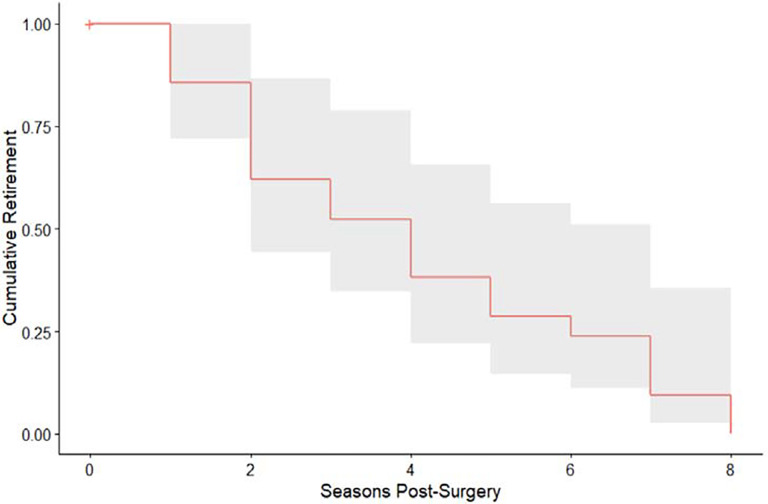
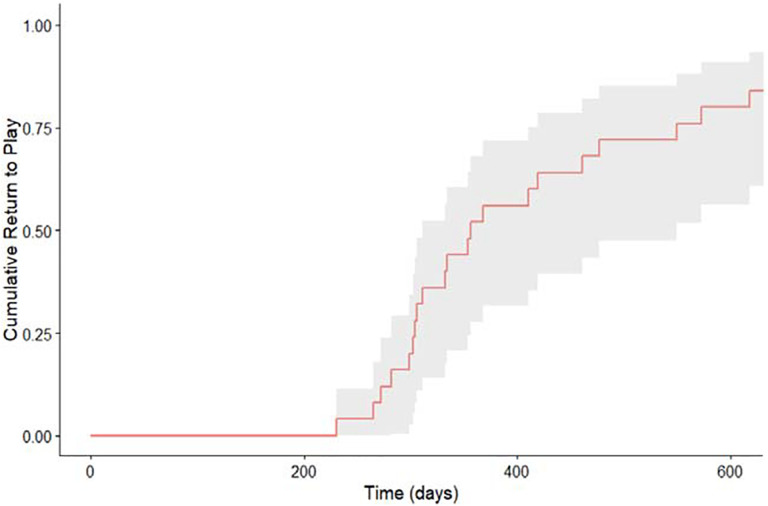
An online database of NBA athlete injuries between 2010 and 2019 was queried using the term . For the included players, the following data were recorded: name; age at injury; position; height, weight, and body mass index; handedness; NBA experience; dates of injury, surgery, and return; knee affected; and postoperative seasons played. Regular season statistics for 1 preinjury season and 2 postoperative seasons were compiled and included games started and played, minutes played, and player efficiency rating. Kaplan-Meier survivorship plots were computed for athlete return-to-play and retirement endpoints.
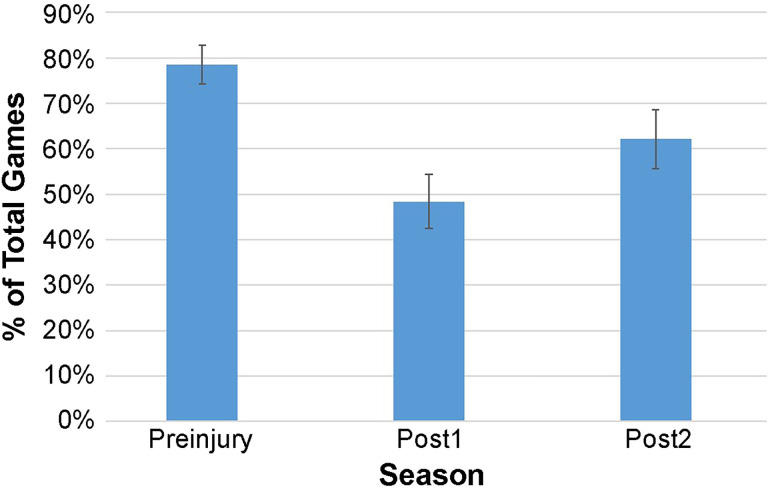
A total of 26 athletes underwent ACLR; of these, 84% (95% CI, 63.9%-95.5%) returned to play at a mean 372.5 days (95% CI, 323.5-421.5 days) after surgery. Career length after injury was a mean of 3.36 seasons (95% CI, 2.27-4.45 seasons). Factors that contributed to an increased probability of return to play included younger age at injury (odds ratio, 0.71 [95% CI, 0.47-0.92]; = .0337) and fewer years of experience in the NBA before injury (odds ratio, 0.70 [95% CI, 0.45-0.93]; = .0335). Postoperatively, athletes played a significantly lower percentage of total games in the first season (48.4%; = .0004) and second season (62.1%; = .0067) as compared with the preinjury season (78.5%). Player efficiency rating in the first season was 19.3% less than that in the preinjury season ( = .0056). Performance in the second postoperative season was not significantly different versus preinjury.
NBA players have a high rate of RTP after ACLR. However, it may take longer than a single season for elite NBA athletes to return to their full preinjury performance. Younger players and those with less NBA experience returned at higher rates.
美国职业篮球联赛(NBA)球员的前交叉韧带(ACL)损伤会对球员的职业生涯长度和表现产生重大影响。目前的文献报道重返赛场的比例很高,但关于ACL重建(ACLR)后表现的数据有限。
目的/假设:确定NBA球员ACLR后第一和第二个赛季的重返赛场情况和球员表现。我们假设球员将以很高的比例重返赛场。然而,我们也假设ACLR后第一个赛季的表现与受伤前相比会更差,到术后第2年恢复到基线水平。
病例系列;证据等级,4级。
使用该术语查询2010年至2019年NBA运动员损伤的在线数据库。对于纳入的球员,记录以下数据:姓名;受伤时年龄;位置;身高、体重和体重指数;惯用手;NBA经验;受伤、手术和回归日期;受影响的膝关节;以及术后参赛赛季。汇编了1个受伤前赛季和2个术后赛季的常规赛数据,包括首发和参赛场次、上场时间以及球员效率值。计算了运动员重返赛场和退役终点的Kaplan-Meier生存曲线。
共有26名运动员接受了ACLR;其中,84%(95%CI,63.9%-95.5%)在术后平均372.5天(95%CI,323.5-421.5天)重返赛场。受伤后的职业生涯长度平均为3.36个赛季(95%CI,2.27-4.45个赛季)。有助于提高重返赛场概率的因素包括受伤时年龄较小(优势比,0.71[95%CI,0.47-0.92];P =.0337)以及受伤前在NBA的经验年限较少(优势比,0.70[95%CI,0.45-0.93];P =.0335)。术后,与受伤前赛季(78.5%)相比,运动员在第一个赛季(48.4%;P =.0004)和第二个赛季(62.1%;P =.0067)参加的总比赛百分比显著降低。第一个赛季的球员效率值比受伤前赛季低19.3%(P =.0056)。术后第二个赛季的表现与受伤前相比无显著差异。
NBA球员ACLR后重返赛场的比例很高。然而,对于精英NBA运动员来说,可能需要不止一个赛季才能恢复到受伤前的全部表现。年轻球员和NBA经验较少的球员重返赛场的比例更高。