Mironenko N V, Gavrilenko T A, Khiutti A V, Afanasenko O S
All-Russian Research Institute of Plant Protection, Pushkin, St. Petersburg, Russia Institute of Cytology and Genetics of Siberian Branch of the Russian Academy of Sciences, Novosibirsk, Russia.
Institute of Cytology and Genetics of Siberian Branch of the Russian Academy of Sciences, Novosibirsk, Russia Federal Research Center the N.I. Vavilov All-Russian Institute of Plant Genetic Resources (VIR), St. Petersburg, Russia.
Vavilovskii Zhurnal Genet Selektsii. 2020 Nov;24(7):705-721. doi: 10.18699/VJ20.665.
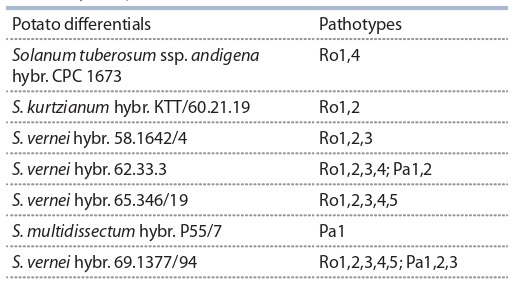
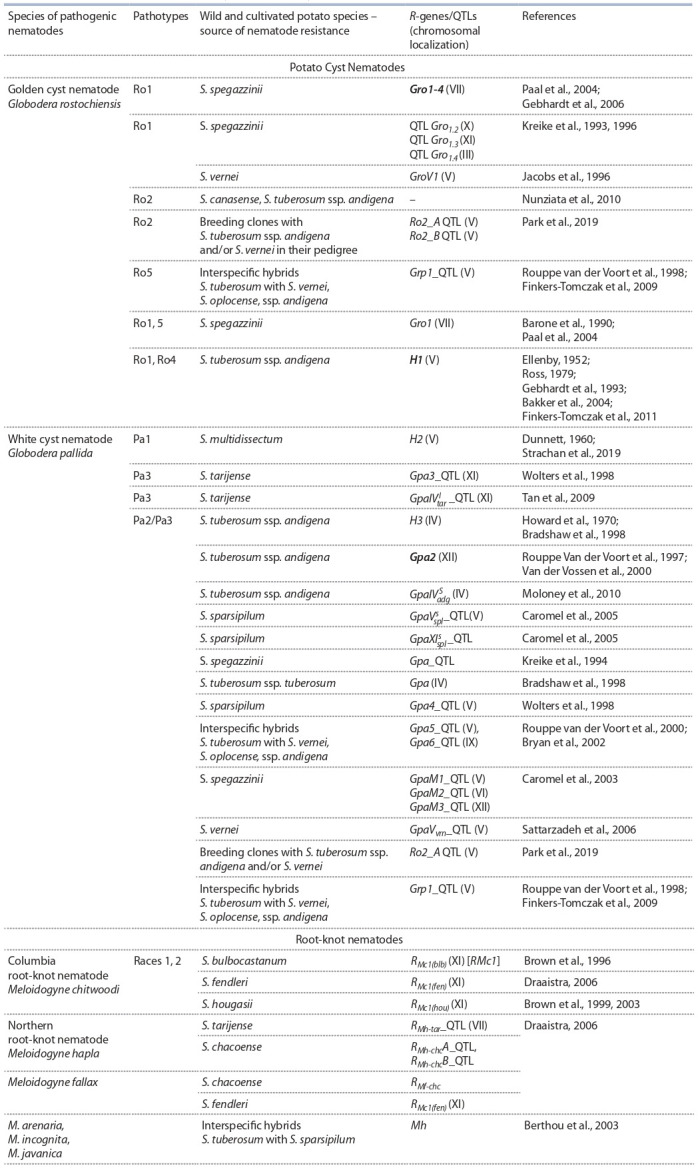
The review considers quarantine species and nematode pathotypes potentially dangerous for domestic potato production. Potatoes are affected by more than 30 types of parasitic nematodes, but the review focuses on the most harmful representatives of genera that cause great damage to potato production: Globodera, Ditylenchus, Nacobbus and Meloidogyne. Phytopathological and molecular methods of identification of species and pathotypes and the main achievements in studying the population variability of parasitic potato nematodes were analyzed. It was shown that due to the peculiarities of the life cycle of nematodes and lability of their genomes, the genetic variability of these organisms is very high, which creates a threat of forming new pathogenic genotypes of the parasites. The information about the intra- and interpopulation variability of nematodes is important for studying the ways of introduction and distribution of separate species, as well as for searching for the correlations of molecular markers with the pathotype. Phylogenetic studies based on modern data on genetic variability of populations have allowed to reveal species complexes in Globodera pallida (Stone) Behrens and Nacobbus aberrans (Thorne) Thorne & Allen (sensu lato), including cryptic species. The main components of successful protection preventing a wide distribution of parasitic nematodes are quarantine measures, agricultural techniques, biological methods of protection and cultivation of resistant cultivars. Special attention in the review is paid to the breeding of potato cultivars with durable resistance to various nematode pathotypes, because the cultivation of such varieties is the most ecologically safe and economically advantageous way to prevent epiphytoties. Currently, significant progress has been made in the genetic protection of potato cultivars, especially against cyst-forming nematodes. The review provides data on sources of potato resistance to parasitic nematodes identified in collections of wild and cultivated species. Data on identified R-gens and QTL of resistance that have been introduced into breeding varieties using different methods and approaches are analyzed. The literature data on the study of structural and functional organization of genes for resistance to potato cyst nematodes are given. The results of molecular research on revealing the polymorphisms of loci involved in the control of resistance to cyst and gall nematodes, the development of molecular markers of certain genes and their use in marker-assisted selection for developing of new resistant cultivars, including those with group resistance, are considered.
该综述探讨了对国内马铃薯生产具有潜在危险的检疫性物种和线虫致病型。马铃薯受30多种寄生线虫影响,但该综述聚焦于对马铃薯生产造成重大损害的属中最具危害性的代表:球孢囊线虫属、茎线虫属、纳科布线虫属和根结线虫属。分析了用于鉴定物种和致病型的植物病理学及分子方法,以及在研究寄生马铃薯线虫种群变异性方面的主要成果。结果表明,由于线虫生命周期的特殊性及其基因组的不稳定性,这些生物的遗传变异性非常高,这构成了形成寄生虫新致病基因型的威胁。关于线虫种群内和种群间变异性的信息,对于研究不同物种的引入和传播方式以及寻找分子标记与致病型之间的相关性很重要。基于现代种群遗传变异性数据的系统发育研究,已揭示出苍白球孢囊线虫(Stone)Behrens和异常纳科布线虫(Thorne)Thorne & Allen(广义)中的物种复合体,包括隐存种。成功防治寄生线虫广泛传播的主要组成部分包括检疫措施、农业技术、生物防治方法和种植抗性品种。该综述特别关注培育对各种线虫致病型具有持久抗性的马铃薯品种,因为种植此类品种是预防疫病最生态安全且经济有利的方式。目前,在马铃薯品种的遗传保护方面,尤其是针对形成孢囊的线虫,已取得显著进展。该综述提供了在野生和栽培物种收集物中鉴定出的马铃薯对寄生线虫抗性来源的数据。分析了已通过不同方法和途径导入育种品种的已鉴定抗性R基因和QTL的数据。给出了关于马铃薯孢囊线虫抗性基因结构和功能组织研究的文献数据。考虑了关于揭示参与控制对孢囊和根结线虫抗性的基因座多态性、某些基因分子标记的开发及其在标记辅助选择中用于培育新抗性品种(包括具有群体抗性的品种)的分子研究结果。