Inserm 1219, University of Bordeaux, and French National Research Institute for Sustainable Development, Bordeaux, France; Department of Infectious Diseases and Tropical Medicine, Division of Tropical Medicine and Clinical International Health, University Hospital Centre of Bordeaux, Hôpital Pellegrin, Bordeaux, France; Programme PAC-CI/ANRS Research Site, University Hospital Centre of Treichville, Abidjan, Côte d'Ivoire.
Inserm 1219, University of Bordeaux, and French National Research Institute for Sustainable Development, Bordeaux, France; Programme PAC-CI/ANRS Research Site, University Hospital Centre of Treichville, Abidjan, Côte d'Ivoire; The Alliance for International Medical Action, Dakar, Senegal.
Lancet Glob Health. 2021 Apr;9(4):e469-e478. doi: 10.1016/S2214-109X(20)30518-0.
Lassa fever is a viral haemorrhagic fever endemic in parts of west Africa. New treatments are needed to decrease mortality, but pretrial reference data on the disease characteristics are scarce. We aimed to document baseline characteristics and outcomes for patients hospitalised with Lassa fever in Nigeria.
We did a prospective cohort study (LASCOPE) at the Federal Medical Centre in Owo, Nigeria. All patients admitted with confirmed Lassa fever were invited to participate and asked to give informed consent. Patients of all ages, including newborn infants, were eligible for inclusion, as were pregnant women. All participants received standard supportive care and intravenous ribavirin according to Nigeria Centre for Disease Control guidelines and underwent systematic biological monitoring for 30 days. Patients' characteristics, care received, mortality, and associated factors were recorded using standard WHO forms. We used univariable and multivariable logistic regression models to investigate an association between baseline characteristics and mortality at day 30.
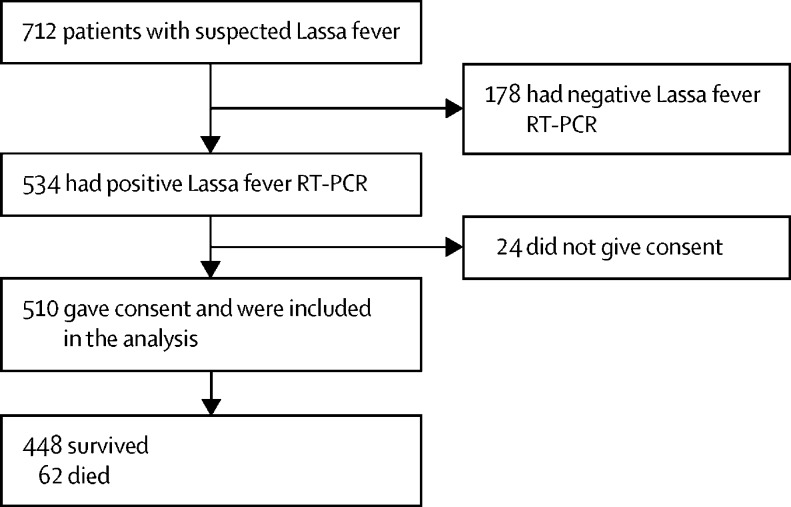
Between April 5, 2018, and March 15, 2020, 534 patients with confirmed Lassa fever were admitted to hospital, of whom 510 (96%) gave consent and were included in the analysis. The cohort included 258 (51%) male patients, 252 (49%) female patients, 426 (84%) adults, and 84 (16%) children (younger than 18 years). The median time between first symptoms and hospital admission was 8 days (IQR 7-13). At baseline, 176 (38%) of 466 patients had a Lassa fever RT-PCR cycle threshold (Ct) lower than 30. From admission to end of follow-up, 120 (25%) of 484 reached a National Early Warning Score (second version; NEWS2) of 7 or higher, 67 (14%) of 495 reached a Kidney Disease-Improving Global Outcome (KDIGO) stage of 2 or higher, and 41 (8%) of 510 underwent dialysis. All patients received ribavirin for a median of 10 days (IQR 9-13). 62 (12%) patients died (57 [13%] adults and five [6%] children). The median time to death was 3 days (1-6). The baseline factors independently associated with mortality were the following: age 45 years or older (adjusted odds ratio 16·30, 95% CI 5·31-50·30), NEWS2 of 7 or higher (4·79, 1·75-13·10), KDIGO grade 2 or higher (7·52, 2·66-21·20), plasma alanine aminotransferase 3 or more times the upper limit of normal (4·96, 1·69-14·60), and Lassa fever RT-PCR Ct value lower than 30 (4·65, 1·50-14·50).
Our findings comprehensively document clinical and biological characteristics of patients with Lassa fever and their relationship with mortality, providing prospective estimates that could be useful for designing future therapeutic trials. Such trials comparing new Lassa fever treatments to a standard of care should take no more than 15% as the reference mortality rate and consider adopting a combination of mortality and need for dialysis as the primary endpoint.
Institut National de la Santé et de la Recherche Médicale, University of Oxford, EU, UK Department for International Development, Wellcome Trust, French Ministry of Foreign Affairs, Agence Nationale de Recherches sur le SIDA et les hépatites virales, French National Research Institute for Sustainable Development.
拉沙热是一种在西非部分地区流行的病毒性出血热。需要新的治疗方法来降低死亡率,但关于该病特征的前期参考数据很少。本研究旨在记录在尼日利亚因拉沙热住院的患者的基线特征和结局。
我们在尼日利亚奥沃的联邦医疗中心进行了一项前瞻性队列研究(LASCOPE)。所有确诊为拉沙热的住院患者均被邀请参加并签署知情同意书。所有年龄的患者,包括新生儿和孕妇,均符合纳入标准。所有患者均接受标准支持性治疗和根据尼日利亚疾病控制中心指南进行静脉内利巴韦林治疗,并在 30 天内进行系统的生物监测。使用标准的世界卫生组织表格记录患者的特征、所接受的治疗、死亡率和相关因素。我们使用单变量和多变量逻辑回归模型来研究基线特征与第 30 天死亡率之间的关联。
2018 年 4 月 5 日至 2020 年 3 月 15 日期间,共有 534 名确诊为拉沙热的患者住院,其中 510 名(96%)同意并纳入分析。该队列包括 258 名(51%)男性患者、252 名(49%)女性患者、426 名(84%)成年人和 84 名(16%)儿童(年龄小于 18 岁)。从首次出现症状到住院的中位时间为 8 天(IQR 7-13)。基线时,466 名患者中有 176 名(38%)的拉沙热 RT-PCR 循环阈值(Ct)低于 30。从入院到随访结束,484 名患者中有 120 名(25%)达到国家早期预警评分(第 2 版;NEWS2)的 7 分或更高,495 名患者中有 67 名(14%)达到肾脏疾病改善全球结局(KDIGO)的 2 级或更高,510 名患者中有 41 名(8%)接受了透析。所有患者均接受利巴韦林治疗,中位治疗时间为 10 天(IQR 9-13)。62 名(12%)患者死亡(57 名[13%]成年人和 5 名[6%]儿童)。中位死亡时间为 3 天(1-6)。与死亡率相关的基线因素包括:年龄 45 岁或以上(调整后优势比 16.30,95%CI 5.31-50.30)、NEWS2 为 7 分或更高(4.79,1.75-13.10)、KDIGO 分级 2 级或更高(7.52,2.66-21.20)、血浆丙氨酸氨基转移酶水平高于正常值 3 倍以上(4.96,1.69-14.60)和拉沙热 RT-PCR Ct 值低于 30(4.65,1.50-14.50)。
本研究全面记录了拉沙热患者的临床和生物学特征及其与死亡率的关系,提供了前瞻性估计,可能有助于设计未来的治疗试验。与标准护理相比,比较新的拉沙热治疗方法的试验不应超过 15%作为参考死亡率,并考虑采用死亡率和需要透析的组合作为主要终点。
法国国家健康与医学研究院、牛津大学、英国国际发展部、威康信托基金会、法国艾滋病和病毒性肝炎研究国家机构、法国国家可持续发展研究所。