Department of Radiology, The Affiliated Yixing Hospital of Jiangsu University, NO.75 Tongzhenguan Road, Yixing, Jiangsu Province, 214200, P.R. China.
Department of Radiology, First Affiliated Hospital of Xi'an Jiaotong University, Xi'an, Shaanxi Province, China.
BMC Neurol. 2021 Mar 19;21(1):128. doi: 10.1186/s12883-021-02140-9.
Although increasing evidence showed the correlations between white matter hyperintensities (WMHs) and cognitive impairment, the relationship between them is still modest. Many researchers began to focus on the variation caused by the heterogeneity of WMH. We tried to explore the pathological heterogeneity in WMH by using diffusion tensor imaging (DTI), so as to provide a new insight into the future research.
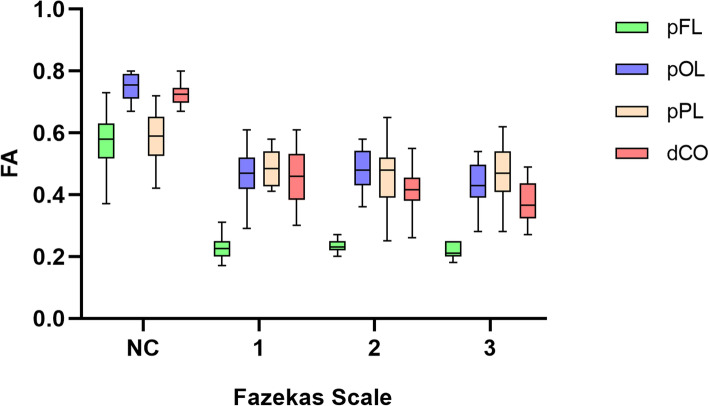
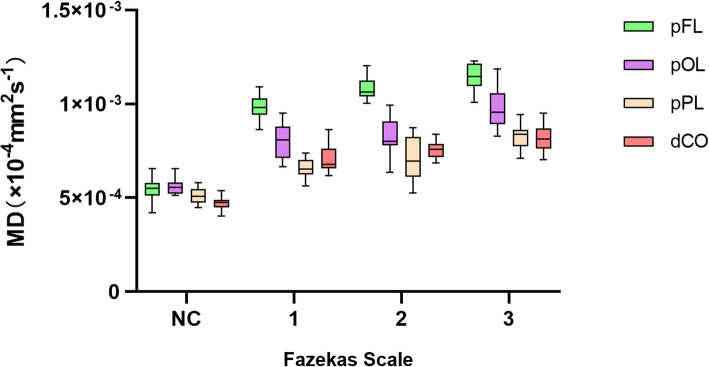
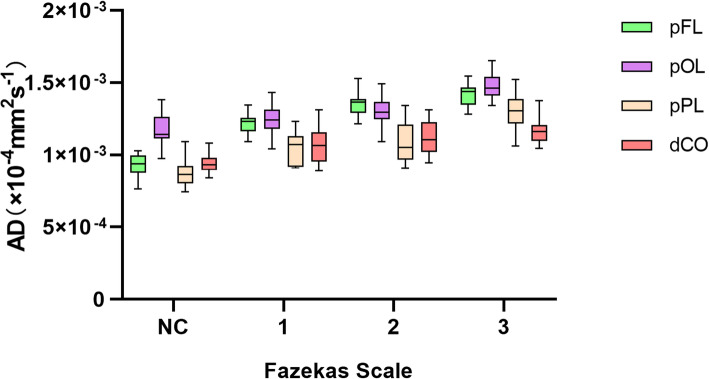
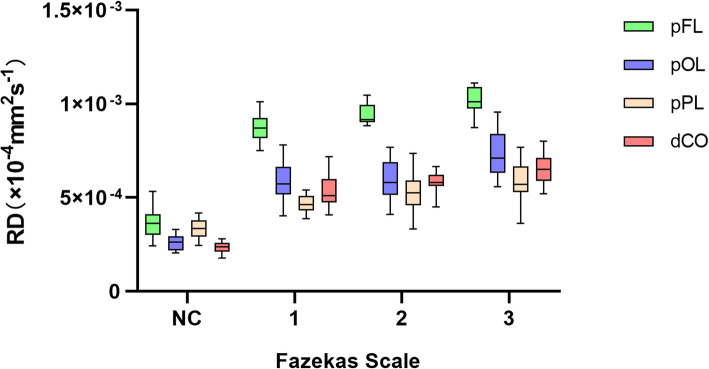
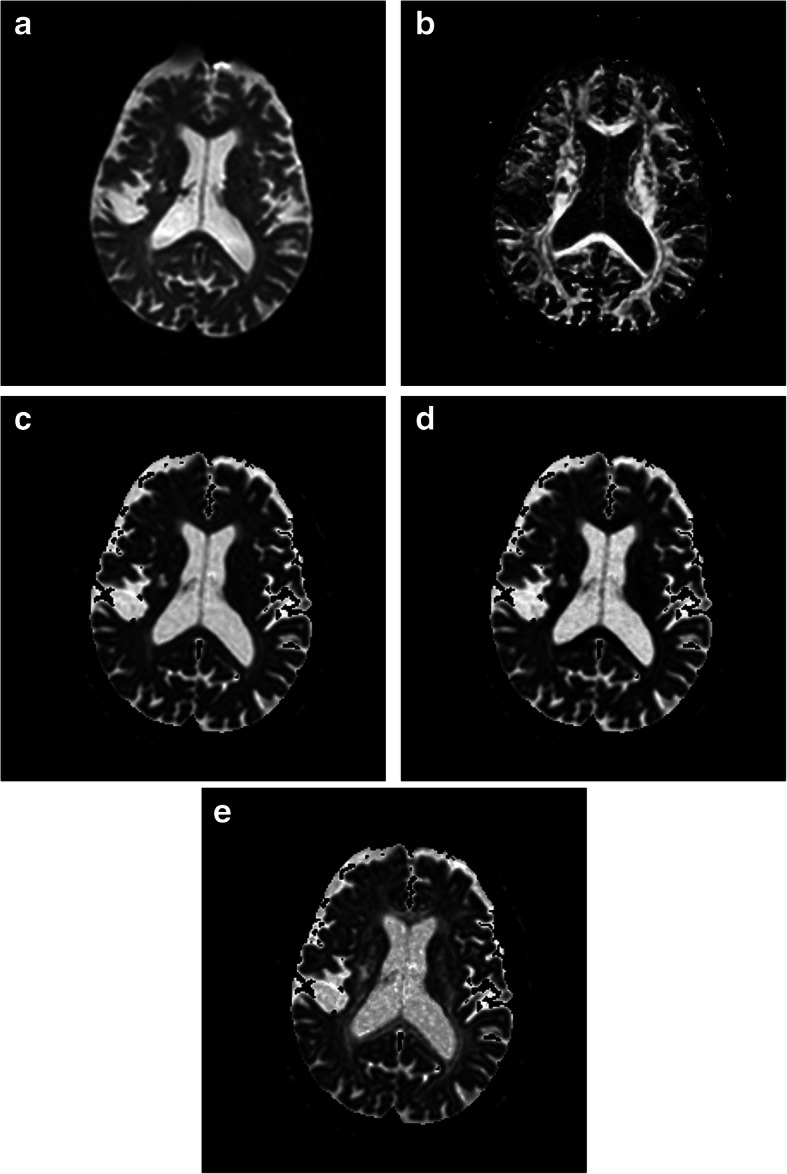
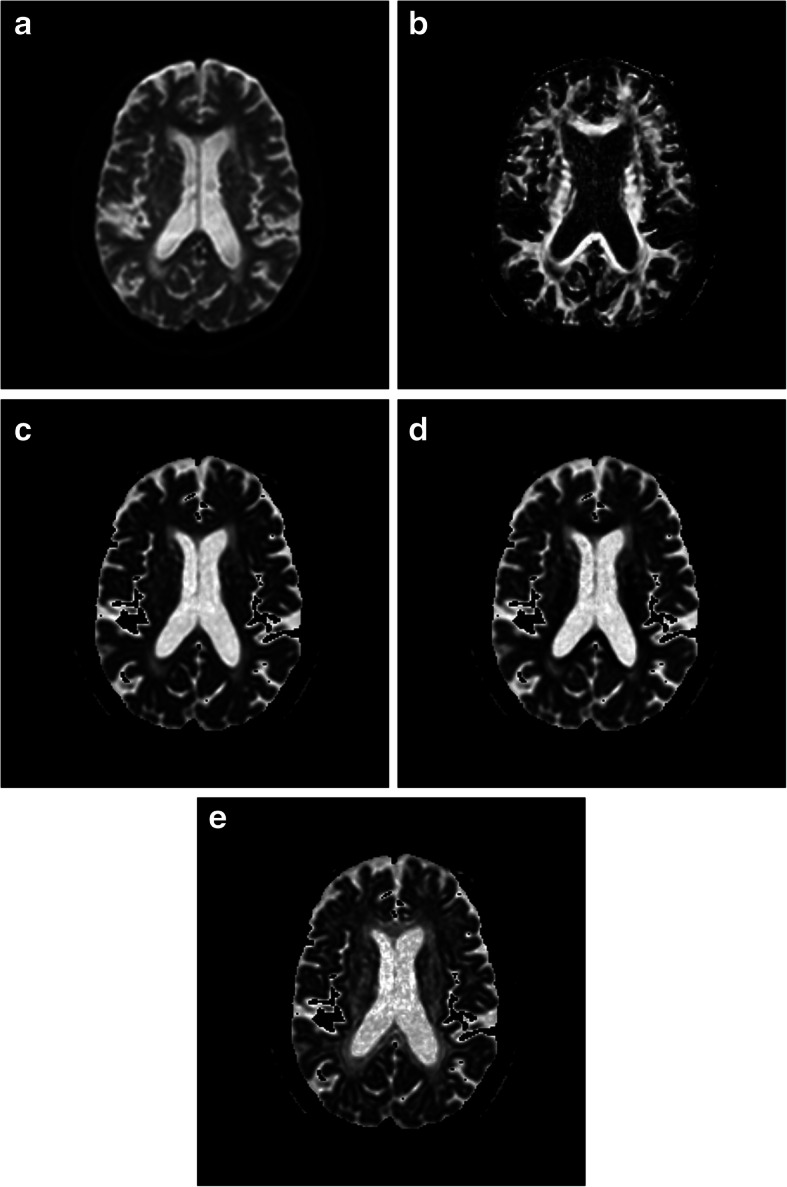
Diffusion weighted images (DWIs) of the brain were acquired from 73 patients with WMH and 18 healthy controls, which were then modeled by DTI. We measured fractional anisotropy (FA), mean diffusivity (MD), axial diffusivity (AD), and radial diffusivity (RD) of white matter of the periventricular frontal lobe (pFL), periventricular occipital lobe (pOL), periventricular parietal lobe (pPL) and deep centrum ovales (dCO), and grouped these measures according to the Fazekas scale. Then we compared the DTI metrics of different regions with the same Fazekas scale grade.
Significantly lower FA values (all p < 0.001), and higher MD (all p < 0.001) and RD values (all p < 0.001) were associated with WMH observed in the periventricular frontal lobe (pFL) compared to all other regions with the same Fazekas grades. The AD of WMH in the pFL was higher than that of pPL and dCO, but the differences between groups was not as high as of MD and RD, as indicated by the effect size. In the normal control group, DTI metrics between pFL and other regions were not significantly different or less significant different. The difference of DTI metrics of WMH between pPL, pOL and dCO was lower than that of normal white matter, as indicated by the effect size.
Distinct pathological processes can be revealed by DTI between frontal periventricular WMH and other regions. These processes may represent the effects of severe demyelination within the frontal periventricular WMH.
尽管越来越多的证据表明脑白质高信号(WMH)与认知障碍之间存在相关性,但它们之间的关系仍然不太明确。许多研究人员开始关注WMH 异质性引起的变化。我们试图通过弥散张量成像(DTI)来探索 WMH 的病理异质性,以期为未来的研究提供新的视角。
对 73 例 WMH 患者和 18 例健康对照者的脑部弥散加权图像(DWIs)进行采集,并通过 DTI 对其进行建模。我们测量了脑室周围额叶(pFL)、脑室周围枕叶(pOL)、脑室周围顶叶(pPL)和深部脑白质(dCO)的白质各向异性分数(FA)、平均弥散度(MD)、轴向弥散度(AD)和径向弥散度(RD),并根据 Fazekas 量表对这些指标进行分组。然后,我们比较了不同区域与相同 Fazekas 分级的 DTI 指标。
与其他具有相同 Fazekas 分级的区域相比,脑室周围额叶(pFL)WMH 观察到的 FA 值显著降低(均 p<0.001),MD 值(均 p<0.001)和 RD 值(均 p<0.001)更高。与 pPL 和 dCO 相比,pFL 中 WMH 的 AD 值更高,但组间差异不如 MD 和 RD 显著,如效应大小所示。在正常对照组中,pFL 与其他区域之间的 DTI 指标没有显著差异或差异较小。与正常白质相比,pPL、pOL 和 dCO 之间 WMH 的 DTI 指标差异较小,如效应大小所示。
DTI 可以揭示脑室周围额状 WM 与其他区域之间的不同病理过程。这些过程可能代表了脑室周围额状 WM 内严重脱髓鞘的影响。