Structure and Motion Laboratory, Department of Comparative Biomedical Sciences, The Royal Veterinary College, Hawkshead Lane, North Mymms, Hertfordshire AL9 7TA, UK.
Museum für Naturkunde Berlin, Leibniz Institut für Evolutions-und Biodiversitätsforschung, Invalidenstraße 43, 10115 Berlin, Germany.
Sci Adv. 2021 Mar 19;7(12). doi: 10.1126/sciadv.abe2778. Print 2021 Mar.
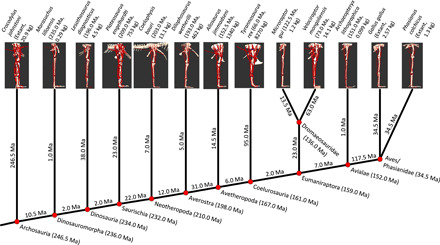
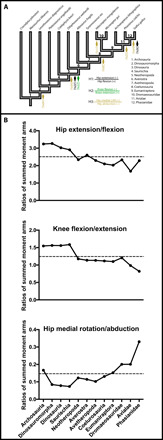
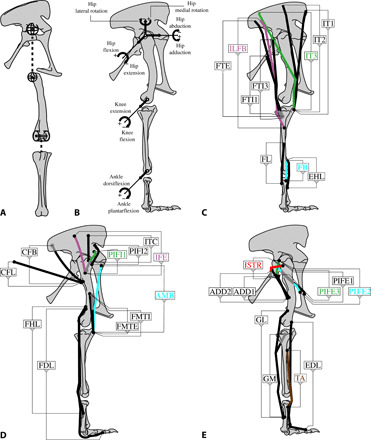
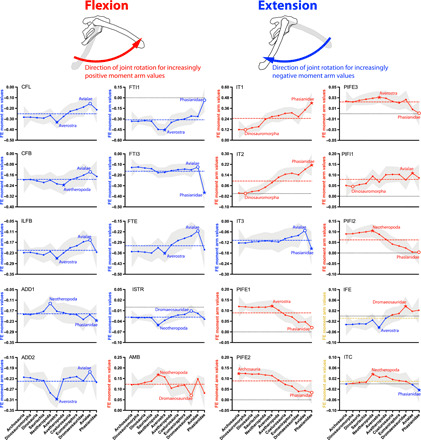
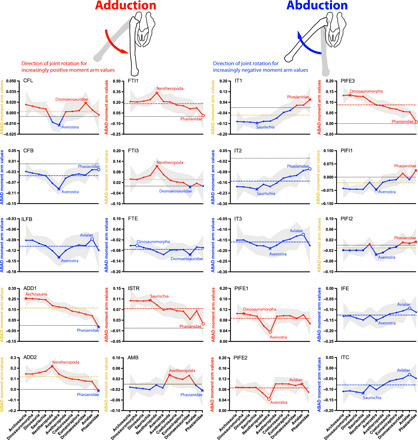
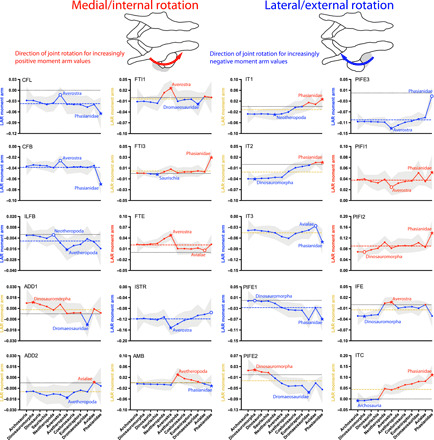
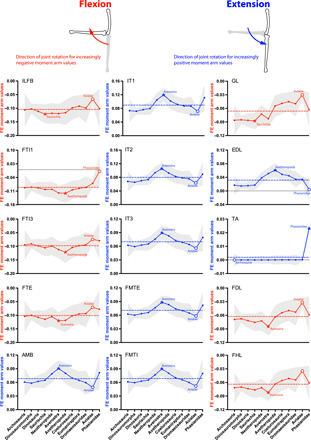
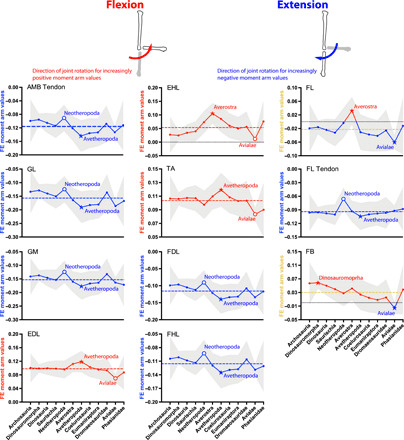
Bipedal locomotion evolved along the archosaurian lineage to birds, shifting from "hip-based" to "knee-based" mechanisms. However, the roles of individual muscles in these changes and their evolutionary timings remain obscure. Using 13 three-dimensional musculoskeletal models of the hindlimbs of bird-line archosaurs, we quantify how the moment arms (i.e., leverages) of 35 locomotor muscles evolved. Our results support two hypotheses: From early theropod dinosaurs to birds, knee flexors' moment arms decreased relative to knee extensors', and medial long-axis rotator moment arms for the hip increased (trading off with decreased hip abductor moment arms). Our results reveal how, from the Triassic Period, bipedal theropod dinosaurs gradually modified their hindlimb form and function, shifting more from hip-based to knee-based locomotion and hip-abductor to hip-rotator balancing mechanisms inherited by birds. Yet, we also discover unexpected ancestral specializations in larger Jurassic theropods, lost later in the bird-line, complicating the paradigm of gradual transformation.
两足动物的步态沿着主龙类演化到鸟类,从“髋关节为基础”转变为“膝关节为基础”的机制。然而,个别肌肉在这些变化中的作用及其进化时间仍然不清楚。我们使用了 13 种鸟类主龙类后肢的三维肌肉骨骼模型,定量研究了 35 种运动肌肉的力臂(即杠杆作用)是如何进化的。我们的结果支持两个假说:从早期兽脚亚目恐龙到鸟类,膝关节屈肌的力臂相对于伸肌减小,髋关节内轴旋转肌的力臂增加(与髋关节外展肌的力臂减小有关)。我们的研究结果揭示了两足的兽脚亚目恐龙是如何从三叠纪时期开始逐渐改变它们的后肢形态和功能,从以髋关节为基础的运动逐渐转变为以膝关节为基础的运动,以及从由鸟类继承的髋关节外展肌平衡机制转变为髋关节内轴旋转肌平衡机制。然而,我们也发现了在更大的侏罗纪兽脚亚目中出乎意料的祖先特化现象,这些特化在鸟类谱系中后来丢失了,这使得逐渐转变的范例变得复杂。