Department of Health Administration, Hanyang Women's University, 200 Salgoji-gil, Seongdong-gu, Seoul, 04763, Republic of Korea.
Jaseng Spine and Joint Research Institute, Jaseng Medical Foundation, 3F, 538 Gangnam-daero, Gangnam-gu, Seoul, 06110, Republic of Korea.
Health Qual Life Outcomes. 2021 Mar 20;19(1):99. doi: 10.1186/s12955-021-01737-5.
"Unmet healthcare needs" refers to the situation in which patients or citizens cannot fulfill their medical needs, likely due to socioeconomic reasons. The purpose of this study was to analyze factors related to unmet healthcare needs among South Korean adults.
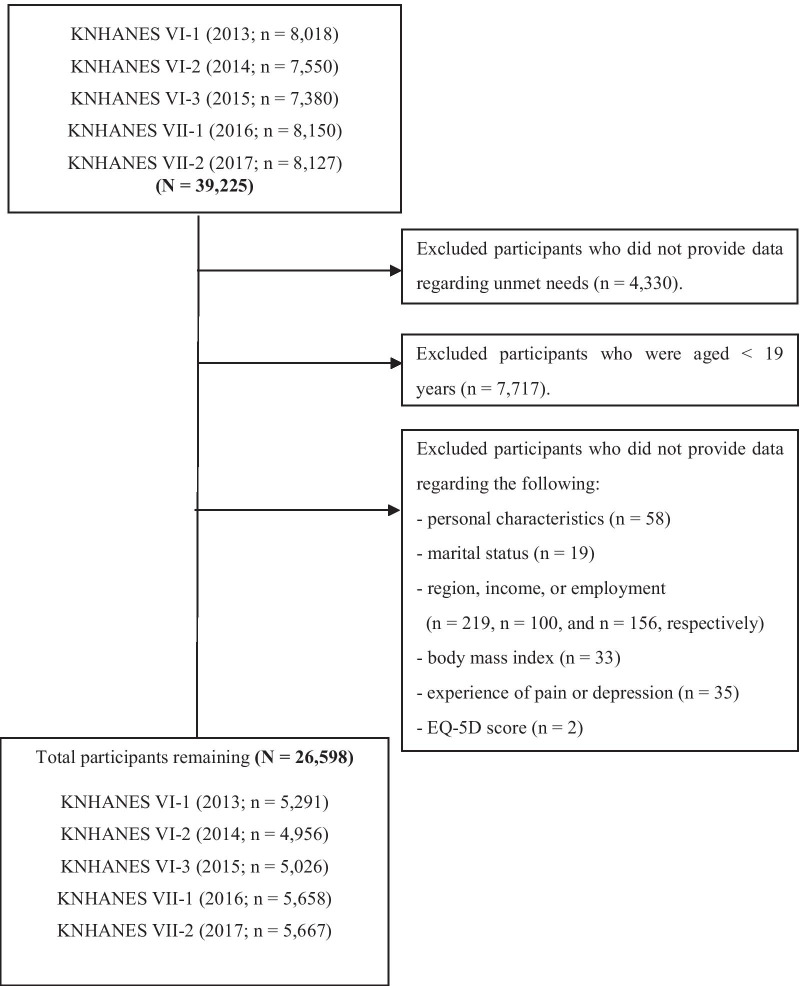
We used a retrospective cross-sectional study design. This nationwide-based study included the data of 26,598 participants aged 19 years and older, which were obtained from the 2013-2017 Korea National Health and Nutrition Examination Surveys. Using multiple logistic regression models, we analyzed the associations between factors that influence unmet healthcare needs and participants' subgroups.
Despite South Korea's universal health insurance system, in 2017, 9.5% of South Koreans experienced unmet healthcare needs. In both the male and female groups, younger people (age 19-39) had a higher odds ratio (OR) of experiencing unmet healthcare needs compared to older people (reference: age ≥ 60) (men: OR 1.83, 95% confidence interval [CI] = 1.35-2.48; women: OR 1.42, 95% CI 1.12-1.81). In particular, unlike men, women's unmet healthcare needs increased as their incomes decreased (1 quartile OR 1.55, 2 quartiles OR 1.29, 3 quartiles OR 1.26). Men and women showed a tendency to have more unmet healthcare needs with less exercise, worse subjective health state, worse pain, and a higher degree of depression.
The contributing factors of unmet healthcare needs included having a low socioeconomic status, high stress, severe pain, and severe depression. Considering our findings, we suggest improving healthcare access for those with low socioeconomic status.
“未满足的医疗需求”是指患者或公民由于社会经济原因无法满足其医疗需求的情况。本研究旨在分析韩国成年人未满足医疗需求的相关因素。
我们使用回顾性横断面研究设计。这项基于全国的研究包括了 2013-2017 年韩国国家健康和营养检查调查中年龄在 19 岁及以上的 26598 名参与者的数据。我们使用多因素逻辑回归模型分析了影响未满足医疗需求的因素与参与者亚组之间的关系。
尽管韩国实行了全民健康保险制度,但在 2017 年,仍有 9.5%的韩国人经历过未满足的医疗需求。在男性和女性群体中,年轻人(19-39 岁)比老年人(参考:年龄≥60 岁)更有可能经历未满足的医疗需求(男性:OR 1.83,95%置信区间 [CI] = 1.35-2.48;女性:OR 1.42,95%CI 1.12-1.81)。特别是,与男性不同,女性的未满足医疗需求随着收入的减少而增加(第 1 四分位数 OR 1.55,第 2 四分位数 OR 1.29,第 3 四分位数 OR 1.26)。男性和女性的未满足医疗需求随着运动量的减少、主观健康状况的恶化、疼痛的加剧和抑郁程度的加深而增加。
未满足医疗需求的因素包括社会经济地位较低、压力大、疼痛严重和抑郁严重。考虑到我们的研究结果,我们建议改善低社会经济地位人群的医疗保健服务。