Guo Deliang, Ma Dong, Liu Pengpeng, Lan Jianwei, Liu Zhisu, Liu Quanyan
Department of Hepatobiliary Surgery, Zhongnan Hospital of Wuhan University, Wuhan 430071, P.R. China.
Department of Hepatobiliary Surgery, Tianjin Medical University General Hospital, Tianjin 300052, P.R. China.
Aging (Albany NY). 2021 Mar 19;13(7):9874-9899. doi: 10.18632/aging.202740.
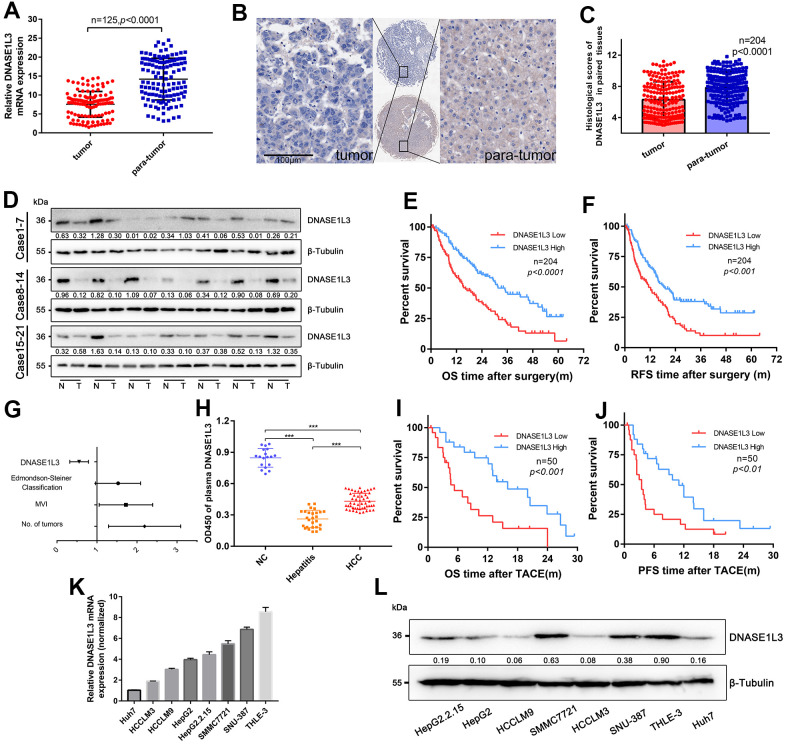
Hepatocellular carcinoma (HCC) is one of the most challenging and aggressive cancers with limited treatment options because of tumor heterogeneity. Tumor angiogenesis is a hallmark of HCC and is necessary for tumor growth and progression. DNA damage stress and its associated deoxyribonuclease1-like 3 (DNASE1L3) are involved in HCC progression. Here, we explored the influence mechanism of DNASE1L3 on tumor angiogenesis under DNA damage stress and . DNASE1L3 was found downregulated and negatively correlated with poor prognosis of resectable and unresectable HCC patients. The tissue microarray of HCC revealed the negative association between DNASE1L3 and cancer vasculature invasion. Mechanistically, DNASE1L3 was found to relieve cytoplasmic DNA accumulation under DNA damage stress in HCC cell lines, in turn cell senescence and senescence-associated secretory phenotype were arrested via the p53 and NF-κB signal pathway, and hence, tumor angiogenesis was impaired. Furthermore, we found that DNASE1L3 excised these functions by translocating to the nucleus and interacting with H2BE under DNA damage stress using co-immunoprecipitation and fluorescence resonance energy transfer assay. In conclusion, DNASE1L3 inhibits tumor angiogenesis via impairing the senescence-associated secretory phenotype in response to DNA damage stress.
肝细胞癌(HCC)是最具挑战性和侵袭性的癌症之一,由于肿瘤异质性,其治疗选择有限。肿瘤血管生成是HCC的一个标志,是肿瘤生长和进展所必需的。DNA损伤应激及其相关的脱氧核糖核酸酶1样3(DNASE1L3)参与HCC的进展。在此,我们探讨了DNA损伤应激下DNASE1L3对肿瘤血管生成的影响机制。研究发现,DNASE1L3表达下调,且与可切除和不可切除HCC患者的不良预后呈负相关。HCC组织芯片显示DNASE1L3与癌血管侵袭呈负相关。机制上,在HCC细胞系中,DNA损伤应激下DNASE1L3可减轻细胞质DNA积累,进而通过p53和NF-κB信号通路阻止细胞衰老和衰老相关分泌表型,从而损害肿瘤血管生成。此外,我们通过免疫共沉淀和荧光共振能量转移试验发现,在DNA损伤应激下,DNASE1L3通过转位到细胞核并与H2BE相互作用发挥这些功能。总之,DNASE1L3通过响应DNA损伤应激损害衰老相关分泌表型来抑制肿瘤血管生成。