Voruganti Dinesh, Shantha Ghanshyam, Dugyala Sushma, Bolton Alexander, Mohsen Ala, Devabhaktuni Subodh, Paydak Hakan, Mehta Jawahar L
Division of Cardiovascular Medicine, University of Arkansas for Medical Sciences, Arkansas, USA.
Division of Cardiovascular Medicine, Wake Forest Medical Center, North Carolina, USA.
J Geriatr Cardiol. 2021 Feb 28;18(2):114-122. doi: 10.11909/j.issn.1671-5411.2021.02.007.
Nonagenarians (NG), individuals aged ≥ 90 years, constitute an increasing proportion of hospitalizations presenting with atrial fibrillation (AF). However, not much is known about demographics, clinical outcomes, and trends of hospitalizations. Therefore, we analyzed data about hospitalizations and clinical outcomes among NGs with AF over ten years from 2005 to 2014 using a publically available database, the National Inpatient Sample.
All hospitalizations and major outcomes of subjects ≥ 90 years with a primary diagnosis of AF (ICD-9-CM code 427.31) over a ten-year period were assessed in this study by multivariate logistic regression analysis.
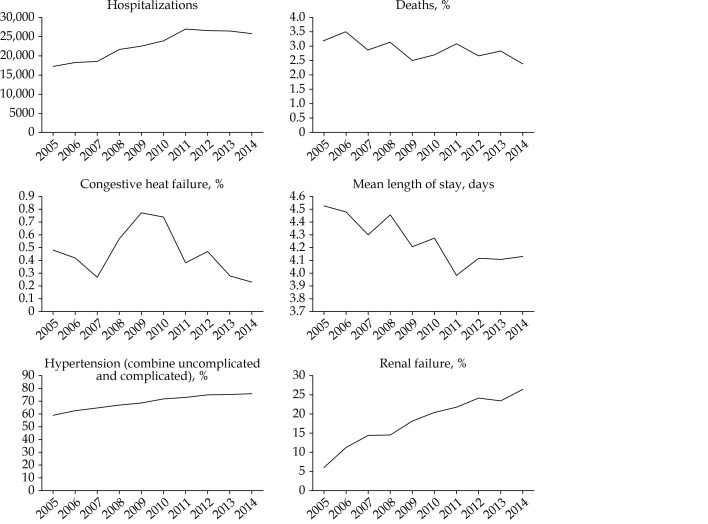
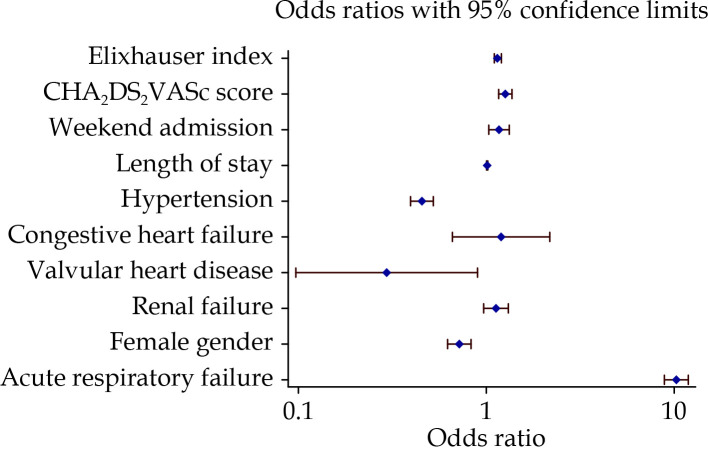
There were more females than males (176,268 females, 51,384 males) in this analysis. The number of hospitalizations for AF among NG increased by 50% (17,295 in 2005 to 25,830 in 2014). Males were more likely to undergo cardioversion (6.14% of males . 5.06% of females, < 0.0001). Over this period, in-hospital mortality declined from 3.21% in 2005 to 2.38% in 2014 ( = 0.0041), with higher in-hospital mortality in males (3.23% in males . 2.76% in females, = 0.0138), mean length of hospitalization decreased from 4.53 days to 4.13 days ( < 0.0001), the prevalence of congestive heart failure fell from 0.48% to 0.23% ( = 0.0257), and the use of anticoagulation increased from 6.09% to 14.54% ( < 0.0001). In a multivariate analysis, hospital admission on the weekend, Elixhauser comorbidity index, CHA DSVASc score, acute respiratory failure, and the length of hospital stay were associated with a higher risk of in-hospital mortality.
From 2005 to 2014, AF-related hospitalizations among NGs increased, more so in in females population, mortality trends improved, rates of anticoagulation increased, and cardioversions increased. Despite the decreasing trend of in-hospital mortality since 2005, the relatively high mortality rate in males warrants further studies.
年龄≥90岁的非agenarians(NG)在因心房颤动(AF)住院的患者中所占比例日益增加。然而,对于住院患者的人口统计学特征、临床结局及趋势,我们知之甚少。因此,我们利用公开可用的数据库——国家住院样本,分析了2005年至2014年这十年间NG合并AF患者的住院及临床结局数据。
本研究通过多因素逻辑回归分析,评估了十年间所有年龄≥90岁、主要诊断为AF(国际疾病分类第九版临床修正本代码427.31)患者的住院情况及主要结局。
本分析中女性多于男性(女性176,268例,男性51,384例)。NG中AF的住院人数增加了50%(从2005年的17,295例增至2014年的25,830例)。男性更有可能接受心脏复律(男性为6.14%,女性为5.06%,P<0.0001)。在此期间,住院死亡率从2005年的3.21%降至2014年的2.38%(P = 0.0041),男性的住院死亡率更高(男性为3.23%,女性为2.76%,P = 0.0138),平均住院时间从4.53天降至4.13天(P<0.0001),充血性心力衰竭的患病率从0.48%降至0.23%(P = 0.0257),抗凝治疗的使用率从6.09%增至14.54%(P<0.0001)。在多因素分析中,周末入院、埃利克斯豪泽合并症指数、CHA DSVASc评分、急性呼吸衰竭及住院时间与住院死亡风险较高相关。
从2005年到2014年,NG中与AF相关的住院人数增加,女性人群增加更为明显,死亡率趋势有所改善,抗凝治疗率增加,心脏复律增加。尽管自2005年以来住院死亡率呈下降趋势,但男性相对较高的死亡率仍需进一步研究。