• 文献检索
  • 文档翻译
  • 深度研究
  • 学术资讯
  • Suppr Zotero 插件Zotero 插件
  • 邀请有礼
  • 套餐&价格
  • 历史记录
应用&插件
Suppr Zotero 插件Zotero 插件浏览器插件Mac 客户端Windows 客户端微信小程序
定价
高级版会员购买积分包购买API积分包
服务
文献检索文档翻译深度研究API 文档MCP 服务
关于我们
关于 Suppr公司介绍联系我们用户协议隐私条款
关注我们

Suppr 超能文献

核心技术专利:CN118964589B侵权必究
粤ICP备2023148730 号-1Suppr @ 2026

文献检索

告别复杂PubMed语法,用中文像聊天一样搜索,搜遍4000万医学文献。AI智能推荐,让科研检索更轻松。

立即免费搜索

文件翻译

保留排版,准确专业,支持PDF/Word/PPT等文件格式,支持 12+语言互译。

免费翻译文档

深度研究

AI帮你快速写综述,25分钟生成高质量综述,智能提取关键信息,辅助科研写作。

立即免费体验

利用点探测范式中的眼动来研究疾病焦虑障碍中的注意偏向。

Using eye movements in the dot-probe paradigm to investigate attention bias in illness anxiety disorder.

作者信息

Zhang Yan-Bo, Wang Peng-Chong, Ma Yun, Yang Xiang-Yun, Meng Fan-Qiang, Broadley Simon A, Sun Jing, Li Zhan-Jiang

机构信息

The Department of Clinical Psychology and National Clinical Research Center for Mental Disorders and Beijing Key Laboratory of Mental Disorders, Beijing An'Ding Hospital, Capital Medical University, and Center of Schizophrenia, Beijing Institute for Brain Disorders, Beijing 100089, China.

Menzies Health Institute Queensland and School of Medicine, Griffith University, Gold Coast 4222, Queensland, Australia.

出版信息

World J Psychiatry. 2021 Mar 19;11(3):73-86. doi: 10.5498/wjp.v11.i3.73.

DOI:10.5498/wjp.v11.i3.73
PMID:33747805
原文链接:https://pmc.ncbi.nlm.nih.gov/articles/PMC7953363/
Abstract

BACKGROUND

Illness anxiety disorder (IAD) is a common, distressing, and debilitating condition with the key feature being a persistent conviction of the possibility of having one or more serious or progressive physical disorders. Because eye movements are guided by visual-spatial attention, eye-tracking technology is a comparatively direct, continuous measure of attention direction and speed when stimuli are oriented. Researchers have tried to identify selective visual attention biases by tracking eye movements within dot-probe paradigms because dot-probe paradigm can distinguish these attentional biases more clearly.

AIM

To examine the association between IAD and biased processing of illness-related information.

METHODS

A case-control study design was used to record eye movements of individuals with IAD and healthy controls while participants viewed a set of pictures from four categories (illness-related, socially threatening, positive, and neutral images). Biases in initial orienting were assessed from the location of the initial shift in gaze, and biases in the maintenance of attention were assessed from the duration of gaze that was initially fixated on the picture per image category.

RESULTS

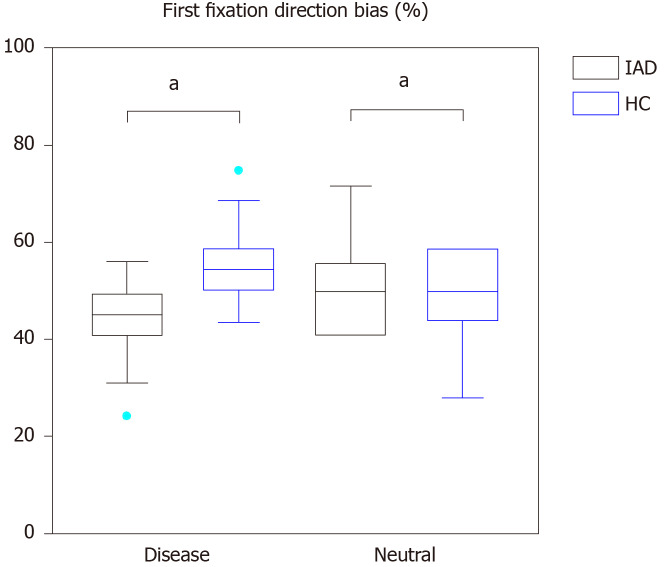
The eye movement of the participants in the IAD group was characterized by an avoidance bias in initial orienting to illness-related pictures. There was no evidence of individuals with IAD spending significantly more time viewing illness-related images compared with other images. Patients with IAD had an attention bias at the early stage and overall attentional avoidance. In addition, this study found that patients with significant anxiety symptoms showed attention bias in the late stages of attention processing.

CONCLUSION

Illness-related information processing biases appear to be a robust feature of IAD and may have an important role in explaining the etiology and maintenance of the disorder.

摘要

背景

疾病焦虑障碍(IAD)是一种常见、令人痛苦且使人衰弱的病症,其关键特征是持续坚信自己可能患有一种或多种严重或进行性身体疾病。由于眼球运动受视觉空间注意力引导,眼动追踪技术是一种在刺激定向时相对直接、连续地测量注意力方向和速度的方法。研究人员试图通过在点探测范式中追踪眼球运动来识别选择性视觉注意偏差,因为点探测范式能够更清晰地辨别这些注意偏差。

目的

研究疾病焦虑障碍与疾病相关信息的偏向性加工之间的关联。

方法

采用病例对照研究设计,记录疾病焦虑障碍患者和健康对照者在观看四类图片(疾病相关、社会威胁、积极和中性图片)时的眼球运动。从首次注视转移的位置评估初始定向偏差,从每张图片类别最初注视图片的持续时间评估注意力维持偏差。

结果

疾病焦虑障碍组参与者的眼球运动特点是在初始定向时对疾病相关图片存在回避偏差。没有证据表明疾病焦虑障碍患者与其他图片相比,花费显著更多时间观看疾病相关图片。疾病焦虑障碍患者在早期存在注意偏差且总体上存在注意回避。此外,本研究发现有明显焦虑症状的患者在注意力加工后期存在注意偏差。

结论

疾病相关信息加工偏差似乎是疾病焦虑障碍的一个稳定特征,可能在解释该障碍的病因和维持方面具有重要作用。

https://cdn.ncbi.nlm.nih.gov/pmc/blobs/c17b/7953363/b219891793b8/WJP-11-73-g004.jpg
https://cdn.ncbi.nlm.nih.gov/pmc/blobs/c17b/7953363/205969c2d428/WJP-11-73-g001.jpg
https://cdn.ncbi.nlm.nih.gov/pmc/blobs/c17b/7953363/9faf55d75afe/WJP-11-73-g002.jpg
https://cdn.ncbi.nlm.nih.gov/pmc/blobs/c17b/7953363/25a46859e4fa/WJP-11-73-g003.jpg
https://cdn.ncbi.nlm.nih.gov/pmc/blobs/c17b/7953363/b219891793b8/WJP-11-73-g004.jpg
https://cdn.ncbi.nlm.nih.gov/pmc/blobs/c17b/7953363/205969c2d428/WJP-11-73-g001.jpg
https://cdn.ncbi.nlm.nih.gov/pmc/blobs/c17b/7953363/9faf55d75afe/WJP-11-73-g002.jpg
https://cdn.ncbi.nlm.nih.gov/pmc/blobs/c17b/7953363/25a46859e4fa/WJP-11-73-g003.jpg
https://cdn.ncbi.nlm.nih.gov/pmc/blobs/c17b/7953363/b219891793b8/WJP-11-73-g004.jpg

相似文献

1
Using eye movements in the dot-probe paradigm to investigate attention bias in illness anxiety disorder.利用点探测范式中的眼动来研究疾病焦虑障碍中的注意偏向。
World J Psychiatry. 2021 Mar 19;11(3):73-86. doi: 10.5498/wjp.v11.i3.73.
2
Using eye movements to investigate selective attention in chronic daily headache.运用眼动研究慢性每日头痛的选择性注意。
Pain. 2014 Mar;155(3):503-510. doi: 10.1016/j.pain.2013.11.014. Epub 2013 Nov 25.
3
Effects of chronic pain and pain-related fear on orienting and maintenance of attention: an eye movement study.慢性疼痛和与疼痛相关的恐惧对定向和维持注意力的影响:一项眼动研究。
J Pain. 2013 Oct;14(10):1148-57. doi: 10.1016/j.jpain.2013.04.017. Epub 2013 Jul 10.
4
Biases in orienting and maintenance of attention among weight dissatisfied women: an eye-movement study.体重不满女性在注意定向和维持方面的偏见:一项眼动研究。
Behav Res Ther. 2011 Apr;49(4):252-9. doi: 10.1016/j.brat.2011.01.009. Epub 2011 Feb 1.
5
Biases in visual orienting to negative and positive scenes in dysphoria: An eye movement study.烦躁情绪中对消极和积极场景的视觉定向偏差:一项眼动研究。
J Abnorm Psychol. 2007 Aug;116(3):491-7. doi: 10.1037/0021-843X.116.3.491.
6
Identifying selective visual attention biases related to fear of pain by tracking eye movements within a dot-probe paradigm.通过在点探测范式中跟踪眼球运动,识别与疼痛恐惧相关的选择性视觉注意偏差。
Pain. 2012 Aug;153(8):1742-1748. doi: 10.1016/j.pain.2012.05.011. Epub 2012 Jun 19.
7
Depressive Symptoms in Late Pregnancy Disrupt Attentional Processing of Negative-Positive Emotion: An Eye-Movement Study.晚期妊娠中的抑郁症状扰乱负性-正性情绪的注意加工:一项眼动研究。
Front Psychiatry. 2019 Oct 31;10:780. doi: 10.3389/fpsyt.2019.00780. eCollection 2019.
8
Attentional Bias for Imperfect Pictures in Perfectionism: An Eye-Movement Study.完美主义中对不完美图片的注意偏向:一项眼动研究。
Front Psychol. 2020 Oct 2;11:566482. doi: 10.3389/fpsyg.2020.566482. eCollection 2020.
9
Keeping an eye on pain: investigating visual attention biases in individuals with chronic pain using eye-tracking methodology.关注疼痛:使用眼动追踪方法研究慢性疼痛个体的视觉注意偏向
J Pain Res. 2016 Aug 10;9:551-61. doi: 10.2147/JPR.S104268. eCollection 2016.
10
Physically active individuals look for more: An eye-tracking study of attentional bias.积极运动的个体寻求更多:注意偏向的眼动研究。
Psychophysiology. 2020 Jun;57(6):e13582. doi: 10.1111/psyp.13582. Epub 2020 Apr 11.

引用本文的文献

1
Mechanistic studies in pathological health anxiety: A systematic review and emerging conceptual framework.病理性健康焦虑的机制研究:系统综述及新兴概念框架。
J Affect Disord. 2024 Aug 1;358:222-249. doi: 10.1016/j.jad.2024.05.029. Epub 2024 May 6.
2
Characteristics of attentional bias in adolescents with major depressive disorders: differentiating the impact of anxious distress specifier.重度抑郁症青少年的注意偏向特征:区分焦虑痛苦特质的影响
Front Psychiatry. 2024 Mar 18;15:1352971. doi: 10.3389/fpsyt.2024.1352971. eCollection 2024.

本文引用的文献

1
The efficacy of cognitive behavioural therapy in somatoform disorders and medically unexplained physical symptoms: A meta-analysis of randomized controlled trials.认知行为疗法治疗躯体形式障碍和医学无法解释的躯体症状的疗效:随机对照试验的荟萃分析。
J Affect Disord. 2019 Feb 15;245:98-112. doi: 10.1016/j.jad.2018.10.114. Epub 2018 Oct 22.
2
Attentional bias modification in depression through gaze contingencies and regulatory control using a new eye-tracking intervention paradigm: study protocol for a placebo-controlled trial.通过注视偶联和使用新的眼动追踪干预范式进行调节控制来改变抑郁症中的注意偏向:一项安慰剂对照试验的研究方案
BMC Psychiatry. 2016 Dec 8;16(1):439. doi: 10.1186/s12888-016-1150-9.
3
Beck Depression Inventory.
贝克抑郁量表
Occup Med (Lond). 2016 Mar;66(2):174-5. doi: 10.1093/occmed/kqv087.
4
Metacognitive beliefs moderate the relationship between catastrophic misinterpretation and health anxiety.元认知信念调节灾难性误解与健康焦虑之间的关系。
J Anxiety Disord. 2015 Aug;34:8-14. doi: 10.1016/j.janxdis.2015.05.005. Epub 2015 Jun 10.
5
A randomized trial of treatments for high-utilizing somatizing patients.高利用躯体化患者治疗的随机试验。
J Gen Intern Med. 2013 Nov;28(11):1396-404. doi: 10.1007/s11606-013-2392-6. Epub 2013 Mar 14.
6
Hypochondriacal attitudes comprise heterogeneous non-illness-related cognitions.疑病症态度包含异质的非疾病相关认知。
BMC Psychiatry. 2012 Oct 17;12:173. doi: 10.1186/1471-244X-12-173.
7
Health anxiety in Australia: prevalence, comorbidity, disability and service use.澳大利亚的健康焦虑症:患病率、共病、残疾和服务利用。
Br J Psychiatry. 2013 Jan;202(1):56-61. doi: 10.1192/bjp.bp.111.103960. Epub 2012 Apr 12.
8
Dysfunctional beliefs about symptoms and illness in patients with hypochondriasis.疑病症患者对症状和疾病的功能失调信念。
Psychosomatics. 2012 Mar-Apr;53(2):148-54. doi: 10.1016/j.psym.2011.11.007.
9
A general population study of the Chinese Whiteley-7 index in Hong Kong.一项针对中国怀特利-7 指数在香港的普通人群研究。
J Psychosom Res. 2011 Dec;71(6):387-91. doi: 10.1016/j.jpsychores.2011.05.013. Epub 2011 Jul 1.
10
Hypochondriacal attitudes may reflect a general cognitive bias that is not limited to illness-related thoughts.疑病症态度可能反映了一种普遍的认知偏差,这种偏差不仅局限于与疾病相关的想法。
Psychol Health. 2011 Aug;26(8):965-73. doi: 10.1080/08870446.2010.498583. Epub 2011 May 24.