Department of Pediatrics and Child Health Nursing, College of Health Sciences, Debre Tabor University, Debre Tabor, Ethiopia.
Department of Emergency Medicine and Critical Care Nursing, College of Health Sciences, Debre Tabor University, Debre Tabor, Ethiopia.
Biomed Res Int. 2021 Mar 2;2021:6627430. doi: 10.1155/2021/6627430. eCollection 2021.
Although the efforts at global and national levels have attempted to decrease the COVID-19 pandemic, the low level of preparedness among healthcare providers is a challenge mainly in developing countries. Hence, this study is aimed at assessing the level of preparedness for COVID-19 and its associated factors among frontline healthcare providers in South Gondar public hospitals, northwest Ethiopia.
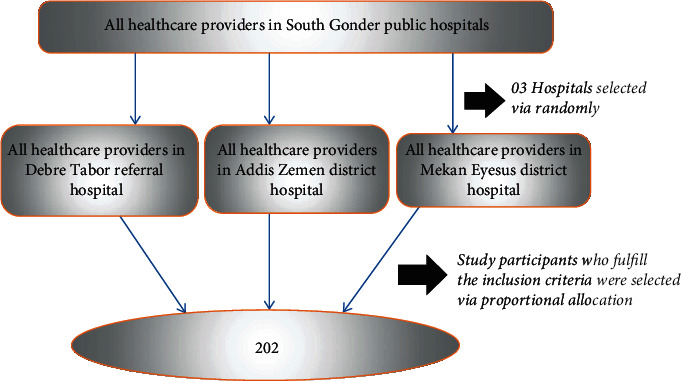
A hospital-based cross-sectional study was conducted among 207 selected healthcare providers who were working in South Gondar public hospital from July 08 to August 29, 2020. A pretested structured questionnaire was used to collect data. The healthcare providers were selected through simple random sampling techniques. Both bivariable and multivariable logistic regressions with a 95% confidence interval were fitted with 95% CI to establish the associated factors with a low level of preparedness. A value < 0.05 was considered statistically significant.
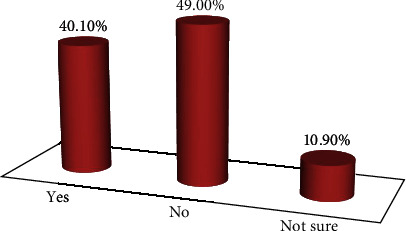
The overall level of preparedness among healthcare providers for COVID-19 was found to be 41.3% (95% CI: 37.4, 44.7). Only 81 (40.1%) healthcare providers had prepared for telling their family and friends if they are infected with COVID-19. Besides, only 23.8% of healthcare providers obtained alcohol-based hand sanitizer in every patient room. Factors associated with a low level of preparedness include being male (AOR = 2.5, 95% CI: 1.22-4.94), unmarried (AOR = 3.4, 95% CI: 1.44-8.00), and working experience less than five years (AOR = 3.4, 95% CI: 1.29-9.09).
The level of preparedness among frontline healthcare providers towards COVID-19 was found to be very low. In the future, more emphasis should be placed on healthcare providers who are male, unmarried, and had working experience of lower than five years to decrease the burden of the COVID-19 pandemic.
尽管全球和国家层面都在努力降低 COVID-19 大流行的影响,但医疗保健提供者准备不足仍是一个挑战,尤其是在发展中国家。因此,本研究旨在评估埃塞俄比亚西北部南贡达尔公立医院一线医护人员对 COVID-19 的准备情况及其相关因素。
这是一项在 2020 年 7 月 8 日至 8 月 29 日期间在南贡达尔公立医院工作的 207 名选定医护人员中进行的基于医院的横断面研究。使用经过预测试的结构化问卷收集数据。医护人员采用简单随机抽样技术进行选择。采用双变量和多变量逻辑回归分析,95%置信区间(95%CI)来确定与低准备水平相关的因素。 值<0.05 被认为具有统计学意义。
研究发现,医护人员对 COVID-19 的总体准备水平为 41.3%(95%CI:37.4,44.7)。只有 81 名(40.1%)医护人员准备告诉家人和朋友如果他们感染了 COVID-19。此外,只有 23.8%的医护人员在每个患者房间都配备了酒精基洗手液。与低准备水平相关的因素包括男性(AOR=2.5,95%CI:1.22-4.94)、未婚(AOR=3.4,95%CI:1.44-8.00)和工作经验不足五年(AOR=3.4,95%CI:1.29-9.09)。
研究发现,一线医护人员对 COVID-19 的准备水平非常低。未来,应更加关注男性、未婚和工作经验不足五年的医护人员,以减轻 COVID-19 大流行的负担。