Chế Thị Cẩm Hà, Nguyễn Hữu Đạt, Lê Hoàng Duy Minh
Hue University of Sciences, Viet Nam.
Hue University of Medicine and Pharmacy, Viet Nam.
Heliyon. 2021 Mar 8;7(3):e06248. doi: 10.1016/j.heliyon.2021.e06248. eCollection 2021 Mar.
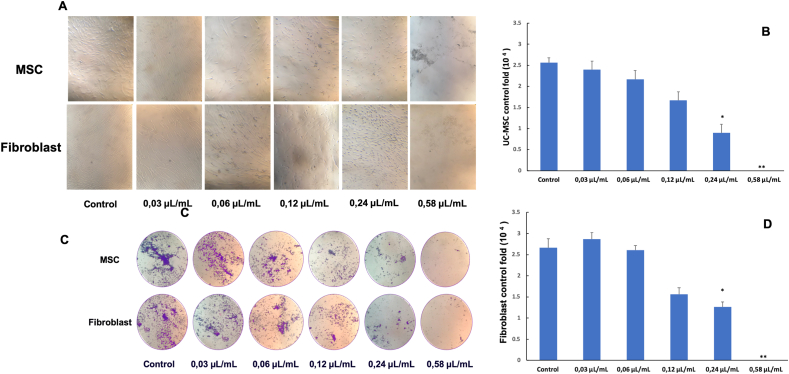
This research aimed to test the effects of L. from Vietnam on fibroblasts and UC-derived mesenchymal stem cells (UC-MSCs) from human umbilical cord (UC) on the scratch assay. We tested the extract at different concentrations and then assessed the level of expression of the factors involved in the inflammatory process on fibroblasts including IL-33, VCAM, CD248 by assay real time qPCR. At the concentrations of 0.025 μL/mL and 0.03 μL/mL, the extracts positively affected fibroblast proliferation and UC-MSCs. By contrast, the concentration of 0.058 μL/mL, the extract was toxic to UC-MSCs and fibroblast cell lines, the cells were no longer able to survive. qPCR results show that L. extract has the ability to reduce the expression levels of IL-33 (50.8%), VCAM (32.1%), CD248 (46.13%) which trigger inflammatory processes, thereby reducing cellular stress and promoting the process of healing scratches. Our study revealed the proliferation capabilities of L. extract from Vietnam In vitro. Hence, L. could be recommended as a potential source of wound healing agents.
本研究旨在通过划痕试验检测来自越南的L.对成纤维细胞和人脐带间充质干细胞(UC-MSCs)的作用。我们对不同浓度的提取物进行了测试,然后通过实时定量PCR检测评估了成纤维细胞中参与炎症过程的因子(包括IL-33、VCAM、CD248)的表达水平。在0.025μL/mL和0.03μL/mL的浓度下,提取物对成纤维细胞增殖和UC-MSCs有积极影响。相比之下,在0.058μL/mL的浓度下,提取物对UC-MSCs和成纤维细胞系有毒性,细胞无法再存活。qPCR结果表明,[L.]提取物有能力降低引发炎症过程的IL-33(50.8%)、VCAM(32.1%)、CD248(46.13%)的表达水平,从而减轻细胞应激并促进划痕愈合过程。我们的研究揭示了来自越南的[L.]提取物在体外的增殖能力。因此,[L.]可被推荐为伤口愈合剂的潜在来源。